Please select a subject first
Advertisements
Advertisements
An I0m long uniform metallic wire having a resistance of 20Ω IS used as a potentiometer wire. This wire is connected in series with another resistance of 480Ω
and a battery of emf 5V having negligible internal resistance. If an unknown emf e is balanced across 6m of the potentiometer wire, calculate
1) the potential gradient across the potentiometer wire
2) the value of the unknown emf e.
Concept: undefined >> undefined
A closed surface in vacuum encloses charges –q and +3q. The total electric flux emerging out of the surface is :
Concept: undefined >> undefined
Advertisements
State Gauss’ Law.
Concept: undefined >> undefined
A meter bridge is balanced with a known resistance (R) in the left hand gap and an unknown resistance (S) in the right hand gap. Balance point is found to be at a distance of 1 cm from the left hand side. When the battery and the galvanometer are interchanged, balance point will ______.
Concept: undefined >> undefined
In a potentiometer experiment, balancing length is found to be 120 cm for a cell E1 of emf 2V. What will be the balancing length for another cell E2 of emf 1.5V? (No other changes are made in the experiment.)
Concept: undefined >> undefined
In a potentiometer experiment, the balancing length with a resistance of 2Ω is found to be 100 cm, while that of an unknown resistance is 500 cm. Calculate the value of the unknown resistance.
Concept: undefined >> undefined
Draw a labelled circuit diagram of a potentiometer to measure the internal resistance ‘r’ of a cell. Write the working formula (derivation is not required).
Concept: undefined >> undefined
Figure below shows two resistors R1 and R2 connected to a battery having an emf of 40V and negligible internal resistance. A voltmeter having a resistance of. 300 Ω is used to measure the potential difference across R1 Find the reading of the voltmeter.

Concept: undefined >> undefined
Draw a labelled circuit diagram of a potentiometer to compare emfs of two cells. Write the working formula (Derivation not required).
Concept: undefined >> undefined
Three identical cells each of emf 'e' are connected in parallel to form a battery. What is the emf of the battery?
Concept: undefined >> undefined
The Figure below shows a potentiometer circuit in which the driver cell D has an emf of 6 V and internal resistance of 2 Ω. The potentiometer wire AB is 10 m long and has a resistance of 28 Ω. The series resistance RS is of 2 Ω.

- The current Ip flowing in the potentiometer wire AB when the jockey (J) does not touch the wire AB.
- emf of the cell X if the balancing length AC is 4.5 m.
Concept: undefined >> undefined
In a potentiometer, a cell is balanced against 110 cm when the circuit is open. A cell is balanced at 100 cm when short-circuited through a resistance of 10 Ω. Find the internal resistance of the cell.
Concept: undefined >> undefined
Deduce an expression for equivalent capacitance C when three capacitors C1, C2 and C3 connected in parallel.
Concept: undefined >> undefined
Figure 4 below shows a capacitor C, an inductor L and a resistor R, connected in series
to an a.c. supply of 220 V
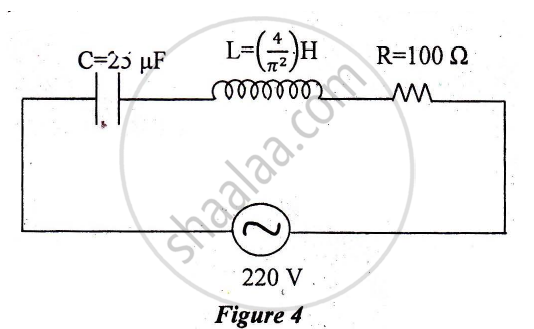
Calculate:
1) The resonant frequency of the given CLR circuit.
2) Current flowing through·the circuit.
3) Average power consumed by the circuit.
Concept: undefined >> undefined
Three capacitors of capacitance `C_1 = 3muf` , `C_2 = 6muf` , `C_3 = 10muf` , are connected to a 10V battery as shown in figure 3 below :
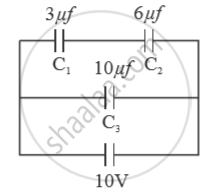
Calculate :
(a) Equivalent capacitance.
(b) Electrostatic potential energy stored in the system
Concept: undefined >> undefined
A wire of resistance ‘R’ is cut into ‘n’ equal parts. These parts are then connected in parallel with each other. The equivalent resistance of the combination is:
Concept: undefined >> undefined
The focal length of a concave lens is 20 cm. The focal length of a convex lens is 25 cm. These two are placed in contact with each other. What is the power of the combination? Is it diverging, converging or undeviating in nature?
Concept: undefined >> undefined
The focal length of a double convex lens is equal to the radius of curvature of either surface. What is the refractive index of its material?
Concept: undefined >> undefined
State any two difference between the primary rainbow and secondary rainbow
Concept: undefined >> undefined
For any prism, prove that :
'n' or `mu = sin((A + delta_m)/2)/sin(A/2)`
where the terms have their usual meaning
Concept: undefined >> undefined
