Advertisements
Advertisements
Using suitable identities, evaluate the following.
10.1 × 10.2
Concept: undefined >> undefined
The following expression is the area of a rectangle. Find the possible length and breadth of the rectangle.
x2 – 6x + 8
Concept: undefined >> undefined
Advertisements
The following expression is the area of a rectangle. Find the possible length and breadth of the rectangle.
x2 – 3x + 2
Concept: undefined >> undefined
The following expression is the area of a rectangle. Find the possible length and breadth of the rectangle.
x2 – 7x + 10
Concept: undefined >> undefined
The following expression is the area of a rectangle. Find the possible length and breadth of the rectangle.
x2 + 19x – 20
Concept: undefined >> undefined
The following expression is the area of a rectangle. Find the possible length and breadth of the rectangle.
x2 + 9x + 20
Concept: undefined >> undefined
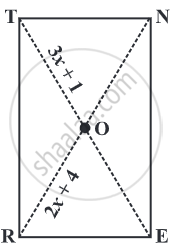
Concept: undefined >> undefined
Length of one of the diagonals of a rectangle whose sides are 10 cm and 24 cm is ______.
Concept: undefined >> undefined
Diagonals of a rectangle are ______.
Concept: undefined >> undefined
If one diagonal of a rectangle is 6 cm long, length of the other diagonal is ______.
Concept: undefined >> undefined
Diagonals of a rectangle are equal.
Concept: undefined >> undefined
Diagonals of rectangle bisect each other at right angles.
Concept: undefined >> undefined
A photo frame is in the shape of a quadrilateral. With one diagonal longer than the other. Is it a rectangle? Why or why not?
Concept: undefined >> undefined
Name the quadrilaterals whose diagonals are equal
Concept: undefined >> undefined
Explain why a rectangle is a convex quadrilateral.
Concept: undefined >> undefined
ABC is a right-angled triangle and O is the mid point of the side opposite to the right angle. Explain why O is equidistant from A, B and C. (The dotted lines are drawn additionally to help you)
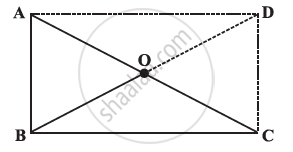
Concept: undefined >> undefined
The shorter side of a parallelogram is 4.8 cm and the longer side is half as much again as the shorter side. Find the perimeter of the parallelogram.
Concept: undefined >> undefined
Two adjacent angles of a parallelogram are (3x − 4)° and (3x + 10)°. Find the angles of the parallelogram.
Concept: undefined >> undefined
In a parallelogram ABCD, the diagonals bisect each other at O. If ∠ABC = 30°, ∠BDC = 10° and ∠CAB = 70°. Find:
∠DAB, ∠ADC, ∠BCD, ∠AOD, ∠DOC, ∠BOC, ∠AOB, ∠ACD, ∠CAB, ∠ADB, ∠ACB, ∠DBC and ∠DBA.
Concept: undefined >> undefined
The angle between the altitudes of a parallelogram, through the same vertex of an obtuse angle of the parallelogram is 60°. Find the angles of the parallelogram.
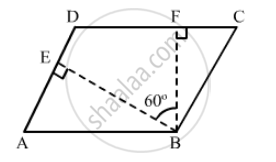
Concept: undefined >> undefined
