Advertisements
Advertisements
A parallel plate capacitor (A) of capacitance C is charged by a battery to voltage V. The battery is disconnected and an uncharged capacitor (B) of capacitance 2C is connected across A. Find the ratio of total electrostatic energy stored in A and B finally and that stored in A initially.
Concept: undefined >> undefined
An ammeter of resistance 0.81 ohm reads up to 1 A. The value of the required shunt to increase the range to 10 A is ______.
Concept: undefined >> undefined
Advertisements
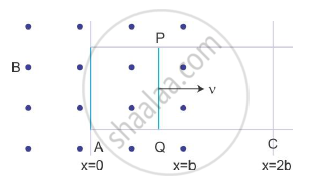
Sketch the change in flux, emf and force when a conducting rod PQ of resistance R and length l moves freely to and fro between A and C with speed v on a rectangular conductor placed in uniform magnetic field as shown in the figure
Concept: undefined >> undefined
Describe, with the help of a circuit diagram, the working of Zener diode as a voltage regulator.
Concept: undefined >> undefined
Two large conducting spheres carrying charges Q1 and Q2 are brought close to each other. Is the magnitude of the electrostatic force between them exactly given by Q1 Q2/4π∈0r 2, where r is the distance between their centres?
Concept: undefined >> undefined
In a Van de Graaff type generator a spherical metal shell is to be a 15 × 106 V electrode. The dielectric strength of the gas surrounding the electrode is 5 × 10⁷ Vm−1. What is the minimum radius of the spherical shell required? (You will learn from this exercise why one cannot build an electrostatic generator using a very small shell which requires a small charge to acquire a high potential.)
Concept: undefined >> undefined
A small sphere of radius r1 and charge q1 is enclosed by a spherical shell of radius r2 and charge q2. Show that if q1 is positive, charge will necessarily flow from the sphere to the shell (when the two are connected by a wire) no matter what the charge q2 on the shell is.
Concept: undefined >> undefined
In the following diagram, an object 'O' is placed 15 cm in front of a convex lens L1 of focal length 20 cm and the final image is formed at I at a distance of 80 cm from the second lens L2. Find the focal length of the lens L2.

Concept: undefined >> undefined
Explain, with the help of a circuit diagram, the principle and working of a Zener diode as voltage regular.
Concept: undefined >> undefined
Draw the circuit diagram of zener diode as a voltage regulator and briefly explains its working ?
Concept: undefined >> undefined
A small compass needle of magnetic moment ‘m’ is free to turn about an axis perpendicular to the direction of uniform magnetic field ‘B’. The moment of inertia of the needle about the axis is ‘I’. The needle is slightly disturbed from its stable position and then released. Prove that it executes simple harmonic motion. Hence deduce the expression for its time period.
Concept: undefined >> undefined
Name the device which is used as a voltage regulator. Draw the necessary circuit diagram and explain its working?
Concept: undefined >> undefined
A short bar magnet of magnetic moment 0.9 J/T is placed with its axis at 30° to a uniform magnetic field. It experiences a torque of 0.063 J.
(i) Calculate the magnitude of the magnetic field.
(ii) In which orientation will the bar magnet be in stable equilibrium in the magnetic field?
Concept: undefined >> undefined
Draw the I − V characteristics of zener diode and explain briefly how reverse current suddenly increase at the breakdown voltage.
Concept: undefined >> undefined
Describe briefly with the help of a circuit diagram how a zener diode works to obtain a constant dc voltage from the unregulated dc output of a rectifier ?
Concept: undefined >> undefined
Trace the rays of light showing the formation of an image due to a point object placed on the axis of a spherical surface separating the two media of refractive indices n1 and n2. Establish the relation between the distances of the object, the image and the radius of curvature from the central point of the spherical surface.
Hence derive the expression of the lens maker’s formula.
Concept: undefined >> undefined
Can a virtual image be photographed by a camera?
Concept: undefined >> undefined
If a spherical mirror is dipped in water, does its focal length change?
Concept: undefined >> undefined
If a thin lens is dipped in water, does its focal length change?
Concept: undefined >> undefined
Four modifications are suggested in the lens formula to include the effect of the thickness t of the lens. Which one is likely to be correct?
Concept: undefined >> undefined
