Advertisements
Advertisements
प्रश्न
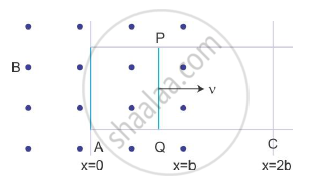
Sketch the change in flux, emf and force when a conducting rod PQ of resistance R and length l moves freely to and fro between A and C with speed v on a rectangular conductor placed in uniform magnetic field as shown in the figure
Advertisements
उत्तर
The flux enclosed by the rod is
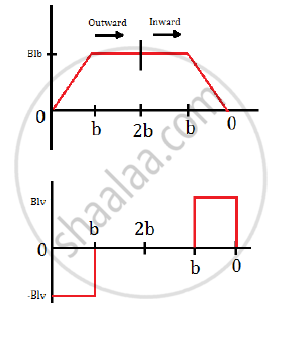
Φ = Blx for 0 ≤ x ≤ b
= Blx for b ≤ x ≤ 2b
Now, the magnitude of induced emf is
`epsilon=(dphi)/dt=-Bl(dx)/dt= -Blv` for 0 ≤ x ≤ b
`=-Bl(db)/dt=0` for b ≤ x ≤ 2b
Now, the magnitude of induced current when induced emf is non-zero is ε = IR
`:.I=epsilon/r=(Blv)/r`
The force required to keep the conductor in motion is F = BIl
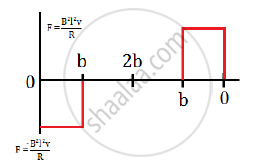
`:.F=B(Blv)/Rl=(B^2l^2v)/R`
`:.F=(B^2l^2v)/R` for b ≤ x < b
= 0 for b ≤ x ≤ 2b
Therefore, the variation of flux, emf and force is
APPEARS IN
संबंधित प्रश्न
A small compass needle of magnetic moment ‘m’ is free to turn about an axis perpendicular to the direction of uniform magnetic field ‘B’. The moment of inertia of the needle about the axis is ‘I’. The needle is slightly disturbed from its stable position and then released. Prove that it executes simple harmonic motion. Hence deduce the expression for its time period.
A short bar magnet of magnetic moment 0.9 J/T is placed with its axis at 30° to a uniform magnetic field. It experiences a torque of 0.063 J.
(i) Calculate the magnitude of the magnetic field.
(ii) In which orientation will the bar magnet be in stable equilibrium in the magnetic field?
Which of the following particles will have minimum frequency of revolution when projected with the same velocity perpendicular to a magnetic field?
A particle moves in a region with a uniform magnetic field and a parallel, uniform electric field. At some instant, the velocity of the particle is perpendicular to the field direction. The path of the particle will be
You are facing a circular wire carrying an electric current. The current is clockwise as seen by you. Is the field at the centre coming towards you or going away from you?
Two parallel wires carry currents of 20 A and 40 A in opposite directions. Another wire carying a current anti parallel to 20 A is placed midway between the two wires. T he magnetic force on it will be
A current of 5.0 A exists in the circuit shown in the figure. The wire PQ has a length of 50 cm and the magnetic field in which it is immersed has a magnitude of 0.20 T. Find the magnetic force acting on the wire PQ.
A rigid wire consists of a semi-circular portion of radius R and two straight sections (figure). The wire is partially immersed in a perpendicular magnetic field B, as shown in the figure. Find the magnetic force on the wire if it carries a current i.

The wire ABC shown in figure forms an equilateral triangle. Find the magnetic field B at the centre O of the triangle assuming the wire to be uniform.

A straight horizontal conducting rod of length 0.45 m and mass 60 g is suspended by two vertical wires at its ends. A current of 5.0 A is set up in the rod through the wires.
(a) What magnetic field should be set up normal to the conductor in order that the tension in the wires is zero?
(b) What will be the total tension in the wires if the direction of current is reversed keeping the magnetic field same as before?
(Ignore the mass of the wires) g = 9.8 m s–2.
