Advertisements
Advertisements
In Corner point method for solving a linear programming problem, one finds the feasible region of the linear programming problem, determines its corner points, and evaluates the objective function Z = ax + by at each corner point. Let M and m respectively be the largest and smallest values at corner points. In case feasible region is unbounded, M is the maximum value of the objective function if ____________.
Concept: undefined >> undefined
In Corner point method for solving a linear programming problem, one finds the feasible region of the linear programming problem, determines its corner points, and evaluates the objective function Z = ax + by at each corner point. Let M and m respectively be the largest and smallest values at corner points. In case the feasible region is unbounded, m is the minimum value of the objective function.
Concept: undefined >> undefined
Advertisements
If two corner points of the feasible region are both optimal solutions of the same type, i.e., both produce the same maximum or minimum.
Concept: undefined >> undefined
In a LPP, the objective function is always ____________.
Concept: undefined >> undefined
Maximize Z = 3x + 5y, subject to x + 4y ≤ 24, 3x + y ≤ 21, x + y ≤ 9, x ≥ 0, y ≥ 0.
Concept: undefined >> undefined
Maximize Z = 4x + 6y, subject to 3x + 2y ≤ 12, x + y ≥ 4, x, y ≥ 0.
Concept: undefined >> undefined
Maximize Z = 7x + 11y, subject to 3x + 5y ≤ 26, 5x + 3y ≤ 30, x ≥ 0, y ≥ 0.
Concept: undefined >> undefined
Maximize Z = 6x + 4y, subject to x ≤ 2, x + y ≤ 3, -2x + y ≤ 1, x ≥ 0, y ≥ 0.
Concept: undefined >> undefined
Maximize Z = 10 x1 + 25 x2, subject to 0 ≤ x1 ≤ 3, 0 ≤ x2 ≤ 3, x1 + x2 ≤ 5.
Concept: undefined >> undefined
Z = 6x + 21 y, subject to x + 2y ≥ 3, x + 4y ≥ 4, 3x + y ≥ 3, x ≥ 0, y ≥ 0. The minimum value of Z occurs at ____________.
Concept: undefined >> undefined
The feasible region for an LPP is shown shaded in the figure. Let Z = 3x - 4y be the objective function. Minimum of Z occurs at ____________.

Concept: undefined >> undefined
Maximize Z = 10×1 + 25×2, subject to 0 ≤ x1 ≤ 3, 0 ≤ x2 ≤ 3, x1 + x2 ≤ 5.
Concept: undefined >> undefined
The feasible region for an LPP is shown shaded in the following figure. Minimum of Z = 4x + 3y occurs at the point.
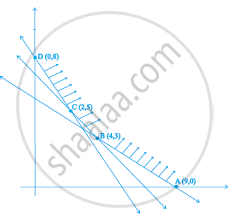
Concept: undefined >> undefined
Given triangles with sides T1: 3, 4, 5; T2: 5, 12, 13; T3: 6, 8, 10; T4: 4, 7, 9 and a relation R inset of triangles defined as R = `{(Delta_1, Delta_2) : Delta_1 "is similar to" Delta_2}`. Which triangles belong to the same equivalence class?
Concept: undefined >> undefined
Given set A = {1, 2, 3} and a relation R = {(1, 2), (2, 1)}, the relation R will be ____________.
Concept: undefined >> undefined
Given set A = {a, b, c}. An identity relation in set A is ____________.
Concept: undefined >> undefined
A relation S in the set of real numbers is defined as `"xSy" => "x" - "y" + sqrt3` is an irrational number, then relation S is ____________.
Concept: undefined >> undefined
A general election of Lok Sabha is a gigantic exercise. About 911 million people were eligible to vote and voter turnout was about 67%, the highest ever

Let I be the set of all citizens of India who were eligible to exercise their voting right in the general election held in 2019. A relation ‘R’ is defined on I as follows:
R = {(V1, V2) ∶ V1, V2 ∈ I and both use their voting right in the general election - 2019}
- The above-defined relation R is ____________.
Concept: undefined >> undefined
A general election of Lok Sabha is a gigantic exercise. About 911 million people were eligible to vote and voter turnout was about 67%, the highest ever
Let I be the set of all citizens of India who were eligible to exercise their voting right in the general election held in 2019. A relation ‘R’ is defined on I as follows:
R = {(V1, V2) ∶ V1, V2 ∈ I and both use their voting right in the general election - 2019}
- Mr. Shyam exercised his voting right in General Election-2019, then Mr. Shyam is related to which of the following?
Concept: undefined >> undefined
Sherlin and Danju are playing Ludo at home during Covid-19. While rolling the dice, Sherlin’s sister Raji observed and noted the possible outcomes of the throw every time belongs to set {1,2,3,4,5,6}. Let A be the set of players while B be the set of all possible outcomes.
A = {S, D}, B = {1,2,3,4,5,6}
- Let R ∶ B → B be defined by R = {(x, y): y is divisible by x} is ____________.
Concept: undefined >> undefined
