Please select a subject first
Advertisements
Advertisements
What effect does branching of an alkane chain has on its boiling point?
Concept: undefined >> undefined
Kp = 0.04 atm at 899 K for the equilibrium shown below. What is the equilibrium concentration of C2H6 when it is placed in a flask at 4.0 atm pressure and allowed to come to equilibrium?
\[\ce{C2H6 (g) ⇌ C2H4 (g) + H2 (g)}\]
Concept: undefined >> undefined
Advertisements
Describe two important uses of the following quicklime.
Concept: undefined >> undefined
Describe the importance of the limestone.
Concept: undefined >> undefined
Describe the importance of the cement.
Concept: undefined >> undefined
Describe the importance of the plaster of paris.
Concept: undefined >> undefined
What is the relationship between the members of following pairs of structures? Are they structural or geometrical isomers or resonance contributors?
\[\begin{array}{cc}
\ce{D}\phantom{......}\ce{H}\\
\backslash\phantom{......}/\\
\ce{C = C}\\
\phantom{...}/\phantom{......}\backslash\phantom{...}\\\ce{H}\phantom{.......}\ce{D}
\end{array}\]
\[\begin{array}{cc}
\ce{D}\phantom{......}\ce{D}\\
\backslash\phantom{......}/\\
\ce{C = C}\\
\phantom{...}/\phantom{......}\backslash\phantom{...}\\\ce{H}\phantom{.......}\ce{H}\end{array}\]
Concept: undefined >> undefined
Calculate a) ΔG°and b) the equilibrium constant for the formation of NO2 from NO and O2 at 298 K
\[\ce{NO(g) + 1/2 O_2 (g) <=> NO_2(g)}\]
where ΔfG⊝ (NO2) = 52.0 kJ/mol
ΔfG⊝ (NO) = 87.0 kJ/mol
ΔfG⊝ (O2) = 0 kJ/mol
Concept: undefined >> undefined
Does the number of moles of reaction products increase, decrease or remain same when each of the following equilibria is subjected to a decrease in pressure by increasing the volume?
\[\ce{3Fe (s) + 4H2O (g) ⇌ Fe3O4 (s) + 4H2 (g)}\]
Concept: undefined >> undefined
Compare the structures of H2O and H2O2.
Concept: undefined >> undefined
Predict which of the following reaction will have the appreciable concentration of reactants and products:
- \[\ce{Cl2 (g) ⇌ 2Cl (g)}\] Kc = 5 ×10–39
- \[\ce{Cl2 (g) + 2NO (g) ⇌ 2NOCl (g)}\] Kc = 3.7 × 10⁸
- \[\ce{Cl2 (g) + 2NO2 (g) ⇌ 2NO2Cl (g)}\] Kc = 1.8
Concept: undefined >> undefined
The value of Kc for the reaction 3O2 (g) ↔ 2O3 (g) is 2.0 ×10–50 at 25°C. If the equilibrium concentration of O2 in the air at 25°C is 1.6 ×10⁻², what is the concentration of O3?
Concept: undefined >> undefined
The reaction, \[\ce{CO(g) + 3H2(g) ↔ CH4(g) + H2O(g)}\] is at equilibrium at 1300 K in a 1L flask. It also contains 0.30 mol of CO, 0.10 mol of H2 and 0.02 mol of H2O and an unknown amount of CH4 in the flask. Determine the concentration of CH4 in the mixture. The equilibrium constant, Kc for the reaction at the given temperature is 3.90.
Concept: undefined >> undefined
What is green chemistry?
Concept: undefined >> undefined
What is the relationship between the members of following pairs of structures? Are they structural or geometrical isomers or resonance contributors?
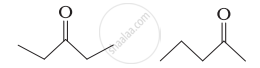
Concept: undefined >> undefined
What is the relationship between the members of following pairs of structures? Are they structural or geometrical isomers or resonance contributors?
\[\begin{array}{cc}\ce{^+OH}\\||\\
\ce{H - C - OH}\end{array}\]
\[\begin{array}{cc}\ce{OH}\phantom{.}\\|\phantom{...}\\
\ce{H - C^+ - OH}\end{array}\]
Concept: undefined >> undefined
Which of the following statements is correct about the reaction given below:
\[\ce{4Fe(s) + 3O2(g) -> 2Fe2O3(g)}\]
Concept: undefined >> undefined
Which of the following reactions is not correct according to the law of conservation of mass.
Concept: undefined >> undefined
Which of the following is not an actinoid?
Concept: undefined >> undefined
The electronic configuration of gadolinium (Atomic number 64) is ______.
Concept: undefined >> undefined
