Advertisements
Advertisements
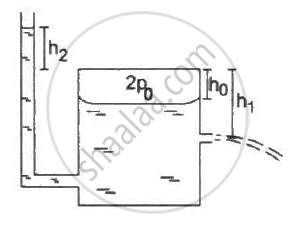
Figure shows a large closed cylindrical tank containing water. Initially the air trapped above the water surface has a height h0 and pressure 2p0 where p0 is the atmospheric pressure. There is a hole in the wall of the tank at a depth h1 below the top from which water comes out. A long vertical tube is connected as shown. (a) Find the height h2 of the water in the long tube above the top initially. (b) Find the speed with which water comes out of the hole. (c) Find the height of the water in the long tube above the top when the water stops coming out of the hole.
Concept: undefined >> undefined
During inelastic collision between two bodies, which of the following quantities always remain conserved?
Concept: undefined >> undefined
Advertisements
Two identical ball bearings in contact with each other and resting on a frictionless table are hit head-on by another ball bearing of the same mass moving initially with a speed V as shown in figure.
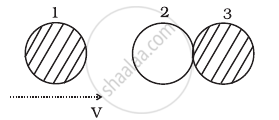
If the collision is elastic, which of the following (Figure) is a possible result after collision?
Concept: undefined >> undefined
A cricket ball of mass 150 g moving with a speed of 126 km/h hits at the middle of the bat, held firmly at its position by the batsman. The ball moves straight back to the bowler after hitting the bat. Assuming that collision between ball and bat is completely elastic and the two remain in contact for 0.001s, the force that the batsman had to apply to hold the bat firmly at its place would be ______.
Concept: undefined >> undefined
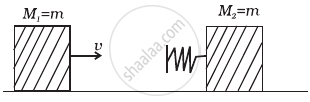
Two blocks M1 and M2 having equal mass are free to move on a horizontal frictionless surface. M2 is attached to a massless spring as shown in figure. Iniially M2 is at rest and M1 is moving toward M2 with speed v and collides head-on with M2.
- While spring is fully compressed all the KE of M1 is stored as PE of spring.
- While spring is fully compressed the system momentum is not conserved, though final momentum is equal to initial momentum.
- If spring is massless, the final state of the M1 is state of rest.
- If the surface on which blocks are moving has friction, then collision cannot be elastic.
Concept: undefined >> undefined
In an elastic collision of two billiard balls, which of the following quantities remain conserved during the short time of collision of the balls (i.e., when they are in contact).
- Kinetic energy.
- Total linear momentum?
Give reason for your answer in each case.
Concept: undefined >> undefined
A ball of mass m, moving with a speed 2v0, collides inelastically (e > 0) with an identical ball at rest. Show that for head-on collision, both the balls move forward.
Concept: undefined >> undefined
A ball of mass m, moving with a speed 2v0, collides inelastically (e > 0) with an identical ball at rest. Show that for a general collision, the angle between the two velocities of scattered balls is less than 90°.
Concept: undefined >> undefined
Consider a one-dimensional motion of a particle with total energy E. There are four regions A, B, C and D in which the relation between potential energy V, kinetic energy (K) and total energy E is as given below:
Region A : V > E
Region B : V < E
Region C : K > E
Region D : V > K
State with reason in each case whether a particle can be found in the given region or not.
Concept: undefined >> undefined
The bob A of a pendulum released from horizontal to the vertical hits another bob B of the same mass at rest on a table as shown in figure.
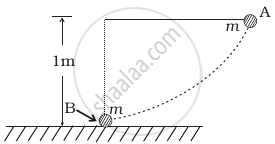
If the length of the pendulum is 1 m, calculate
- the height to which bob A will rise after collision.
- the speed with which bob B starts moving. Neglect the size of the bobs and assume the collision to be elastic.
Concept: undefined >> undefined
Two pendulums with identical bobs and lengths are suspended from a common support such that in rest position the two bobs are in contact (Figure). One of the bobs is released after being displaced by 10° so that it collides elastically head-on with the other bob.
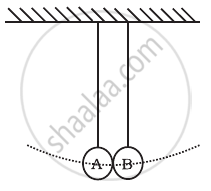
- Describe the motion of two bobs.
- Draw a graph showing variation in energy of either pendulum with time, for 0 ≤ t ≤ 2T, where T is the period of each pendulum.
Concept: undefined >> undefined
When a disc rotates with uniform angular velocity, which of the following is not true?
Concept: undefined >> undefined
Which of the following are true?
- A polar satellite goes around the earth’s pole in north- south direction.
- A geostationary satellite goes around the earth in east-west direction.
- A geostationary satellite goes around the earth in west-east direction.
- A polar satellite goes around the earth in east-west direction.
Concept: undefined >> undefined
What is the angle between the equatorial plane and the orbital plane of polar satellite?
Concept: undefined >> undefined
What is the angle between the equatorial plane and the orbital plane of geostationary satellite?
Concept: undefined >> undefined
Mean solar day is the time interval between two successive noon when sun passes through zenith point (meridian). Sidereal day is the time interval between two successive transit of a distant star through the zenith point (meridian). By drawing appropriate diagram showing earth’s spin and orbital motion, show that mean solar day is four minutes longer than the sidereal day. In other words, distant stars would rise 4 minutes early every successive day.
Concept: undefined >> undefined
A satellite is to be placed in equatorial geostationary orbit around earth for communication.
- Calculate height of such a satellite.
- Find out the minimum number of satellites that are needed to cover entire earth so that at least one satellites is visible from any point on the equator.
[M = 6 × 1024 kg, R = 6400 km, T = 24 h, G = 6.67 × 10⁻¹¹ SI units]
Concept: undefined >> undefined
A glass full of hot milk is poured on the table. It begins to cool gradually. Which of the following is correct?
- The rate of cooling is constant till milk attains the temperature of the surrounding.
- The temperature of milk falls off exponentially with time.
- While cooling, there is a flow of heat from milk to the surrounding as well as from surrounding to the milk but the net flow of heat is from milk to the surounding and that is why it cools.
- All three phenomenon, conduction, convection and radiation are responsible for the loss of heat from milk to the surroundings.
Concept: undefined >> undefined
Is the bulb of a thermometer made of diathermic or adiabatic wall?
Concept: undefined >> undefined
One day in the morning, Ramesh filled up 1/3 bucket of hot water from geyser, to take bath. Remaining 2/3 was to be filled by cold water (at room temperature) to bring mixture to a comfortable temperature. Suddenly Ramesh had to attend to something which would take some times, say 5-10 minutes before he could take bath. Now he had two options: (i) fill the remaining bucket completely by cold water and then attend to the work, (ii) first attend to the work and fill the remaining bucket just before taking bath. Which option do you think would have kept water warmer? Explain.
Concept: undefined >> undefined
