Please select a subject first
Advertisements
Advertisements
Name a plant which flowers every twelve years.
Concept: Flower
Name the terminal stage of ageing in the life cycle of plants.
Concept: Flower
Give a reason for the Following:
Pollen grains of wind-pollinated flowers are produced in large quantities.
Concept: Flower
Define Apomixis.
Concept: Polyembryony
Type of interaction where an individual sacrifices its own welfare (life) for the benefit of another animal of its own species is ______.
Concept: Pollination
State four features of flowers pollinated by insects.
Concept: Pollination
Explain the term perianth.
Concept: Reproduction
Give the biological name of the following:
Baker’s yeast
Concept: Modes of Reproduction >> Asexual Reproduction
State two advantages of vegetative propagation.
Concept: Modes of Reproduction >> Asexual Reproduction
Give four adaptations shown by flowers pollinated by wind.
Concept: Pollination
Give two differences between heartwood and sapwood.
Concept: Reproduction
Briefly discuss any two methods by which plants avoid self-pollination.
Concept: Pollination
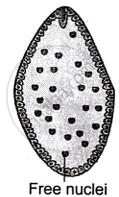
The diagram given below shows the three types of endosperms in angiosperms.
 |
 |
 |
| Type 1 | Type 2 | Type 3 |
- Identify the three types of endosperms shown above.
- Name the type of endosperm which commonly occurs in polypetalous dicots.
Concept: Endosperm
The number of chromosomes in the leaf cells of a male plant is 40 and in the stem cells of a female plant is 60. If they are artificially hybridised, what will be the number of chromosomes in the endosperm?
Concept: Endosperm
Name the pollinating agent of a flowering plant with large and coloured flowers with sticky stigma. State one characteristic feature of the pollen grains produced in such flowers.
Concept: Pollination
Mention one significant difference between Hormones of ovulatory phase and hormones of luteal phase
Concept: Menstrual Cycle (Ovarian Cycle)
Give reasons for the following:
Testes descend into the scrotum before birth.
Concept: Testes >> Structure of Testis
Give a significant point of difference between the oestrous and menstrual cycles.
Concept: Menstrual Cycle (Ovarian Cycle)
Draw a labelled diagram of L.S. of human testis.
Concept: The Male Reproductive System
