मराठी

ISC (Commerce) इयत्ता १२ - CISCE Important Questions for Economics

Advertisements
[object Object]
[object Object]
विषय
मुख्य विषय
अध्याय
Advertisements
Advertisements
Economics
< prev  1 to 20 of 61  next > 

Discuss any four factors affecting price elasticity of demand.

Appears in 2 question papers
Chapter: [4] Elasticity of Demand
Concept: Concept of Elasticity of Demand

What is meant by production function?

Appears in 2 question papers
Chapter: [7] Laws of Returns: Returns to a Factor and Returns to Scale
Concept: Production Function

State whether the following items will be included in the estimation of National Income or not? Give a reason for your answer.

Fresh tomatoes used by a food processing company.

Appears in 2 question papers
Chapter: [31] National Income Aggregates
Concept: National Income Aggregates >> Gross National Product at Market Price

Answer the following question.
Discuss the relationship between the income of the consumer and demand for a commodity with respect to normal goods, inferior goods, and necessities.

Appears in 1 question paper
Chapter: [2] Demand and Law of Demand
Concept: Concept of Demand

Differentiate between the expansion of demand and an increase in demand, using diagrams.

Appears in 1 question paper
Chapter: [2] Demand and Law of Demand
Concept: Movement along the Demand Curve and Shift of the Demand Curve

The figure given below shows the relation between the quantity demanded for the good X and the price of the good Z. What type of goods are X and Z?

Appears in 1 question paper
Chapter: [2] Demand and Law of Demand
Concept: Concept of Demand

Milk is used for making curd, sweets and chocolates.

What type of demand does milk have? Give a reason.

Appears in 1 question paper
Chapter: [2] Demand and Law of Demand
Concept: Concept of Demand

Figures (A), (B) and (C) given below represent different types of Demand curves.
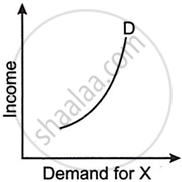
(A) (B) (C)

What kind of goods do each of these Demand curves represent? Give a reason for each of the curves.

Appears in 1 question paper
Chapter: [2] Demand and Law of Demand
Concept: Demand Curve

Draw a straight-line demand curve joining both the axes. Indicate the following on the demand curve.

Elasticity of demand is equal to zero

Appears in 1 question paper
Chapter: [2] Demand and Law of Demand
Concept: Demand Curve

Read the passage given below and answer the questions that follow.

In India, Fixed deposits have long been a favourite investment choice of people, especially senior citizens, as it promise steady returns. It attracts those who are seeking a stable income. But it’s an illusion in the period of inflation.

Inflation is the rate at which the general level of prices for goods and services rises, subsequently eroding the purchasing power of money. In simple terms, what money could buy today might not a few years down the line. Fixed deposits are financial instruments offered by banks where you deposit a lump sum amount for a fixed period at a predetermined rate of interest. Consider an investment of Rs 1 crore in a fixed deposit at a 6% annual interest rate and the annual rate of inflation is 5%. By the 10th year your pre inflation return is 1.79 crore, but post inflation it’s just 1.10 crore. The nominal value of investment in fixed deposits may appear to grow, inflation significantly diminishes their real value and purchasing power over time.

  1. What is the theme of the extract?   (2)
  2. Differentiate between Demand pull and Cost push inflation.   (2)
  3. What are the demand deposits and time deposits?   (2)
  4. Since 1998 RBI has been using new measures of money supply, M0, M1, M2 and M3. Which one of these measures incorporates fixed deposit as one of its components? Mention the other components of that measure.   (2)
Appears in 1 question paper
Chapter: [2] Demand and Law of Demand
Concept: Concept of Demand

The aggregate utility obtained from the consumption of a specific unit of a commodity is called ______.

Appears in 1 question paper
Chapter: [3] Theory of Consumer Behaviour: Marginal Utility and Indifference Curve Analysis
Concept: Cardinal Approach (Utility Analysis)

Utility maximising consumers would like to decrease the consumption when ______.

Appears in 1 question paper
Chapter: [3] Theory of Consumer Behaviour: Marginal Utility and Indifference Curve Analysis
Concept: Total Utility and Marginal Utility

Draw a diagram to show the elasticity of demand when it is greater than one.

Appears in 1 question paper
Chapter: [4] Elasticity of Demand
Concept: Concept of Elasticity of Demand

The price of a good decreases from ₹100 to 80 per unit. If the price elasticity of demand for the good is 2 and the original quantity demanded is 30 units, calculate the new quantity demanded.

Appears in 1 question paper
Chapter: [4] Elasticity of Demand
Concept: Concept of Elasticity of Demand

Which one of the following will cause a rise in the equilibrium price of rice when the demand for rice remains the same?

Appears in 1 question paper
Chapter: [5] Supply: Law of Supply and Price Elasticity of Supply
Concept: Movements Along and Shifts in Supply Curve

The price of a mobile handset has risen in the market. But the dealers have not been able to increase the supply proportionately.

What will be the price elasticity of supply for the mobile handset? Draw the supply curve to indicate the type of elasticity.

Appears in 1 question paper
Chapter: [5] Supply: Law of Supply and Price Elasticity of Supply
Concept: Measurement of Elasticity of Supply

An increase in the number of firms in the market causes a rightward shift in the market supply curve, but the individual supply curve may shift leftward. Justify the statement.

Appears in 1 question paper
Chapter: [5] Supply: Law of Supply and Price Elasticity of Supply
Concept: Movements Along and Shifts in Supply Curve

Give two differences between intended supply and actual supply.

Appears in 1 question paper
Chapter: [5] Supply: Law of Supply and Price Elasticity of Supply
Concept: Determinants of Supply

Prices of air conditioners and refrigerators have shot up in the new year as consumer durables makers pass on the impact of rising raw material costs and higher freight charges to customers, while home appliances like washing machines may witness a 5–10 per cent price hike later this month or by March.

(Source: The Economic Times)

Explain the behaviour of supply of this consumer durable. Illustrate the same in a diagram.

Appears in 1 question paper
Chapter: [5] Supply: Law of Supply and Price Elasticity of Supply
Concept: Determinants of Supply

Explain the law of variable proportions with the help of a diagram.

Appears in 1 question paper
Chapter: [7] Laws of Returns: Returns to a Factor and Returns to Scale
Concept: Law of Variable Proportions
< prev  1 to 20 of 61  next > 
Advertisements
Share
Notifications

Englishहिंदीमराठी


      Forgot password?
Use app×