Advertisements
Advertisements
Show that height of the cylinder of greatest volume which can be inscribed in a right circular cone of height h and semi-vertical angle α is one-third that of the cone and the greatest volume of the cylinder is `(4)/(27) pi"h"^3 tan^2 α`.
Concept: Maximum and Minimum Values of a Function in a Closed Interval
Find the intervals in which the function `f("x") = (4sin"x")/(2+cos"x") -"x";0≤"x"≤2pi` is strictly increasing or strictly decreasing.
Concept: Increasing and Decreasing Functions
A ladder 13 m long is leaning against a vertical wall. The bottom of the ladder is dragged away from the wall along the ground at the rate of 2 cm/sec. How fast is the height on the wall decreasing when the foot of the ladder is 5 m away from the wall?
Concept: Rate of Change of Quantities
Find the values of x such that f(x) = 2x3 – 15x2 + 36x + 1 is increasing function
Concept: Increasing and Decreasing Functions
A rod of 108 m long is bent to form a rectangle. Find it’s dimensions when it’s area is maximum.
Concept: Maxima and Minima
The maximum value of `(1/x)^x` is ______.
Concept: Maxima and Minima
A man 1.6 m tall walks at the rate of 0.3 m/sec away from a street light that is 4 m above the ground. At what rate is the tip of his shadow moving? At what rate is his shadow lengthening?
Concept: Rate of Change of Quantities
Read the following passage and answer the questions given below.
|
|

- Is the function differentiable in the interval (0, 12)? Justify your answer.
- If 6 is the critical point of the function, then find the value of the constant m.
- Find the intervals in which the function is strictly increasing/strictly decreasing.
OR
Find the points of local maximum/local minimum, if any, in the interval (0, 12) as well as the points of absolute maximum/absolute minimum in the interval [0, 12]. Also, find the corresponding local maximum/local minimum and the absolute ‘maximum/absolute minimum values of the function.
Concept: Maxima and Minima
Read the following passage and answer the questions given below.
|
In an elliptical sport field the authority wants to design a rectangular soccer field with the maximum possible area. The sport field is given by the graph of `x^2/a^2 + y^2/b^2` = 1. |
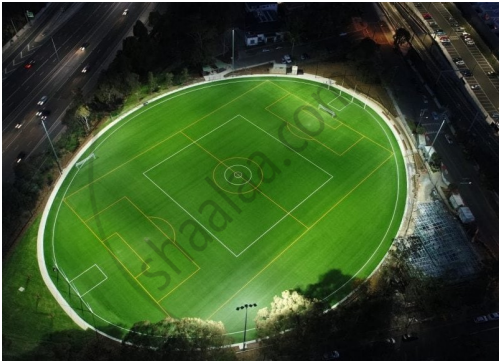
- If the length and the breadth of the rectangular field be 2x and 2y respectively, then find the area function in terms of x.
- Find the critical point of the function.
- Use First derivative Test to find the length 2x and width 2y of the soccer field (in terms of a and b) that maximize its area.
OR
Use Second Derivative Test to find the length 2x and width 2y of the soccer field (in terms of a and b) that maximize its area.
Concept: Maxima and Minima
If the circumference of circle is increasing at the constant rate, prove that rate of change of area of circle is directly proportional to its radius.
Concept: Rate of Change of Quantities
If equal sides of an isosceles triangle with fixed base 10 cm are increasing at the rate of 4 cm/sec, how fast is the area of triangle increasing at an instant when all sides become equal?
Concept: Rate of Change of Quantities
The interval in which the function f(x) = 2x3 + 9x2 + 12x – 1 is decreasing is ______.
Concept: Increasing and Decreasing Functions
The median of an equilateral triangle is increasing at the ratio of `2sqrt(3)` cm/s. Find the rate at which its side is increasing.
Concept: Rate of Change of Quantities
Sum of two numbers is 5. If the sum of the cubes of these numbers is least, then find the sum of the squares of these numbers.
Concept: Maxima and Minima
The function f(x) = x3 + 3x is increasing in interval ______.
Concept: Increasing and Decreasing Functions
Find the interval/s in which the function f : R `rightarrow` R defined by f(x) = xex, is increasing.
Concept: Increasing and Decreasing Functions
If f(x) = `1/(4x^2 + 2x + 1); x ∈ R`, then find the maximum value of f(x).
Concept: Maxima and Minima
Find the maximum profit that a company can make, if the profit function is given by P(x) = 72 + 42x – x2, where x is the number of units and P is the profit in rupees.
Concept: Maxima and Minima
Check whether the function f : R `rightarrow` R defined by f(x) = x3 + x, has any critical point/s or not ? If yes, then find the point/s.
Concept: Maxima and Minima
Evaluate :`int_(pi/6)^(pi/3) dx/(1+sqrtcotx)`
Concept: Methods of Integration>Integration Using Trigonometric Identities
