Please select a subject first
Advertisements
Advertisements
Which one of the following countries was NOT a part of the Soviet Union?
Concept: Why Did the Soviet Union Disintegrate?
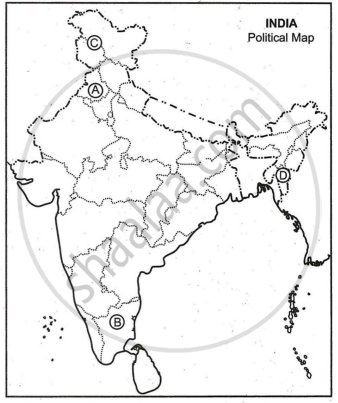
In the given political outline map of India, four states have been marked as (A), (B), (C) and (D). Identify these states on the basis of the information given below and write their correct names in your answer book along with the respective serial number of the information used and the concerned alphabets given in the ‘map as per the format that follows:
| S.No.of the information used |
Concerned Alphabet |
Name of the State |
| (i) | ||
| (ii) | ||
| (iii) | ||
| (iv) |
- The state which has been bifurcated in two Union Territories recently.
- The state where Rajiv Gandhi-Longowal Accord was signed.
- The state to which Laldenga belonged.
- The state from where the Dravidian Movement started.
Concept: Integration of Princely States
Who advanced the 'Two Nation Theory' that led to the partition of British India?
Concept: Partition: Displacement and Rehabilitation
Highlight any three problems faced by Government of India immediately after independence related to the displaced population.
Concept: Partition: Displacement and Rehabilitation
“The ‘Arab Spring’ was the people’s revolution against injustice.” Support the statement with any two examples.
Concept: New Entities in World Politics: Russia, Balkan States and Central Asian States
Examine any six consequences of the disintegration of USSR.
Concept: Disintegration of the Soviet Union and Its Impact Or Consequences on the World Order
On 19th March 2003, the US launched its invasion of Iraq the code name ______.
Concept: The Iraq Invasion
Study the given cartoon carefully and answer the questions that follow:

- The soldier shown in the cartoon belongs to which one of the following countries?
- USSR
- USA
- Iraq
- Iran
- In which year was Iraq attacked under the code name ‘Operation Iraqi Freedom'?
- 1993
- 2000
- 2003
- 2008
- Which one of the following countries shown on the cartoon is a ‘Gulf country’?
- Iran
- Kazakhstan
- Pakistan
- Oman
- The First Gulf War is also known as ______.
- Smart War
- Operation Liberation
- Computer War
- Operation Enduring Freedom
Concept: The Iraq Invasion
The objective of ASEAN is not restricted only to accelerating economic growth. Explain the statement.
Concept: Association of South East Asian Nations (ASEAN)
Evaluate any three steps taken by the Chinese leadership for the growth of Chinese economy.
Concept: The Rise of the Chinese Economy
Study the given cartoon carefully and answer the questions that follow:
 |
 |
- To which country are these two cartoons related?
- Japan
- Vietnam
- South Korea
- China
- Red Book is related to which ideology?
- Capitalism
- Communism
- Humanism
- Terrorism
- What does the 'Red Power Tie' depict?
- Negation of communism
- Acceptance of Capitalism
- Coordination of communism with Capitalism
- Negation of Capitalism
- What is the difference between 'then' and 'now' as per the cartoon?
- 'Rigidity' has increased now in the ideology of 'then'.
- Rigidity has decreased 'now' in the ideology of 'then'.
- The leader under 'then' and the leader under 'now' belong to different political parties.
- The leader under 'then' and the leader under 'now' belong to different organisations.
Concept: The Rise of the Chinese Economy
State any two programmes launched by the NDA government after 2014 for women’s help and progress.
Concept: Womens’ Movement in India
Name any four countries that are included in South Asia.
Concept: What is South Asia?
Planning Commission was set up by ______.
Concept: Introduction of Politics of Planned Development
Highlight the speciality of India-Nepal relations.
Concept: India's Relations with Its Neighbours
Highlight any three features of the First Five Year Plan.
Concept: The Early Initiatives
Analyse any three major happenings in Bangladesh that show peoples’ support to democracy.
Concept: Democracy in Bangladesh
Assertion (A): During constitutional monarchy in 1990s, the political parties and the common people of Nepal wanted to have a more open and responsive system of government.
Reason (R): The King with the help of the army retained full control over the government and restricted the expansion of democracy in Nepal.
Concept: Monarchy and Democracy in Nepal
Which one of the following is not the objective of NITI Aayog?
Concept: Introduction of Politics of Planned Development
Which one of the following statements about relations between India and Nepal is NOT correct?
Concept: India's Relations with Its Neighbours
