Advertisements
Advertisements
'Ram is able to get work only for two hours in a day. Rest of the day, he is looking for work.' Is he unemployed? What kind of job could person like Ram be doing?
Concept: Concept of Unemployment
“The value of all goods and services can be expressed in monetary units.”
On the basis of the given statement, identify the function performed by money:
Concept: Functions of Money
Study the following picture and answer the given question:
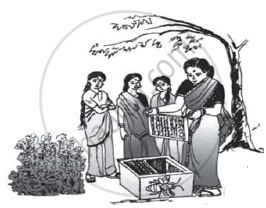
Women in rural households take up bee-keeping as an entrepreneurial activity. Such kind of activities may be envisaged under ______ as diversification activity.
Concept: Diversification into Productive Activities
Micro credit programmes play a vital role in ensuring an overall development of the rural economy as they ______.
- provide financial support
- lead to women empowerment
- enhance the reach of formal credit system
Concept: Credit and Marketing in Rural Areas
Read the following statements carefully:
Statement 1: The nature of unemployment problem in India is uni-faceted.
Statement 2: Worker-Population ratio is an indicator used for analysing the employment situation in a country.
In light of the given statements, choose the correct alternative from the following:
Concept: Participation of People in Employment
State and elaborate whether the following statement is true or false, with valid arguments:
Agricultural marketing is a process that ensures the transportation of various agricultural commodities only.
Concept: Agricultural Market System
“Ravya was initially working as an office clerk in a firm. In the pursuit to attain, a higher position and income, she attended a few on-the-job training sessions. These sessions contributed positively to her skills and expertise.”
Explain the impact of Ravya’s decision on human capital formation.
Concept: Sources of Human Capital
State and elaborate whether the following statement is true or false, with valid arguments:
Jan-Dhan Yojana has been a crucial step for financial resource mobilization in the Indian economy.
Concept: Credit and Marketing in Rural Areas
“Since independence, the government has been playing an important role in generating employment directly or indirectly.” Discuss.
Concept: Government and Employment Generation
State with valid reason whether the following statement is true or false:
‘Self employed workers are different from hired workers.’
Concept: Self-employed and Hired Workers
Explain the importance of credit availability to farmers in rural development.
Concept: Credit and Marketing in Rural Areas
What is the relation between marginal cost and average variable cost when marginal cost is rising and average variable cost is falling?
Concept: Relationship Between Average Variable Cost and Average Total Cost and Marginal Cost
Complete the following table:
| Units of Labour | Average Product (Units) | Marginal Product (Units) |
| 1 | 8 | ............. |
| 2 | 10 | ............ |
| 3 | ............ | 10 |
| 4 | 9 | ........... |
| 5 | ............. | 4 |
| 6 | 7 | ............ |
Concept: Relation Between Total, Average and Marginal Product
What is opportunity cost? Explain with the help of a numerical example.
Concept: Opportunity Cost
What is the relation between Average Variable Cost and Average Total Cost, if Total Fixed Cost is zero?
Concept: Relationship Between Average Variable Cost and Average Total Cost and Marginal Cost
From the following data find out the level of output that will give the producer maximum profit (Use marginal cost and marginal revenue approach,) Give reasons for your answer
| Output (units) | 1 | 2 | 3 | 4 | 5 |
| Total Cost (Rs) | 9 | 17 | 24 | 29 | 36 |
| Total Revenue (Rs) | 11 | 20 | 27 | 32 | 35 |
Concept: Average and Marginal Physical Products
Giving reason comment on the production possibilities curve based on the following schedule:
| Good X (units) | Good Y (units) |
| 0 | 20 |
| 1 | 18 |
| 2 | 14 |
| 3 | 8 |
| 4 | 0 |
Concept: Concept of Production
Giving reason comment on the shape of Production Possibilities curve based on the following schedule :
| Good X (units | Good Y (units) |
| 0 | 30 |
| 1 | 27 |
| 2 | 21 |
| 3 | 12 |
| 4 | 0 |
Concept: Concept of Production
Giving reason comment on the shape of Production Possibilities curve based on the following schedule:
| Good X (units) | Good Y (units) |
| 0 | 16 |
| 1 | 12 |
| 2 | 8 |
| 3 | 4 |
| 4 | 0 |
Concept: Concept of Production
What are the different phases in the Law of Variable Proportions in terms of Total Product ? Give reasons behind each phase. Use diagram.
Concept: Law of Variable Proportions
