Please select a subject first
Advertisements
Advertisements
Write the method of preparation of Ca(OH)2. What happens when CO2 is passed through it? Write balanced chemical equation for the reaction involved.
Concept: Types of Chemical Reactions > Double Displacement Reaction
You are asked to prepare hard water in your laboratory. Select a group from the following groups of salts, any salt of which you may dissolve in distilled water to obtain hard water.
(A) NaCl; Na2SO4; KCl
(B) NaCl; CaCl2; KCl
(C) CaCl2; CaSO4; MgSO4
(D) Na2SO4; CaSO4; MgSO4
Concept: Salts
Out of HCl and CH3COOH, which one is a weak acid and why? Describe an activity to support your answer.
Concept: Acids
Out of three metals P, Q and R, P is less reactive than Q and R is more reactive than P and Q both. Suggest an activity to arragne P, Q and R in order of their decreasing reactivity.
Concept: Acids
Answer the following question.
Identify the acid and the base from which sodium chloride is obtained. Which type of salt is it? When is it called rock salt? How is rock salt formed?
Concept: Acids
A compound which is prepared from gypsum has the property of hardening when mixed with water. identify the compound and write its formula. How is this compound prepared? Describe it in the form of a chemical equation only.
Concept: Plaster of Paris
One of the events that does not occur during photosynthesis is ______.
Concept: Bases
A small amount of copper oxide was taken in a beaker and dilute hydrochloric acid was added with continuous stirring of the solution. Name the compound formed and state the colour of its solution. Write the balanced chemical equation for the reaction that occurs. Based on the reaction, state the nature (acidic/basic) of copper oxide.
Concept: Bases
An aqueous solution of a salt turns blue litmus to red. The salt could be the one obtained by the reaction of ______.
Concept: Salts
Define the following:
Reflex arc
Concept: Human Nervous System
Nervous and hormonal systems together perform the function of control and coordination in human beings. Justify this statement with the help of an example.
Concept: Human Nervous System
Name the parts (a) to (e) in the following diagram.
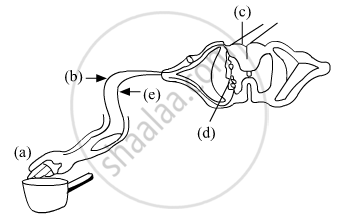
What is the term given to the sequence of events occurring in the diagram?
Concept: Human Nervous System
Plants do not have any nervous system but yet, if we touch a sensitive plant, some observable changes take place in its leaves. Explain how could this plant respond to the external stimuli and how it is communicated.
Concept: Human Nervous System
How is an electric impulse created in human nervous system?
Concept: Human Nervous System
A plant growth inhibitor hormone which causes wilting of leaves is ______.
Concept: Plant Hormones
Trace the sequence of events which occur when you suddenly touch a hot object.
Concept: Human Nervous System
Name the parts labelled as A, B, C and D in the diagram given below:-

Concept: Sexual Reproduction in Plants

(i) Name the part marked 'A' in the diagram.
(ii) How dose 'A' reachese part 'B'?
(iii) State the importance of the part 'C'.
(iv) What happens to the part marked 'D' after fertilisation is over?
Concept: Sexual Reproduction in Plants
A student while observing an embryo of a pea seed in the laboratory listed various parts of the embryo as given below:
Testa, Tegmen, Radicle, Plumule, Micropyle, Cotyledon.
On examining the list the teacher remarked that only three parts are correct. Select three correct parts from the above list:
(a) Testa, Radicle, Cotyleddon
(b) Tegmen, Radicle, Micropyle
(c) Cotyledon, Plumule, Testa
(d) Radicle, Cotyledon, Plumule
Concept: Sexual Reproduction in Plants
"The chromosomal number of the sexually producing parents and their offspring is the same." Justify this statement.
Concept: Sexual Reproduction in Plants
