Definitions [8]
In a proper fraction, the numerator is less than the denominator.
i.e., numerator < denominator.
Example:
`3/4, 1/2, 9/10, 5/8` are examples of a proper fraction.
A fraction is called an improper fraction when the numerator is greater than or equal to the denominator.
i.e., numerator ≥ denominator.
Example:
`3/2, 12/7, 18/5` are all examples of improper fractions
A fraction that contains a whole number and a proper fraction is called a mixed fraction.
`3 2/3, 4 2/3, 3 7/8` are all examples of mixed fractions.
The product of the numerator of the first and the denominator of the second is equal to the product of the denominator of the first and the numerator of the second. These two products are called cross-products.
`a/b = c/d`
`a xx d = c xx b`.
If two or more fractions have the same value, they are called equivalent or equal fractions.
E.g., `1/3`, `3/9`, `6/18` and `9/27` are equivalent fractions.
A like fraction is a collection of two or more fractions with the same denominator.
Example:
`2/6`, `3/6` and `4/6` are examples of like fractions.
Unlike fractions are fractions with different denominators.
Example: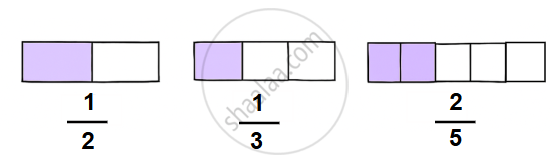
`1/2`, `1/3` and `2/5` are examples of unlike fractions.
A fraction is said to be in the simplest (or lowest) form if its numerator and denominator have no common factor except 1.
`4/3, 2/5` etc. are examples of the simplest form of a fraction.
Formulae [1]
`a/c` × `c/d` = `"a × c" / "b × d"`
Concepts [12]
- Comparing Fractions
- Types of Fractions
- Concept of Proper and Improper Fractions
- Concept of Mixed Fractions
- Concept of Equivalent Fractions
- Like and Unlike Fraction
- Simplest Form of a Fractions
- Addition of Fraction
- Subtraction of Fraction
- Multiplication of a Fraction by a Whole Number
- Conversion between Decimal Fraction and Common Fraction
- Multiplication of Fraction
