Definitions [14]
When two or more lines pass through the same point, they are called concurrent lines. The common point through which they pass is called the point of concurrence, i.e., point O.
A line is a straight path that extends infinitely in both directions and has only length, without width or thickness.

A line segment is part of a line between two endpoints. A line segment AB is generally denoted by the symbol `bar"AB"`.

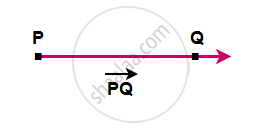
A ray is a portion of a line that begins at a fixed point, called its origin, and extends infinitely in one direction.
Parallel lines are straight lines that never intersect and remain at a constant distance from each other.
They are denoted by the symbol “∥”, meaning ‘is parallel to’.
Examples: Railroad tracks, Zebra crossings, Staircase steps
When two or more lines meet at a common point, they are known as intersecting lines.
Point: A point is a mark of position. It has neither length, width, nor thickness and occupies no space. It is usually denoted by a capital letter.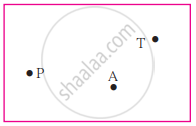
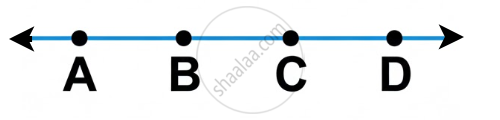
Three or more points that all lie on the same straight line
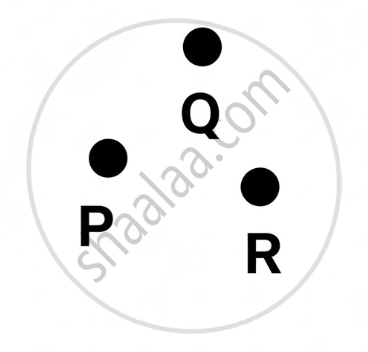
Three or more points that do not lie on the same straight line.
Complementary angles: When the sum of the measures of two angles is 90°, the angles are called complementary angles. Example, 30° + 60° = 90°.
Supplementary angles: When the sum of the measures of two angles is 180° are called supplementary angles. Example, 60° + 120° = 180°.
Linear pair: A linear pair is a pair of adjacent angles whose non-common sides are opposite rays.
A perpendicular bisector is defined as a line or a line segment that divides a given line segment into two parts of equal length and forms a right angle (90°) with it.
If a line or line segment divides an angle into two equal angles, then the line or line segment is called the angle bisector of the given angle.
Concepts [16]
- Concept of Lines
- Line Segments
- Rays
- Parallel Lines
- Intersecting Lines
- Concept of Points
- Types of Angles
- Trigonometrical Ratios of Complementary Angles
- Supplementary Angles
- Concept of Linear Pair
- Concept of Pairs of Angles
- Concept of Transversal Lines
- The Perpendicular Bisector
- Concept of Angle Bisector
- Angles of Special Measures - 30°, 45°, 60°, 90°, and 120°
- Concept of Angle
