Definitions [17]
Coordination compounds are those molecular compounds which retain their identity in solid as well as in aqueous solution. In these compounds, metals or atoms are bonded to a number of anions or neutral molecules by a coordinate bond.
Coordination compounds are compounds in which a central metal atom or ion is linked to a number of ions or neutral molecules by coordinate bonds — i.e., by donation of lone pair of electrons by these ions or neutral molecules (called ligands) to the central metal atom.
A ligand is a molecule, ion or group that is bonded to the metal atom or ion in a complex or coordination compound by a coordinate bond.
Define ligand.
In the coordination compound, the species surrounding the central metal atom or ion are called ligands.
Define monodentate ligand.
A monodentate ligand is one in which a single donor atom shares an electron pair with the centre metal ion to create a coordinate bond.
Define Anionic sphere complex.
A negatively charged coordination sphere or a coordination compound having a negatively charged coordination sphere is called anionic complex or anionic sphere complex.
Define coordination sphere. Give example.
The central metal ion and ligands linked to it are enclosed in a square bracket. This is called a coordination sphere. This is a discrete structural unit. The ionisable groups shown outside the bracket are the counter ions. For example, the compound K4[Fe(CN)6] has [Fe(CN)6]4- coordination sphere with the ionisable K⊕ ions representing counter ions.
Define coordination number.
Coordination number is the number of ligand donor atoms directly bonded to the central metal atom or ion in a complex.
Example: In [Co(NH3)5Cl]2+, the coordination number of cobalt (Co) is 6 because 5 ammonia molecules and 1 chloride ion are attached to it.
The total number of electrons present on the central metal atom/ion, including those gained by it in bonding, is called EAN.
Define the term Hydrated isomers.
Isomers in which there is exchange of solvent (water) ligands between coordination and ionization spheres are called hydrate isomers.
Optical isomers are mirror images that cannot be superimposed on one another. These are called enantiomers.
Isomerism is the phenomenon in which compounds have the same molecular formula but differ in their physical or chemical properties due to a different arrangement of atoms or groups in space or structure.
When two ligands are in opposite directions, i.e., at 180° to each other, the isomer formed is the trans-isomer.
Define Distereoisomers.
Two or more coordination compounds which contain the same number and types of atoms, and bonds (i.e., the connectivity between atoms is the same), but which have different spatial arrangements of the atoms are called distereoisomers.
Define the term Co-ordination isomer.
Isomers which show interchange of ligands between cationic and anionic spheres of different metal ions are called co-ordination isomers.
In a disubstituted complex molecule/ion, when two same ligands are at right angles (90°), the geometrical isomer is known as a cis-isomer.
The stability of a coordination complex refers to the extent to which it exists in a solution as a coordination sphere.
Formulae [1]
Effective atomic number (EAN): EAN = Z – X + Y
Z = Atomic number of metal
X = Number of electrons lost by the metal to form the ion
Y = Number of electrons donated by ligands
Theorems and Laws [2]
In coordination compounds, the central metal exhibits two types of valencies:
- Primary valency
- Secondary valency
Primary valency:
- Satisfied by anions only
- Depends on the oxidation state of the metal
- Ionisable and non-directiona
Secondary valency:
- Satisfied by ligands
- Represents the coordination number
- Non-ionisable and directional
- Determines the geometry of the complex
- Proposed by Heitler and London (1927), further developed by Pauling and Slater.
- A covalent bond is formed when half-filled valence atomic orbitals of similar energies overlap, each containing one unpaired electron.
- Greater the overlap → stronger the bond.
Types of Orbital Overlap:
| Type | Description | Bond Formed |
|---|---|---|
| Axial (Head-on) overlap | Orbitals overlap along the internuclear axis | Sigma (σ) bond |
| Sidewise (Lateral) overlap | Orbitals overlap parallel to each other, perpendicular to the internuclear axis | Pi (π) bond |
Hybridisation & Shapes:
| Hybridisation | Shape | Coordination No. |
|---|---|---|
| sp³ | Tetrahedral | 4 |
| dsp² | Square planar | 4 |
| sp³d | Trigonal bipyramidal | 5 |
| d²sp³ | Octahedral (inner) | 6 |
| sp³d² | Octahedral (outer) | 6 |
Limitations of VBT:
- Involves a number of assumptions.
- Does not give a quantitative interpretation of magnetic data.
- Does not explain the colour exhibited by coordination compounds.
- Does not give a quantitative interpretation of the thermodynamic or kinetic stabilities of coordination compounds.
- Does not make exact predictions regarding the tetrahedral and square planar structures of 4-coordinate complexes.
- Does not distinguish between weak and strong ligands.
Key Points
| Type of Ligand | Number of Donor Atoms | Description | Examples |
|---|---|---|---|
| Monodentate | 1 | Binds through one donor atom | Cl⁻, OH⁻, CN⁻, NH₃ |
| Bidentate | 2 | Binds through two donor atoms | Ethylenediamine |
| Polydentate | ≥2 | Binds through two or more donor atoms | EDTA⁴⁻ (general category) |
| Hexadentate | 6 | Binds through six donor atoms | EDTA⁴⁻ |
| Ambidentate | 2 (one at a time) | Has two donor atoms but uses only one to bind | CN⁻, SCN⁻, NCS⁻ |
Basic Terms:
- Coordination sphere: Metal + ligands inside brackets
- Charge number: Net charge on complex ion
- Oxidation state: Charge on central metal ion
- Coordination number: Number of donor atoms attached to metal
Double Salts vs Coordination Compounds:
| Property | Double Salt | Coordination Compound |
|---|---|---|
| Dissociation | Completely into ions | Gives complex ion |
| Example | Mohr’s salt | K₄[Fe(CN)₆] |
1. On the basis of ligands
- Homoleptic complex:
Contains only one type of ligand
Example: [Co(NH₃)₆]³⁺ - Heteroleptic complex:
Contains two or more types of ligands
Example: [Co(NH₃)₄Cl₂]⁺
2. On the basis of charge
- Cationic complex:
Positively charged coordination sphere
Example: [Zn(NH₃)₄]²⁺ - Anionic complex:
Negatively charged coordination sphere
Example: [Fe(CN)₆]³⁻ - Neutral complex:
No overall charge
Example: [Ni(CO)₄]
1. Order
- Ligand → Metal
- Cation first, then anion
2. Ligand Names
- Cl⁻ → chloro
- CN⁻ → cyano
- OH⁻ → hydroxo
- NH₃ → ammine
- H₂O → aqua
- CO → carbonyl
3. Number Prefix
- di, tri, tetra, penta, hexa
- Special: bis, tris (if ligand has number)
4. Order of Ligands
-
Alphabetical order
5. Metal Name
- Neutral/cation → normal name
- Anionic complex → ends with “-ate”
Fe → ferrate
Cu → cuprate
Co → cobaltate
6. Oxidation State
-
Write in Roman (II), (III)
7. Important
- Counter ions not named
- Complex always in [ ]
8. Examples
Neutral complexes
- [Co(NO₂)₃(NH₃)₃] → Triamminetrinitrocobalt(III)
- Fe(CO)₅ → Pentacarbonyliron(0)
Cationic complexes
- [Cu(NH₃)₄]²⁺ → Tetraamminecopper(II) ion
- [Fe(H₂O)₅(NCS)]²⁺ → Pentaaquathiocyanatoiron(III) ion
Anionic complexes
- [Ni(CN)₄]²⁻ → Tetracyanonickelate(II) ion
- [Fe(CN)₆]⁴⁻ → Hexacyanoferrate(II) ion
Compounds (Very Important)
- [Co(NH₃)₅Cl]Cl₂ → Pentaamminechlorocobalt(III) chloride
- K₃[Al(C₂O₄)₃] → Potassium trioxalatoaluminate(III)
- Na₃[Co(NO₂)₆] → Sodium hexanitrocobaltate(III)
Rules for Writing Formulae:
- The cation is written first, then the anion.
- In the formula of the complex ion/entity, the central metal atom is written first, then the ligands in alphabetical order.
- The formula of the entire coordination entity is enclosed in square brackets.
Rules for Naming:
Rule 1: Names of neutral coordination complexes are given without spaces. Cation is named first, separated by a space from the anion.
Rule 2 (Naming ligands first):
- Ligands that act as anions end in –o: Cl⁻ = chlorido, Br⁻ = bromido, I⁻ = iodido
- Anions ending in –ite and –ate are replaced with –ito and –ato: SO₄²⁻ = sulphato, CO₃²⁻ = carbonato, NO₂⁻ = nitrito, CH₃COO⁻ = acetato
- Neutral ligands get the same name as the uncoordinated molecule (with spaces omitted): C₅H₅N = pyridine, (CH₃)₂SO = dimethylsulfoxide (DMSO)
Exceptions — neutral ligands with special names:
| Molecule | Special Name |
|---|---|
| H₂O | aqua |
| NH₃ | ammine |
| CS | thiocarbonyl |
| CO | carbonyl |
| NO | nitrosyl |
Rule 3 (Prefixes): Greek prefixes (di, tri, tetra) are used for simple ligand names. For polydentate ligands (i.e., those with a binding site name containing di/tri already): bis-, tris-, tetrakis-, pentakis-, hexakis- are used instead. e.g., bis(ethane-1,2-diamine) not "diethylenediamine".
Rule 4: Oxidation state of the metal is indicated by a Roman numeral in parentheses after the metal name. NO = nitrosyl.
Rule 5 (Complex ion is a cation): Metal is named same as the element. e.g., Co in a cationic complex = cobalt. Name = Ligands + Metal name (with OS)
Rule 6 (Complex ion is an anion): Metal name ends in –ate + oxidation number.
Anionic Complex Metal Names:
| Metal | Name in Anionic Complex |
|---|---|
| Iron | Ferrate |
| Lead | Plumbate |
| Gold | Aurate |
| Chromium (Cr) | Chromate |
| Palladium (Pd) | Palladinate |
| Mercury (Hg) | Mercurate |
| Zinc (Zn) | Zincate |
| Nickel (Ni) | Nickelate |
| Copper | Cuprate |
| Silver | Argentate |
| Tin | Stannate |
| Cobalt (Co) | Cobaltate |
| Platinum (Pt) | Platinate |
| Cadmium (Cd) | Cadmate |
| Aluminium (Al) | Aluminate |
IUPAC Name Examples
- Na₂[Fe(CN)₅NO]: Sodium pentacyanonitrosatoferrate(II) (Note: pentacyanonitrosylferrate(II))
- [Fe(CN)₆]³⁻: hexacyanidoferrate(III) ion
- [Pt(NH₃)₂(Br)(NO₂)Cl]Cl: triamminebromochloronitroplatinum(IV) chloride
- K₃[Cr(C₂O₄)₃]: potassium trioxalatochromate(III)
Order of naming ions: Positive ion (cation) first, then negative ion (anion). In naming the complex ion, ligands first (alphabetically), then metal.
| Main Type | Subtype | Condition / Description | Key Rule | Example |
|---|---|---|---|---|
| Stereoisomerism | Geometrical (cis–trans) | Different spatial arrangement | cis = 90°, trans = 180° | [Pt(NH₃)₂Cl₂] |
| Optical | Non-superimposable mirror images | No plane of symmetry | [Co(en)₃]³⁺ | |
| Structural Isomerism | Ionisation | Exchange of ions inside/outside coordination sphere | Counter ion acts as ligand | [Co(NH₃)₅SO₄]Br / [Co(NH₃)₅Br]SO₄ |
| Linkage | Ambidentate ligand attaches via different atoms | NO₂⁻, SCN⁻ | [Co(NH₃)₅NO₂]Cl₂ / [Co(NH₃)₅ONO]Cl₂ | |
| Coordination | Ligand exchange between metal complexes | Two metal centers involved | [Co(NH₃)₆][Cr(CN)₆] | |
| Solvate (Hydrate) | Solvent inside vs outside coordination sphere | Crystal water difference | [Cr(H₂O)₆]Cl₃ / [Cr(H₂O)₅Cl]Cl₂·H₂O |
Factors affecting the stability of a complex:
- Charge on the central metal ion
- Nature of the metal ion
For the same ligand, the stability of complexes formed by divalent metal ions follows the order:
Cu²⁺ > Ni²⁺ > Co²⁺ > Fe²⁺ > Mn²⁺ > Cd²⁺
CFT is an electrostatic model that considers the metal-ligand bond to be ionic, arising purely from electrostatic interactions between the metal ion and the ligand (treated as point charges for anions, or point dipoles for neutral molecules).
CFT considers the effect of ligands on the relative energies of the d-orbitals of the central metal atom/ion.
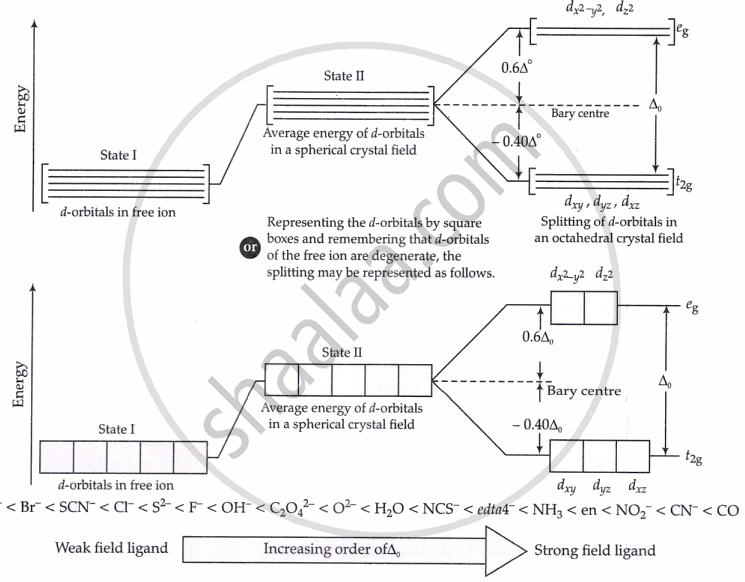
If Δ₀ < P, 4th electron will enter eg giving the configuration \[t_{2g}^3e_{g}^1.\] Ligands for which Δ₀ < P are called weak field ligands.
If Δ₀ > P, pairing will occur in the t2g orbitals and eg orbitals will remain vacant. So, the configuration for 4th e⁻ will be \[t_{2g}^4e_{g}^0.\]. For Δ₀ > P, ligands are strong field ligands.
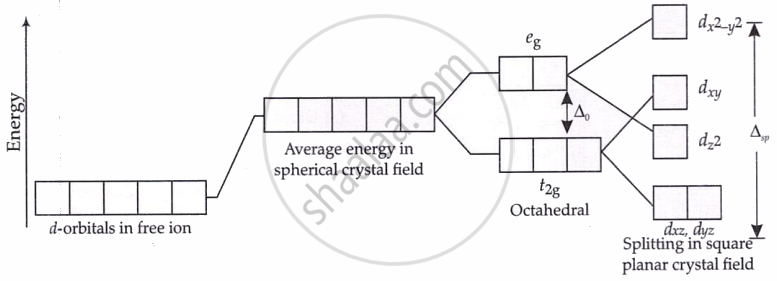
Splitting of d-orbitals in a square planar crystal field:
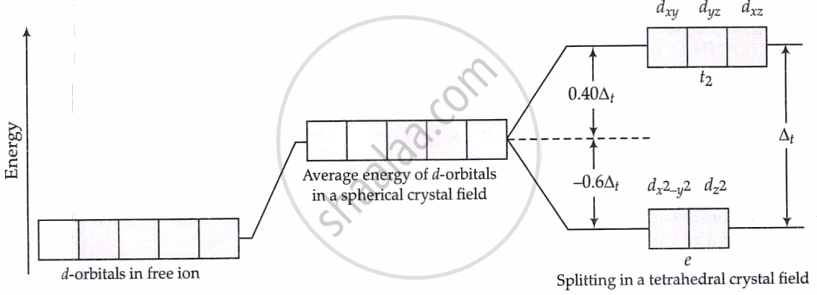
Splitting of d-orbital in a tetrahedral crystal field:
| No. | Application | Description / Key Point | Example |
|---|---|---|---|
| 1 | Qualitative Analysis | Used for the detection of metal ions | Ni²⁺ + DMG → Ni-DMG (red ppt) |
| 2 | Gravimetric Analysis | Metal ions are estimated by forming stable complexes | Conversion into stable coordination compounds |
| 3 | Volumetric Analysis | EDTA is used as a chelating agent in titrations | Estimation of Ca²⁺, Mg²⁺, Zn²⁺ |
| 4 | Biological Systems | Essential role in living organisms | Haemoglobin (Fe²⁺), Chlorophyll (Mg), Vitamin B₁₂ (Co) |
| 5 | Medicinal Uses | Used in the treatment of diseases | Cis-platin [Pt(NH₃)₂Cl₂] (anti-cancer) |
| 6 | Qualitative Separation | Separation based on the stability of complexes | Cu²⁺ & Cd²⁺ via cyanide complexes |
| 7 | Photography | Dissolution of AgBr using complex formation | [Ag(S₂O₃)₂]³⁻ (hypo solution) |
| 8 | Hydrometallurgy | Extraction of metals using complexes | [Ag(CN)₂]⁻, [Au(CN)₂]⁻ |
| 9 | Electroplating | Provides smooth and uniform coating | Metal deposition using complexes |
- In coordination compounds, d-orbitals split into t₂g (lower) and eg (higher) energy levels due to the ligand field.
- The energy difference between them is called the crystal field splitting energy (Δ₀).
- This Δ₀ lies in the visible region, so these compounds absorb visible light.
- When light is absorbed, an electron jumps from t₂g → eg, called a d–d transition.
- The observed colour is complementary to the colour of light absorbed.
- The energy relation is: E = hν = Δ₀.
- Metal ions with d¹–d⁹ configuration are coloured, while d⁰ and d¹⁰ are colourless.
- Some compounds (e.g., KMnO₄) show colour due to charge transfer (LMCT), not d–d transition.
- Ligand strength affects colour: strong field ligands ↑ Δ₀, weak ligands ↓ Δ₀.
- Geometry affects splitting: tetrahedral complexes have smaller splitting
Δₜ = 4/9 Δ₀ (e.g., Co²⁺: pink → blue change).
Concepts [12]
- Concept of Coordination Compounds
- Types of Ligands
- Terms Used in Coordination Chemistry
- Classification of Complexes
- Nomenclature of Coordination Compounds
- Effective Atomic Number (EAN) Rule
- Isomerism in Coordination Compounds
- Stability of Coordination Compounds
- Valence Bond Theory (VBT)
- Crystal Field Theory (CFT)
- Importance and Applications of Coordination Compounds
- Colour in Coordination Compounds
