Definitions [1]
Parallel lines are straight lines that never intersect and remain at a constant distance from each other.
They are denoted by the symbol “∥”, meaning ‘is parallel to’.
Examples: Railroad tracks, Zebra crossings, Staircase steps
Theorems and Laws [3]
If a transversal intersects two parallel lines, then each pair of corresponding angles is equal.
This is also referred to as the corresponding angles axiom.
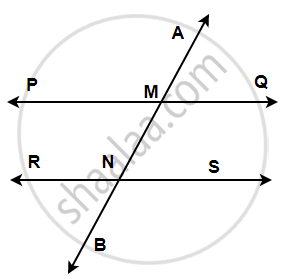
Given: Two Parallel lines PQ and RS.
Let AB be the transversal intersecting PQ at M and RS and N.
To Prove: Each pair of corresponding angles are equal.
i.e., ∠ AMP ≅ ∠ MNR, ∠ PMN ≅ ∠ RNB,
and ∠ AMQ ≅ ∠ MNS, ∠ QMN ≅ ∠ SNB.
Proof:
First, we will prove ∠ AMP ≅ ∠ MNR.
For lines PQ and RS with transversal AB,
∠QMN = ∠MNR ......(Alternate Interior angles)(1)
For lines PQ and AB,
∠AMP = ∠QMN .......(Vertically opposite angles)(2)
From (1) and (2),
∠AMP = ∠MNR
Similarly, we can prove that
∠ PMN ≅ ∠ RNB,
∠ AMQ ≅ ∠ MNS,
∠ QMN ≅ ∠ SNB.
Hence, Each pair of corresponding angles are equal.
If a Transversal Intersects Two Parallel Lines, Then Each Pair of Alternate Interior Angles Are Equal.
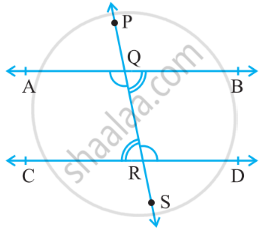
Given: Two parallel lines AB and CD.
Let PS be the transversal intersecting AB at Q and CD at R.
To Prove: Each pair of alternate interior angles are equal.
i.e., ∠BQR = ∠ CRQ
and ∠ AQR = ∠ QRD.
Proof:
First, we will prove ∠ BQR = ∠ CRQ.
For lines AB & CD, with transversal PS.
∠ AQP = ∠ CRQ .....(Corresponding angles)(1)
For lines AB & PS,
∠ AQP = ∠ BQR ......(Vertically opposite angles)(2)
From (1) and (2),
∠ BQR = ∠ CRQ
Similarly, we can prove
∠ AQR = ∠ QRD
Hence, Pair of alternate interior angles are equal.
Hence proved.
If a Transversal Intersects Two Parallel Lines, Then Each Pair of Interior Angles on the Same Side of the Transversal is Supplementary.

Given: Two parallel lines AB and CD and a transversal PS intersecting AB at Q and CD at R.
To Prove: Sum of interior angles on the same side of transversal is supplementary.
i.e., ∠ AQR + ∠ CRQ = 180°.
and ∠ BQR + ∠ DRQ = 180°.
Proof:
For lines AB and CD, with transversal PS
∠ AQP = ∠ CRQ .....(Corresponding angles)(1)
For lines PS,
∠ AQP + ∠ AQR = 180°. .....(Linear pair)(2)
Putting (1) in (2),
∠ AQP + ∠ CRQ = 180°.
Similarly,
We can prove, ∠ BQR + ∠ DRQ = 180°.
Hence, the sum of interior angles on the same side of transversal is 180°.
Hence proved.
