Definitions [5]
Parallel lines are straight lines that never intersect and remain at a constant distance from each other.
They are denoted by the symbol “∥”, meaning ‘is parallel to’.
Examples: Railroad tracks, Zebra crossings, Staircase steps
Angle: An angle consists of two rays that originate from a single initial point. An angle is represented by the symbol ∠.
Arms of an Angle: The two rays forming the angle are called the arms or sides of the angle.
Vertex: The vertex of the angle is the common initial point of two rays.
Example:
The vertex of the angle is the common initial point of two rays.
The two rays forming the angle are called the arms or sides of the angle.
An angle consists of two rays that originate from a single initial point. An angle is represented by the symbol ∠.
Theorems and Laws [3]
If a Transversal Intersects Two Parallel Lines, Then Each Pair of Interior Angles on the Same Side of the Transversal is Supplementary.

Given: Two parallel lines AB and CD and a transversal PS intersecting AB at Q and CD at R.
To Prove: Sum of interior angles on the same side of transversal is supplementary.
i.e., ∠ AQR + ∠ CRQ = 180°.
and ∠ BQR + ∠ DRQ = 180°.
Proof:
For lines AB and CD, with transversal PS
∠ AQP = ∠ CRQ .....(Corresponding angles)(1)
For lines PS,
∠ AQP + ∠ AQR = 180°. .....(Linear pair)(2)
Putting (1) in (2),
∠ AQP + ∠ CRQ = 180°.
Similarly,
We can prove, ∠ BQR + ∠ DRQ = 180°.
Hence, the sum of interior angles on the same side of transversal is 180°.
Hence proved.
If a transversal intersects two parallel lines, then each pair of corresponding angles is equal.
This is also referred to as the corresponding angles axiom.
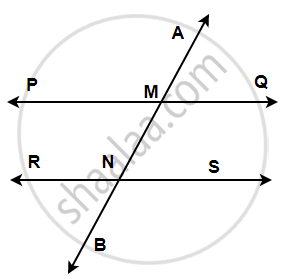
Given: Two Parallel lines PQ and RS.
Let AB be the transversal intersecting PQ at M and RS and N.
To Prove: Each pair of corresponding angles are equal.
i.e., ∠ AMP ≅ ∠ MNR, ∠ PMN ≅ ∠ RNB,
and ∠ AMQ ≅ ∠ MNS, ∠ QMN ≅ ∠ SNB.
Proof:
First, we will prove ∠ AMP ≅ ∠ MNR.
For lines PQ and RS with transversal AB,
∠QMN = ∠MNR ......(Alternate Interior angles)(1)
For lines PQ and AB,
∠AMP = ∠QMN .......(Vertically opposite angles)(2)
From (1) and (2),
∠AMP = ∠MNR
Similarly, we can prove that
∠ PMN ≅ ∠ RNB,
∠ AMQ ≅ ∠ MNS,
∠ QMN ≅ ∠ SNB.
Hence, Each pair of corresponding angles are equal.
If a Transversal Intersects Two Parallel Lines, Then Each Pair of Alternate Interior Angles Are Equal.
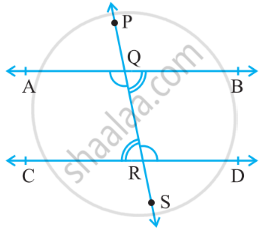
Given: Two parallel lines AB and CD.
Let PS be the transversal intersecting AB at Q and CD at R.
To Prove: Each pair of alternate interior angles are equal.
i.e., ∠BQR = ∠ CRQ
and ∠ AQR = ∠ QRD.
Proof:
First, we will prove ∠ BQR = ∠ CRQ.
For lines AB & CD, with transversal PS.
∠ AQP = ∠ CRQ .....(Corresponding angles)(1)
For lines AB & PS,
∠ AQP = ∠ BQR ......(Vertically opposite angles)(2)
From (1) and (2),
∠ BQR = ∠ CRQ
Similarly, we can prove
∠ AQR = ∠ QRD
Hence, Pair of alternate interior angles are equal.
Hence proved.
Concepts [10]
- Concept of Transversal Lines
- Interior Angle Theorem
- Corresponding Angle Theorem
- Alternate Angles Theorems
- Parallel Lines
- Test for Parallel Lines
- Interior Angles Test
- Angles and Their Measurement in Higher Mathematics
- Corresponding Angles Test
- Corollary of Parallel Lines
