- When light strikes the boundary between two transparent media, it undergoes partial reflection and partial refraction.
- A ray passing from a rarer to a denser medium bends towards the normal, while one passing from a denser to a rarer medium bends away from the normal.
- The angles of incidence and refraction are generally unequal, causing light to bend.
- A ray incident normally (i = 0°) passes undeviated, even though its speed changes.
- Refraction occurs due to a change in the speed of light when it passes from one medium to another.
Definitions [16]
Definition: Refraction of Light
When travelling obliquely from one medium to another, the direction of propagation of light in the second medium changes. This phenomenon is known as refraction of light.
OR
Light changes its direction when going from one transparent medium to another transparent medium. This is called the refraction of light.
OR
The bending of the light ray from its path in passing from one medium to the other medium is called 'refraction' of light.
Definition: Refracted Light
Refracted light is the part of light enters into the other medium and travels in a straight path but in a direction different from its initial direction and is called the refracted light.
Define the principal focus of a concave mirror.
Light rays that are parallel to the principal axis of a concave mirror converge at a specific point on its principal axis after reflecting from the mirror. This point is known as the principal focus of the concave mirror.
Definition: Refraction
The change in the direction of the path of light when it passes from one transparent medium to another transparent medium is called refraction. The refraction of light is essentially a surface phenomenon.
Definition: Lateral Displacement
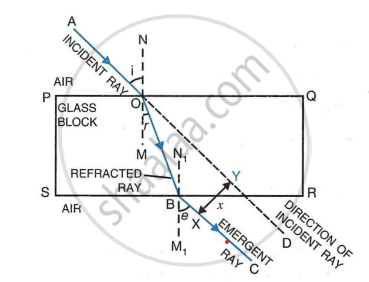
The perpendicular distance XY between the path of the emergent ray BC and the direction of the incident ray OD is called the lateral displacement.
Define the term refractive index of a medium in terms of velocity of light.
It is defined as the ratio of the velocity of light in medium 1 to the velocity of light in medium 2.
Define the absolute refractive index of a medium.
The absolute refractive index is the ratio of the velocity of light in a vacuum to that of the medium.
Definition: Critical Angle
Critical angle is the angle of incidence in the denser medium corresponding to which the angle of refraction in the rarer medium is 90°.
Definition: Total Internal Reflection
The phenomenon where light rays are completely reflected back into a medium instead of being refracted into another medium is called total internal reflection.
Define critical angle for a given medium.
When a ray of light propagates from a denser medium to a rarer medium, the angle of incidence for which the angle of refraction is 90° is called the critical angle.
Definition: Critical Angle
The angle of incidence in the denser medium corresponding to an angle of refraction of 90° in the rarer medium is called the critical angle.
Definition: Critical Angle
The critical angle for two given media is the angle of incidence in the denser medium for which the angle of refraction in the rarer medium is 90°.
Definition: Lateral Shift
“The perpendicular distance between the emergent ray and the direction of the incident ray is called the lateral shift.”
Definition: Relative Refractive Index
When the velocity of light in a medium is compared with that in another medium, the parameter is called the relative refractive index.
Definition: Refractive Index
The refractive index of a medium is the parameter that tells how much slower light travels in that medium compared to vacuum.
Mathematically,
n = \[\frac{\text{velocity of light in vacuum}}{\text{velocity of light in medium}}=\frac{c}{v}\]
where c = 3 × 10⁸ ms-1.
Definition: Total Internal Reflection
When a ray of light, travelling from a denser medium to a rarer medium, is incident at the interface of the two media at an angle greater than the critical angle for the two media, the ray is 'totally' reflected back into the denser medium.
Formulae [4]
Formula: Refractive Index
\[^1n_2=\frac{v_1}{v_2}=\frac{n_2}{n_1}\]
Formula: Lateral Shift
Lateral shift (d) = t sin (i − r) sec r
Formula: Relative Refractive Index Ratio
\[^2n_3=\frac{n_3}{n_2}\]
Formula: Critical Angle Formula
\[_1n_2=\frac{1}{\sin C}\cdot\]
Theorems and Laws [2]
A ray of light moves from a rare medium to a dense medium as shown in the diagram below. Write down the number of the ray which represents the partially reflected ray.

Ray 2 shows partially reflected ray.
Law: Principle of Reversibility of Light
Statement
When a light ray, after undergoing any number of reflections and refractions, has its direction reversed, it retraces its entire original path. This is called the principle of reversibility of light.
Explanation / Proof
Consider a light ray passing from medium 1 to medium 2 and suffering refraction at the boundary.
Let the angle of incidence be i and the angle of refraction be r.
By Snell’s law, the refractive index of medium 2 with respect to medium 1 is:
1n2 = \[\frac {sin i}{sin r}\]
Now, suppose the refracted ray is reflected back and retraces the path in the reverse direction. In this case, the angle of incidence becomes r, and the angle of refraction becomes i.
Again, by Snell’s law, the refractive index of medium 1 with respect to medium 2 is:
2n1 = \[\frac {sin r}{sin i}\]
Multiplying the two equations:
1n2 × 2n1 = 1
This shows that the ray follows the same path in the reverse direction, proving the reversibility of the light path.
Conclusion
Hence, a light ray always retraces its original path when its direction is reversed, even after multiple reflections and refractions. This establishes the principle of reversibility of light.
Key Points
Key Points: Refraction of Light
Key Points: Laws of Refraction
Key Points: Refraction of Light Through a Rectangular Glass Block
Key Points: Physical Significance of Refractive Index
- Refractive index indicates the direction of bending of light at a boundary (towards or away from the normal).
- It gives the ratio of the speeds of light in vacuum and in the medium:
n = \[\frac {c}{v}\]So, a higher refractive index means a lower speed of light in the medium. - The frequency of light remains unchanged during refraction, but the wavelength changes; hence, the refractive index also gives information about the wavelength of light in a medium.
Key Points: Real & Apparent Depth
- An object in a denser medium appears raised when viewed from a rarer medium due to refraction.
- Real depth is the actual depth of the object; apparent depth is the depth at which it appears.
- Refractive index is given by:
n = \[\frac{\text{Real depth}}{\text{Apparent depth}}\] - Normal displacement is the difference between real and apparent depths:
d = Real depth − Apparent depth - For a medium of thickness t:
d = t (1 − \[\frac {1}{n}\])
Key Points: Cause of Refraction
- Refraction occurs due to a change in the speed of light when it passes from one medium to another.
- The greater the change in speed, the greater is the bending of light at the boundary of the two media.
- According to Snell’s law:
If v1 > v2, the ray bends towards the normal (rarer to denser medium).
If v1 < v2, the ray bends away from the normal (denser to rarer medium).
Key Points: Applications of Total Internal Reflection
- Mirage is caused by total internal reflection in hot air layers, making objects appear inverted, as in water reflections.
- Diamonds sparkle because light undergoes repeated total internal reflections due to their small critical angle.
- Totally reflecting prisms use total internal reflection to reflect light efficiently.
- Right-angled prisms can turn light by 90° or 180° using total internal reflection.
- Prisms are better than mirrors because they reflect almost all light and produce clear images.
- Optical fibres guide light by total internal reflection and are used in communication and medical imaging.
Important Questions [3]
Concepts [12]
- Refraction of Light
- Laws of Refraction
- Cause of Refraction
- Physical Significance of Refractive Index
- Reversibility of Light
- Refraction of Light Through a Rectangular Glass Block
- Refraction through Parallel Multiple Media
- Real and Apparent Depths: Normal Displacement
- Critical Angle
- Total Internal Reflection
- Applications of Total Internal Reflection
- Overview: Refraction of Light at a Plane Interface
