Definitions [2]
Define a triangle.
A plane figure bounded by three lines in a plane is called a triangle. The figure below represents a ΔABC, with AB, AC andBC as the three line segments.

A triangle (denoted by the symbol △) is the simplest closed shape in geometry. It is a two-dimensional figure made by connecting three points that do not lie on the same straight line (non-collinear).
Theorems and Laws [6]
In the adjoining figure, QX and RX are the bisectors of the angles Q and R respectively of the triangle PQR.
If XS ⊥ QR and XT ⊥ PQ;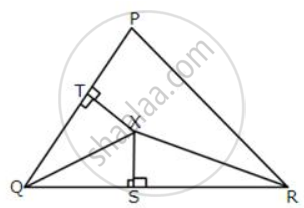
Prove that:
- ΔXTQ ≅ ΔXSQ.
- PX bisects angle P.
Given: A(ΔPQR) in which QX is the bisector of ∠Q and RX is the bisector of ∠R.
XS ⊥ QR and XT ⊥ PQ.
We need to prove that:
- ΔXTQ ≅ ΔXSQ.
- PX bisects angle P.
Construction: Draw XZ ⊥ PR and join PX.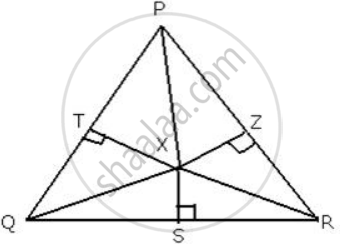
i. In ΔXTQ and ΔXSQ,
∠QTX = ∠QSX = 90° ...[XS ⊥ QR and XT ⊥ PQ]
∠TQX = ∠SQX ...[QX is bisector of ∠Q]
QX = QX ...[Common]
∴ By Angle-Side-Angle Criterion of congruence,
ΔXTQ ≅ ΔXSQ
ii. The corresponding parts of the congruent triangles are congruent.
∴ XT = XS ...[c.p.c.t.]
In ΔXSR and ΔXRZ
∠XSR = ∠XZR = 90° ...[XS ⊥ QR and ∠XSR = 90°]
∠XRS = ∠ZRX ...[RX is bisector of ∠R]
RX = RX ....[Common]
∴ By Angle-Angle-Side criterion of congruence,
ΔXSR ≅ ΔXRZ
The corresponding parts of the congruent triangles are congruent.
∴ XS = XT ...[c.p.c.t.]
From (1) and (2)
XT = XZ
In ΔXTP and ΔPZX
∠XTP = ∠XZP = 90° ....[Given]
XP = XP ....[Common]
XT = XZ
∴ By Right angle-Hypotenuse-side criterion of congruence,
ΔXTP ≅ ΔPZX
The corresponding parts of the congruent triangles are
congruent.
∴ ∠TPX = ∠ZPX ...[c.p.c.t.]
∴ PX bisects ∠P.
Angle Sum Property of a Triangle:
Theorem: The sum of the angles of a triangle is 180°.
Construction: Draw a line XPY parallel to QR through the opposite vertex P.
Proof:
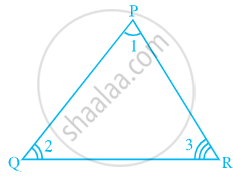
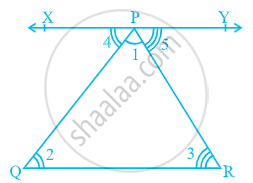
In △ PQR,
Sum of all angles of a triangle is 180°.
∠PQR + ∠PRQ + ∠QPR = 180°......(1)
Since XY is a straight line, it can be concluded that:
Therefore, ∠XPY + ∠QRP + ∠RPY = 180°.
But XPY || QR and PQ, PR are transversals.
So,
∠XPY = ∠PQR.....(Pairs of alternate angles)
∠RPY = ∠PRQ.....(Pairs of alternate angles)
Substituting ∠XPY and ∠RPY in (1), we get
∠PQR + ∠PRQ + ∠QPR = 180°
Thus, The sum of the angles of a triangle is 180°.
Line segment joining the mid-points M and N of parallel sides AB and DC, respectively of a trapezium ABCD is perpendicular to both the sides AB and DC. Prove that AD = BC.
Given: In trapezium ABCD, points M and N are the mid-points of parallel sides AB and DC respectively and join MN, which is perpendicular to AB and DC.
To prove: AD = BC
Proof: Since, M is the mid-point of AB.
∴ AM = MB
Now, in ΔAMN and ΔBMN,
AM = MB ...[Proved above]
∠3 = ∠4 ...[Each 90°]
MN = MN ...[Common side]
∴ ΔAMN ≅ ΔBMN ...[By SAS congruence rule]
∴ ∠1 = ∠2 ...[By CPCT]
On multiplying both sides of above equation by –1 and then adding 90° both sides, we get
90° – ∠1 = 90° – ∠2
⇒ ∠AND = ∠BNC ...(i)
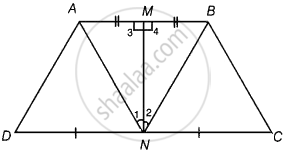
Now, in ΔADN and ΔBCN,
∠AND = ∠BNC ...[From equation (i)]
AN = BN ...[∵ΔAMN ≅ ΔBMN]
And DN = NC ...[∵ N is the mid-point of CD (given)]
∴ ΔADN ≅ ΔBCN ...[By SAS congruence rule]
Hence, AD = BC ...[By CPCT]
Hence proved.
Theorem (SSS congruence rule) : If three sides of one triangle are equal to the three sides of another triangle, then the two triangles are congruent.
Construct two right angled triangles with hypotenuse equal to 5 cm and one side equal to 4 cm each in following fig.
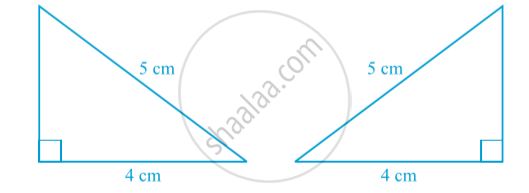
The two triangles cover each other completely and so they are congruent.
Note that, the right angle is not the included angle in this case.
Theorem (RHS congruence rule) : If in two right triangles the hypotenuse and one side of one triangle are equal to the hypotenuse and one side of the other triangle, then the two triangles are congruent.
Note that RHS stands for Right angle - Hypotenuse - Side.
Prove that the perimeter of a triangle is greater than the sum of its three medians.
Given: ΔABC is on which AD, BE and CF are its medians.
To Prove: We know that the sum of any two sides of a triangle is greater than twice the median bisecting the third side.
Therefore, AD is the median bisecting BC
⇒ AB + AC > 2AD ...(i)
BE is the median bisecting AC ...(ii)
And CF is the median bisecting AB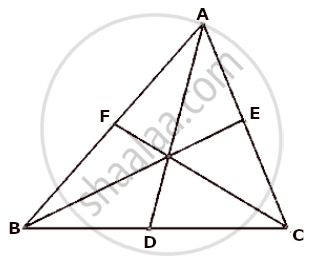
⇒ BC + AC > 2EF ...(iii)
Adding (i), (ii) and (iii), we get
(AB + AC) + (AB + BC) + (BC + AC) > 2. AD + 2 . BE + 2 . BE + 2 . CF
⇒ 2 (AB + BC + AC) > 2 (AD + BE + CF)
⇒ AB + BC + AC > AD + BE + CF.
Theorem : If two sides of a triangle are unequal, the angle opposite to the longer side is larger (or greater).
Activity : Draw a line-segment AB. With A as centre and some radius, draw an arc and mark different points say P, Q, R, S, T on it. Join each of these points with A as well as with B in following fig .
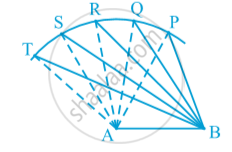
Observe that as we move from P to T, ∠ A is becoming larger and larger. The length of the side is also increasing; that is ∠ TAB > ∠ SAB > ∠ RAB > ∠ QAB > ∠ PAB and TB > SB > RB > QB > PB.
Now, draw any triangle with all angles unequal to each other. Measure the lengths of the sides in following fig.
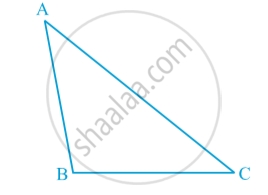
Observe that the side opposite to the largest angle is the longest. In Fig , ∠ B is the largest angle and AC is the longest side.
Theorem : In any triangle, the side opposite to the larger (greater) angle is longer.
Now take a triangle ABC and in it, find AB + BC, BC + AC and AC + AB.
You will observe that AB + BC > AC, BC + AC > AB and AC + AB > BC.
Theorem : The sum of any two sides of a triangle is greater than the third side.
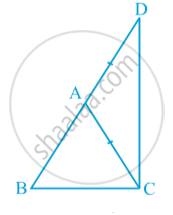
In above fig. the side BA of ∆ ABC has been produced to a point D such that AD = AC.
