Definitions [13]
Two figures are similar if they have the same shape but may differ in size.
- Same shape means: Corresponding angles are equal
-
May differ in size means: Corresponding sides are proportional
Two figures are congruent if they have the same shape and size.
Important relation:
- Congruent figures are always similar
- Similar figures are not necessarily congruent
SAS Congruence criterion: If under a correspondence, two sides and the angle included between them of a triangle are equal to two corresponding sides and the angle included between them of another triangle, then the triangles are congruent.
ASA Congruence criterion: If under a correspondence, two angles and the included side of a triangle are equal to two corresponding angles and the included side of another triangle, then the triangles are congruent.
RHS Congruence criterion: If under a correspondence, the hypotenuse and one side of a right-angled triangle are respectively equal to the hypotenuse and one side of another right-angled triangle, then the triangles are congruent.
Two triangles are similar if
- Their corresponding angles are equal, and
- Their corresponding sides are proportional.
- Symbolically:
ΔABC ∼ ΔPQR (read as “ABC is similar to PQR”).
In similar triangles, the angles opposite to proportional sides are the corresponding angles, and so, they are equal.
-
∠A = ∠P
-
∠B = ∠Q
-
∠C = ∠R
In similar triangles, the sides opposite to equal angles are said to be the
corresponding sides.
ΔABC ∼ ΔPQR
\[\frac{AB}{PQ}=\frac{BC}{QR}=\frac{AC}{PR}\]
The line segment joining a vertex of a triangle to the midpoint of its opposite side is called a median of the triangle.
- The point where all three medians meet is called the centroid.
An altitude of a triangle is a straight line from one vertex, drawn perpendicular (at 90°) to the opposite side (or to its extension)
- Orthocentre: The altitudes of a triangle pass through exactly one point; that means they are concurrent. The point of concurrence is called the orthocentre.
A circumcircle is a circle that passes through all three vertices of a triangle. The three vertices lie on the boundary of the circle.
The circumcenter is the center point of the circumcircle. It is the unique point where all three perpendicular bisectors of the triangle's sides meet.
- The circumcenter is equidistant from all three vertices of the triangle.
The circumradius is the radius of the circumcircle. It is the distance from the circumcenter to any vertex of the triangle.
Theorems and Laws [7]
In the adjoining figure, QX and RX are the bisectors of the angles Q and R respectively of the triangle PQR.
If XS ⊥ QR and XT ⊥ PQ;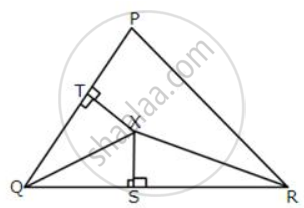
Prove that:
- ΔXTQ ≅ ΔXSQ.
- PX bisects angle P.
Given: A(ΔPQR) in which QX is the bisector of ∠Q and RX is the bisector of ∠R.
XS ⊥ QR and XT ⊥ PQ.
We need to prove that:
- ΔXTQ ≅ ΔXSQ.
- PX bisects angle P.
Construction: Draw XZ ⊥ PR and join PX.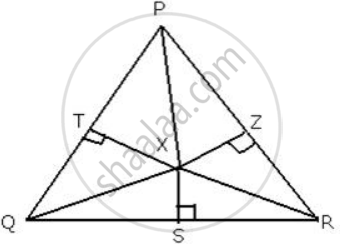
i. In ΔXTQ and ΔXSQ,
∠QTX = ∠QSX = 90° ...[XS ⊥ QR and XT ⊥ PQ]
∠TQX = ∠SQX ...[QX is bisector of ∠Q]
QX = QX ...[Common]
∴ By Angle-Side-Angle Criterion of congruence,
ΔXTQ ≅ ΔXSQ
ii. The corresponding parts of the congruent triangles are congruent.
∴ XT = XS ...[c.p.c.t.]
In ΔXSR and ΔXRZ
∠XSR = ∠XZR = 90° ...[XS ⊥ QR and ∠XSR = 90°]
∠XRS = ∠ZRX ...[RX is bisector of ∠R]
RX = RX ....[Common]
∴ By Angle-Angle-Side criterion of congruence,
ΔXSR ≅ ΔXRZ
The corresponding parts of the congruent triangles are congruent.
∴ XS = XT ...[c.p.c.t.]
From (1) and (2)
XT = XZ
In ΔXTP and ΔPZX
∠XTP = ∠XZP = 90° ....[Given]
XP = XP ....[Common]
XT = XZ
∴ By Right angle-Hypotenuse-side criterion of congruence,
ΔXTP ≅ ΔPZX
The corresponding parts of the congruent triangles are
congruent.
∴ ∠TPX = ∠ZPX ...[c.p.c.t.]
∴ PX bisects ∠P.
Theorem (ASA congruence rule) : Two triangles are congruent if two angles and the included side of one triangle are equal to two angles and the included side of other triangle.
Proof : We are given two triangles ABC and DEF in which:
∠ B = ∠ E, ∠ C = ∠ F
and BC = EF
We need to prove that ∆ ABC ≅ ∆ DEF
For proving the congruence of the two triangles see that three cases arise.
Case (i) : Let AB = DE in following fig.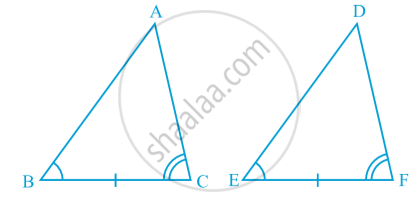
You may observe that
AB = DE (Assumed)
∠ B = ∠ E (Given)
BC = EF (Given)
So, ∆ ABC ≅ ∆ DEF (By SAS rule)
Case (ii) :
Let if possible AB > DE. So, we can take a point P on AB such that PB = DE. Now consider ∆ PBC and ∆ DEF in following fig.
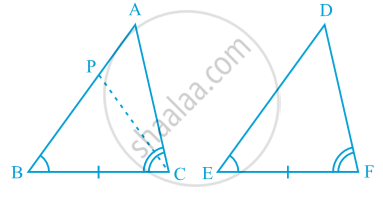
Observe that in ∆ PBC and ∆ DEF,
PB = DE (By construction)
∠ B = ∠ E (Given)
BC = EF (Given)
So, we can conclude that:
∆ PBC ≅ ∆ DEF, by the SAS axiom for congruence.
Since the triangles are congruent, their corresponding parts will be equal.
So, ∠ PCB = ∠ DFE
But, we are given that
∠ ACB = ∠ DFE So, ∠ ACB = ∠ PCB
This is possible only if P coincides with A.
or, BA = ED
So, ∆ ABC ≅ ∆ DEF (by SAS axiom)
Case (iii) : If AB < DE, we can choose a point M on DE such that ME = AB and repeating the arguments as given in Case (ii), we can conclude that AB = DE and so, ∆ ABC ≅ ∆ DEF.
You know that the sum of the three angles of a triangle is 180°. So if two pairs of angles are equal, the third pair is also equal (180° – sum of equal angles).
So, two triangles are congruent if any two pairs of angles and one pair of corresponding sides are equal. We may call it as the AAS Congruence Rule.
In the given figure, AD is a median of a triangle ABC and AM ⊥ BC. Prove that:
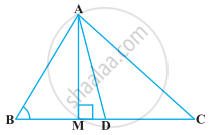
`"AC"^2 = "AD"^2 + "BC"."DM" + (("BC")/2)^2`
Applying Pythagoras theorem in ΔAMD, we obtain
AM2 + MD2 = AD2 … (1)
Applying Pythagoras theorem in ΔAMC, we obtain
AM2 + MC2 = AC2
AM2 + (MD + DC)2 = AC2
(AM2 + MD2) + DC2 + 2MD.DC = AC2
AD2 + DC2 + 2MD.DC = AC2 [Using equation (1)]
Using the result, DC = `"BC"/2`, we obtain
`"AD"^2+(("BC")/2)^2 + 2"MD".(("BC")/2) = "AC"^2`
`"AD"^2+(("BC")/2)^2 + "MC" xx "BC" = "AC"^2`
In the given figure, AD is a median of a triangle ABC and AM ⊥ BC. Prove that:
(i) `"AC"^2 = "AD"^2 + "BC"."DM" + (("BC")/2)^2`
(ii) `"AB"^2 = "AD"^2 - "BC"."DM" + (("BC")/2)^2`
(iii) `"AC"^2 + "AB"^2 = 2"AD"^2 + 1/2"BC"^2`
(i) Applying Pythagoras theorem in ΔAMD, we obtain
AM2 + MD2 = AD2 … (1)
Applying Pythagoras theorem in ΔAMC, we obtain
AM2 + MC2 = AC2
AM2 + (MD + DC)2 = AC2
(AM2 + MD2) + DC2 + 2MD.DC = AC2
AD2 + DC2 + 2MD.DC = AC2 [Using equation (1)]
Using the result, DC = `"BC"/2`, we obtain
`"AD"^2+(("BC")/2)^2 + 2"MD".(("BC")/2) = "AC"^2`
`"AD"^2+(("BC")/2)^2 + "MC" xx "BC" = "AC"^2`
(ii) Applying Pythagoras theorem in ΔABM, we obtain
AB2 = AM2 + MB2
= (AD2 − DM2) + MB2
= (AD2 − DM2) + (BD − MD)2
= AD2 − DM2 + BD2 + MD2 − 2BD × MD
= AD2 + BD2 − 2BD × MD
= `"AD"^2+(("BC")/2)^2 - 2(("BC")/2) xx "MD"`
= `"AD"^2 + ("BC"/2)^2 - "BC" xx "MD"`
(ii) Applying Pythagoras theorem in ΔABM, we obtain
AM2 + MB2 = AB2 … (1)
Applying Pythagoras theorem in ΔAMC, we obtain
AM2 + MC2 = AC2 … (2)
Adding equations (1) and (2), we obtain
2AM2 + MB2 + MC2 = AB2 + AC2
2AM2 + (BD − DM)2 + (MD + DC)2 = AB2 + AC2
2AM2+BD2 + DM2 − 2BD.DM + MD2 + DC2 + 2MD.DC = AB2 + AC2
2AM2 + 2MD2 + BD2 + DC2 + 2MD (− BD + DC)
= AB2 + AC2
= `2("AM"^2 + "MD"^2) + (("BC")/2)^2 + (("BC")/2)^2 + 2"MD" ((-"BC")/2 + ("BC")/2) = "AB"^2 + "AC"^2`
`"2AD"^2 + ("BC"^2)/2 = "AB"^2 + "AC"^2`
In the given figure, ∆ABC is an obtuse triangle, obtuse-angled at B. If AD ⊥ CB (produced) prove that AC2 = AB2 + BC2 + 2BC · BD.
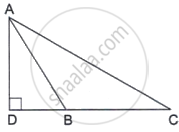
Given: An obtuse triangle ABC, obtuse-angled at B and AD is perpendicular to CB produced.
To Prove: AC2 = AB2 + BC2 + 2BC × BD
Proof: Since ∆ADB is a right triangle right angled at D. Therefore, by
Pythagoras theorem, we have AB2 = AD2 + DB2 ….(i)
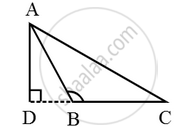
Again ∆ADC is a right triangle right angled at D.
Therefore, by Phythagoras theorem, we have
AC2 = AD2 + DC2
⇒ AC2 = AD2 + (DB + BC)2
⇒ AC2 = AD2 + DB2 + BC2 + 2BC • BD
⇒ AC2 = AB2 + BC2 + 2BC • BD [Using (i)]
Hence, AC2 = AB2 + BC2 + 2BC • BD
Prove that, in a right-angled triangle, the square of the hypotenuse is equal to the sum of the square of remaining two sides.
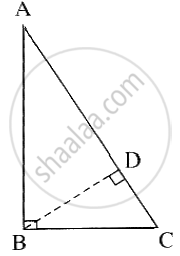
Draw perpendicular BD from the vertex B to the side AC. A – D
In right-angled ΔABC
seg BD ⊥ hypotenuse AC.
∴ By the similarity in right-angled triangles
ΔABC ~ ΔADB ~ ΔBDC
Now, ΔABC ~ ΔADB
∴ `"AB"/"AD" = "AC"/"AB"` ...(c.s.s.t)
∴ AB2 = AC × AD ...(1)
Also, ΔABC ~ ΔBDC
∴ `"BC"/"DC" = "AC"/"BC"` ...(c.s.s.t)
∴ BC2 = AC × DC ...(2)
From (1) and (2),
AB2 + BC2 = AC × AD + AC × DC
= AC × (AD + DC)
= AC × AC ...(A – D – C)
∴ AB2 + BC2 = AC2
i.e., AC2 = AB2 + BC2
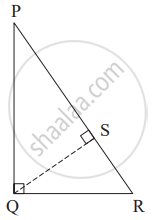
Given: In ΔPQR, ∠PQR = 90°.
To prove: PR2 = PQ2 + QR2.
Construction:
Draw seg QS ⊥ side PR such that P–S–R.
Proof: In ΔPQR,
∠PQR = 90° ...(Given)
Seg QS ⊥ hypotenuse PR ...(Construction)
∴ ΔPSQ ∼ ΔQSR ∼ ΔPQR ...(Similarity of right-angled triangles) ...(1)
ΔPSQ ∼ ΔPQR ...[From (1)]
∴ `"PS"/"PQ" = "PQ"/"PR"` ...(Corresponding sides of similar triangles are in proportion)
∴ PQ2 = PS × PR ...(2)
ΔQSR ∼ ΔPQR ...[From (1)]
∴ `"SR"/"QR" = "QR"/"PR"` ...(Corresponding sides of similar triangles are in proportion)
∴ QR2 = SR × PR ...(3)
Adding (2) and (3), we get
PQ2 + QR2 = PS × PR + SR × PR
∴ PQ2 + QR2 = PR(PS + SR)
∴ PQ2 + QR2 = PR × PR ...(P–S–R)
∴ PQ2 + QR2 = PR2 OR PR2 = PQ2 + QR2.
In the given figure, triangle PQR is right-angled at Q. S is the mid-point of side QR. Prove that QR2 = 4(PS2 – PQ2).

Given: In triangle PQR, ∠PQR = 90° and S is the mid-point of QR.
To prove: QR2 = 4(PS2 – PQ2)
in right-angled ΔPQS, by Pythagoras theorem,
PQ2 + QS2 = PS2
⇒ QS2 = PS2 – PQ2 .......(i)
Since S is the mid-point of side QR,
∴ QS = `(QR)/2`
Substituting the value of QS in equation (i),
`((QR)/2)^2 = PS^2 - PQ^2`
`(QR^2)/4 = PS^2 - PQ^2`
QR2 = 4(PS2 – PQ)2
Hence proved.
Key Points
-
AA / AAA → two angles equal
-
SAS → included angle equal + sides proportional
-
SSS → all sides proportional
Concepts [37]
- Similarity and Congruency of Figures
- Congruence of Triangles
- Criteria for Congruence of Triangles
- Criteria for Similarity of Triangles
- SAS Congruence Criterion
- ASA Congruence Criterion
- RHS Congruence Criterion
- Similarity of Triangles (Corresponding Sides & Angles)
- Right-angled Triangles and Pythagoras Property
- Converse of Pythagoras Theorem
- Point of Concurrency
- Median of a Triangle
- Altitudes of a Triangle
- Perpendicular Bisectors of a Triangle
- Circumcircle of a Triangle
- The Property of the Angle Bisectors of a Triangle
- Constructing a Quadrilateral When the Lengths of Four Sides and a Diagonal Are Given
- Constructing a Quadrilateral When Two Diagonals and Three Sides Are Given
- Construct a Quadrilateral When Its Four Sides and One Angle Are Given.
- Constructing a Quadrilateral When Three Sides and Two Included Angles Are Given
- Constructing a Quadrilateral When Two Adjacent Sides and Three Angles Are Known
- Constructing a trapezium when its three sides and one diagonal are given
- Constructing a Trapezium When Its Three Sides and One Angle Are Given
- Constructing a Trapezium When Its Two Sides and Two Angles Are Given.
- Constructing a Trapezium When Its Four Sides Are Given.
- Constructing a Parallelogram When Its Two Adjacent Sides and One Angle Are Given.
- Constructing a Parallelogram When Its Two Adjacent Sides and One Diagonal Are Given.
- Constructing a Parallelogram When Its Two Diagonals and One Included Angle Are Given.
- Constructing a Parallelogram When Its One Side, One Diagonal and One Angle Are Given.
- Construction of a Rhombus When One Side and One Diagonal Are Given.
- Construction of a Rhombus When One Side and One Angle Are Given.
- Construction of a Rhombus When Two Diagonals Are Given.
- Construction of a Rhombus When One Diagonal and One Angle Are Given.
- Construction of a Rectangle When Its Length and Breadth Are Given.
- Construction of a Rectangle When a Side and a Diagonal Are Given.
- Construction of a Square When Its Side is Given.
- Construction of a Square When Its Diagonal is Given.
