Definitions [8]
A parabola is the locus of a point which moves in a plane such that its distance from a fixed point (i.e. focus) is always equal to its distance from a fixed straight line (i.e. directrix).
Latus rectum of a parabola is a line segment perpendicular to the axis of the parabola, through the focus and whose end points lie on the parabola in following fig.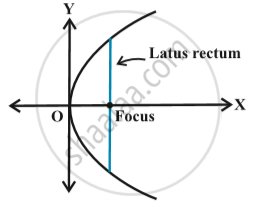
To find the Length of the latus rectum of the parabola `y^2` = 4ax in following fig.
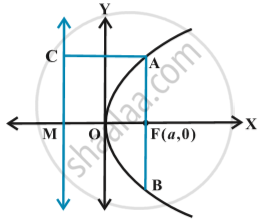
By the definition of the parabola, AF = AC.
But AC = FM = 2a
Hence AF = 2a.
And since the parabola is symmetric with respect to x-axis AF = FB and so
AB = Length of the latus rectum = 4a.
The eccentricity of an ellipse is the ratio of the distances from the centre of the ellipse to one of the foci and to one of the vertices of the ellipse (eccentricity is denoted by e) i.e., e = `c/a.`
Then since the focus is at a distance of c from the centre, in terms of the eccentricity the focus is at a distance of ae from the centre.
An ellipse is the set of all points in a plane, the sum of whose distances from two fixed points in the plane is constant.
Latus rectum of an ellipse is a line segment perpendicular to the major axis through any of the foci and whose end points lie on the ellipse in following fig.
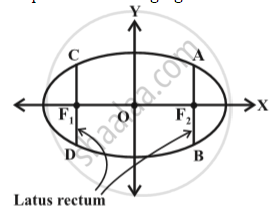
To find the length of the latus rectum of the ellipse `x^2/a^2 + y^2/b^2 = 1`
Let the length of `AF_2` be l.
Then the coordinates of A are (c, l ),i.e., (ae, l )
Since A lies on the ellipse `x^2/a^2 + y^2/b^2 = 1`,
`(ae)^2/a^2+l^2/b^2=1`
`=> l^2 = b^2(1-e^2)`
But `e^2 = c^2/a^2 = (a^2 - b^2)/a^2 = 1- b^2/a^2`
Therefore `l^2 = b^4/a^2, i.e., l = b^2/a`
Since the ellipse is symmetric with respect to y-axis ,`AF_2` = `F_2B` and so length of the latus rectum is `(2b)^2/a.`
A hyperbola is the locus of a point in a plane which moves in such a way that the ratio of its distance from a fixed point (i.e. focus) to its distance from a fixed line (i.e. directrix) is always constant and greater than unity.
Just like an ellipse, the ratio e = `c/a`
is called the eccentricity of the hyperbola. Since c ≥ a, the eccentricity is never less than one. In terms of the eccentricity, the foci are at a distance of ae from the centre.
Latus rectum of hyperbola is a line segment perpendicular to the transverse axis through any of the foci and whose end points lie on the hyperbola. As in ellipse, it is easy to show that the length of the latus rectum in hyperbola is `(2b)^2/a`.
Key Points
| Property | y² = 4ax | y² = −4ax | x² = 4ay | x² = −4ay |
|---|---|---|---|---|
| Vertex | (0, 0) | (0, 0) | (0, 0) | (0, 0) |
| Focus | (a, 0) | (−a, 0) | (0, a) | (0, −a) |
| Directrix | x + a = 0 | x − a = 0 | y + a = 0 | y − a = 0 |
| Axis | y = 0 | y = 0 | x = 0 | x = 0 |
| Axis of Symmetry | X-axis | X-axis | Y-axis | Y-axis |
| Eccentricity | 1 | 1 | 1 | 1 |
| Latus Rectum Length | 4a | 4a | 4a | 4a |
| Endpoints of Latus Rectum | (a, ±2a) | (−a, ±2a) | (±2a, a) | (±2a, −a) |
| Equation of Latus Rectum | x = a | x = −a | y = a | y = −a |
| Tangent at Vertex | x = 0 | x = 0 | y = 0 | y = 0 |
| Parametric Equations | x = at², y = 2at | x = −at², y = 2at | x = 2at, y = at² | x = 2at, y = −at² |
| Parametric Point | (at², 2at) | (−at², 2at) | (2at, at²) | (2at, −at²) |
| Focal Distance of P(x₁,y₁) | x₁ + a | a − x₁ | y₁ + a | a − y₁ |
| Fundamental Terms | Horizontal Ellipse (a>b) | Vertical Ellipse (a<b) |
|---|---|---|
| Equation | \[\frac{x^{2}}{a^{2}}+\frac{y^{2}}{b^{2}}=1\] | \[\frac{x^{2}}{a^{2}}+\frac{y^{2}}{b^{2}}=1\] |
| Centre | (0,0) | (0,0) |
| Vertices | (±a,0) | (0,±b) |
| Length of major axis | 2a | 2b |
| Length of minor axis | 2b | 2a |
| Foci | (±ae,0) | (0, ±be) |
| Relation between (a,b,e) | \[\mathrm{b}^{2}=\mathrm{a}^{2}(1-\mathrm{e}^{2})\] | \[\mathbf{a}^{2}=\mathbf{b}^{2}(1-\mathbf{e}^{2})\] |
| Eccentricity | \[\mathrm{e}=\frac{\sqrt{\mathrm{a}^{2}-\mathrm{b}^{2}}}{\mathrm{a}}\] | \[\mathrm{e}=\frac{\sqrt{\mathrm{b}^{2}-\mathrm{a}^{2}}}{\mathrm{b}}\] |
| Equation of directrices | \[x=\pm\frac{\mathrm{a}}{\mathrm{e}}\] | \[y=\pm\frac{b}{e}\] |
| Distance between foci | 2ae | 2be |
| Distance between directrices | \[\frac{2a}{e}\] | \[\frac{2b}{e}\] |
| Length of latus rectum | \[\frac{2\mathrm{b}^2}{a}\] | \[\frac{2\mathrm{a}^2}{b}\] |
| Endpoints of the latus rectum | \[\left(\pm ae,\pm\frac{b^{2}}{a}\right)\] | \[\left(\pm\frac{a^{2}}{b},\pm be\right)\] |
| Equation of axes | Major: (y = 0), Minor: (x = 0) | Major: (x = 0), Minor: (y = 0) |
| Parametric equations | \[\begin{cases} x=a\cos\alpha \\ y=b\sin\alpha & \end{cases}\] | \[\begin{cases} x=a\cos\alpha \\ y=b\sin\alpha & \end{cases}\] |
| Focal distances | \[\mid SP\mid=\left(a-ex_{1}\right)\mathrm{and}\mid S^{\prime}P\mid=\left(a+ex_{1}\right)\] | \[\mid SP\mid=(b-ey_{1})\mathrm{~and}\mid S^{\prime}P\mid=(b+ey_{1})\] |
| Sum of focal radii | 2a | 2b |
| Equation of the tangent at the vertex | (x = ± a) | (y = ± b) |
| Property |
Standard Hyperbola \[\frac{x^{2}}{a^{2}}-\frac{y^{2}}{b^{2}}=1\] |
Conjugate Hyperbola \[\frac{y^{2}}{b^{2}}-\frac{x^{2}}{a^{2}}=1\] |
|---|---|---|
| Centre | (0, 0) | (0, 0) |
| Vertices | (±a, 0) | (0, ±b) |
| Transverse Axis Length | 2a | 2b |
| Conjugate Axis Length | 2b | 2a |
| Foci | (±ae, 0) | (0, ±be) |
| Eccentricity | \[\mathrm{e}=\frac{\sqrt{\mathrm{a}^{2}+\mathrm{b}^{2}}}{\mathrm{a}}\] | \[\mathrm{e}=\frac{\sqrt{\mathrm{b}^2+\mathrm{a}^2}}{\mathrm{b}}\] |
| Relation | \[\mathbf{b}^2=\mathbf{a}^2(\mathbf{e}^2-1)\] | \[\mathbf{a}^2=\mathbf{b}^2(\mathbf{e}^2-1)\] |
| Directrices | \[x=\pm\frac{\mathrm{a}}{\mathrm{e}}\] | \[y=\pm\frac{\mathrm{b}}{\mathrm{e}}\] |
| Length of Latus Rectum | \[\frac{2\mathrm{b}^2}{\mathrm{a}}\] | \[\frac{2\mathrm{a}^2}{\mathrm{b}}\] |
| Ends of Latus Rectum | \[\left(\pm ae,\pm\frac{b^{2}}{a}\right)\] | \[\left(\pm\frac{a^{2}}{b},\pm e\right)\] |
| Distance between Foci | 2ae | 2be |
| Difference of Focal Radii | 2a | 2b |
| Axis Equations | Transverse: y = 0, Conjugate: x = 0 | Transverse: x = 0, Conjugate: y = 0 |
| Parametric Equations | x = a secθ, y = b tanθ | x = a tanθ, y = b secθ |
| Parametric Point | (a secθ, b tanθ) | (a tanθ, b secθ) |
| Tangent at Vertex | x = ±a | y = ±b |
Concepts [12]
- Sections of a Cone
- Parabola and its types
- Latus Rectum
- Relationship Between Semi-major Axis, Semi-minor Axis and the Distance of the Focus from the Centre of the Ellipse
- Special Cases of an Ellipse
- Eccentricity
- Ellipse and its Types
- Latus Rectum
- Hyperbola and its Types
- Eccentricity
- Latus Rectum
- Standard Equation of a Circle
