Definitions [4]
Angle: An angle consists of two rays that originate from a single initial point. An angle is represented by the symbol ∠.
Arms of an Angle: The two rays forming the angle are called the arms or sides of the angle.
Vertex: The vertex of the angle is the common initial point of two rays.
Example:
The vertex of the angle is the common initial point of two rays.
The two rays forming the angle are called the arms or sides of the angle.
An angle consists of two rays that originate from a single initial point. An angle is represented by the symbol ∠.
Formulae [1]
\[sineA=\frac{\text{Perpendicular}}{\text{Hypotenuse}}\]
\[cosineA=\frac{\mathrm{Base}}{\text{Hypotenuse}}\]
\[tangentA=\frac{\text{Perpendicular}}{\mathrm{Base}}\]
\[cotangent A = \frac{\text{Base}}{\text{Perpendicular}}\]
\[secantA=\frac{\text{Hypotenuse}}{\mathrm{Base}}\]
\[cosecantA=\frac{\text{Hypotenuse}}{\text{Perpendicular}}\]
Theorems and Laws [17]
If `sin θ = 3/4` prove that `sqrt(("cosec"^2θ - cot^2θ)/(sec^2θ - 1)) = sqrt(7)/3`.
We have `sin theta = 3/4`
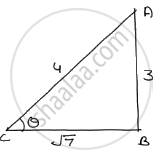
In ΔABC
`AC^2 = AB^2 + BC^2`
`=> (4)^2 = (3)^2 + BC^2`
`=> BC^2= 16 - 9`
`=> BC^2 = 7`
`=> BC = sqrt7`
`:. cosec theta = 4/3, sec theta = 4/sqrt7 and cot theta = sqrt7/3`
Now
L.H.S `sqrt((cosec^2 theta - cot^2 theta)/(sec^2 theta - 1))`
`= sqrt(((4/3)^2 - (sqrt7/3)^2)/((4/sqrt7)^2 - 1)`
`= sqrt((16/9 - 7/9)/(16/7 - 1)`
`=sqrt((9/9)/((16 - 7)/7 ))`
`= sqrt(7/9)`
`= sqrt7/3`
= R.H.S
If `tan θ = a/b` then prove that `((a sin theta - b cos theta)/(a sin theta + b cos theta)) = ((a^2 - b^2))/((a^2 + b^2))`.
Let `(a sin theta - b cos theta)/(a sin theta + b cos theta)`
Divide both Nr and Dr with cos θ of (a)
`((a sin theta - b cos theta)/cos theta)/((a sin theta + b cos theta)/cos theta)`
`= (tan theta - b)/(a tan theta + b)`
`=(a xx (a/b) - b)/(a xx (a/b) + b)`
`= (a^2 - b^2)/(a^2 + b^2)`
If `cot theta = 3/4`, prove that `sqrt((sec theta - cosec theta)/(sec theta + cosec theta)) = 1/sqrt7`
`cot theta = "𝑎𝑑𝑗𝑎𝑐𝑒𝑛𝑡 𝑠𝑖𝑑𝑒"/"𝑜𝑝𝑝𝑜𝑠𝑖𝑡𝑒 𝑠𝑖𝑑𝑒"`
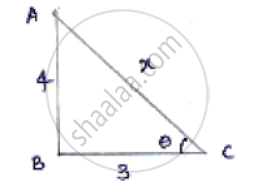
Let x be the hypotenuse by applying Pythagoras theorem.
𝐴𝐶2 = 𝐴𝐵2 + 𝐵𝐶2
𝑥2 = 16 + 9
`x^2 = 25 => x = 5`
`sec theta = (AC)/(BC) = 5/3`
`cosec theta = (AC)/(AB) = 5/4`
On substituting in equation we get
`sqrt((sec theta - cosec theta)/(sec theta + cosec theta)) = sqrt((5/3 - 5/4)/(5/3 + 5/4))`
`= sqrt(((20 - 15)/12)/((20 + 15)/12)) = sqrt(5/35) = 1/sqrt7`
If tanθ = `(sinalpha - cosalpha)/(sinalpha + cosalpha)`, then show that sinα + cosα = `sqrt(2)` cosθ.
[Hint: Express tanθ = `tan (alpha - pi/4) theta = alpha - pi/4`]
Given that: tanθ = `(sinalpha - cosalpha)/(sinalpha + cosalpha)`
⇒ tanθ = `(tanalpha - 1)/(tan alpha + 1)`
= `(tanalpha - tan pi/4)/(1 + tan pi/4 tan alpha)`
⇒ tanθ = `tan(alpha - pi/4)`
∴ θ = `alpha - pi/4`
⇒ cosθ = `cos(alpha - pi/4)`
⇒ cosθ = `cos alpha cos pi/4 + sin alpha sin pi/4`
⇒ cosθ = `cos alpha . 1/sqrt(2) + sin alpha . 1/sqrt(2)`
⇒ `sqrt(2) cos theta` = cosα + sinα
⇒ sinα + cosα = `sqrt(2) cos theta`
Hence proved.
If cos(θ + Φ) = m cos(θ – Φ), then prove that 1 tan θ = `(1 - m)/(1 + m) cot phi`
[Hint: Express `(cos(theta + Φ))/(cos(theta - Φ)) = m/1` and apply Componendo and Dividendo]
Given that: cos(θ + Φ) = m cos(θ – Φ)
⇒ `(cos(theta + phi))/(cos(theta - phi)) = m/1`
Using componendo and dividendo theorem, we get
`(cos(theta + phi) + cos(theta - phi))/(cos(theta + phi) - cos(theta - phi)) = (m + 1)/(m - 1)`
⇒ `(2cos((theta + phi + theta - phi)/2).cos((theta+ phi - theta + phi)/2))/(-2sin((theta + phi + theta - phi)/2)*sin((theta + phi - theta + phi)/2)) = (m + 1)/(m - 1)`
⇒ `(costheta.cosphi)/(-sintheta.sinphi) = (m + 1)/(m - 1)`
⇒ `- cot theta . cot phi = (m + 1)/(m - 1)`
⇒ `(-cot phi)/(tantheta) = (m + 1)/(m - 1) - (1 + m)/(1 - m)`
⇒ tan θ = `(1 - m)/(1 + m) cot phi`
Hence proved.
If `(sin(x + y))/(sin(x - y)) = (a + b)/(a - b)`, then show that `tanx/tany = a/b` [Hint: Use Componendo and Dividendo].
Given that: `(sin(x + y))/(sin(x - y)) = (a + b)/(a - b)`
⇒ `(sin(x + y) + sin(x - y))/(sin(x + y) - sin(x - y)) = (a + b + a - b)/(a + b - a + b)` .....(Using componendo and dividendo theorem)
⇒ `(2sin((x + y + x - y)/2) cos ((x + y - x + y)/2))/(2cos((x + y + x - y)/2) sin((x + y - x + y)/2)) = (2a)/(2b)`
⇒ `(sinx . cos y)/(cosx . sin y) = a/b`
⇒ tan x.cot y = `a/b`
⇒ `tanx/tany = a/b`
Hence proved.
If a cosθ + b sinθ = m and a sinθ - b cosθ = n, then show that a2 + b2 = m2 + n2
a cosθ + b sinθ = m ......(i)
a sinθ - b cosθ = n ......(ii)
Squaring and adding equations 1 and 2, we get,
(a cosθ + b sinθ)2 + (a sinθ - b cosθ)2 = m2 + n2
⇒ a2cos2θ + b2sin2θ + 2ab sin θ cos θ + a2sin2θ + b2cos2θ - 2ab sin θ cos θ = m2 + n2
⇒ a2cos2θ + b2sin2θ + a2sin2θ + b2cos2θ = m2 + n2
⇒ a2(sin2θ + cos2θ) + b2(sin2θ + cos2θ) = m2 + n2
Using, sin2θ + cos2θ = 1
We get,
⇒ a2 + b2 = m2 + n2
Theorem 1: For any real numbers x and y,
sin x = sin y implies x = nπ + (–1)n y, where n ∈ Z
Proof :If sin x = sin y, then
sin x – sin y = 0
or `2cos (x+y)/2 sin (x-y)/2= 0`
which gives `cos (x+y)/2= 0` or `sin (x-y)/2= 0`
Therefore `(x+y)/2= (2n+1) π/2` or `(x-y)/2= nπ`, where n ∈ Z
i.e. x = (2n + 1) π – y or x = 2nπ + y, where n∈Z
Hence x = (2n + 1)π + (–1)2n + 1 y or x = 2nπ +(–1)2n y, where n ∈ Z.
Combining these two results, we get x = nπ + (–1)n y, where n ∈ Z.
Theorem 2: For any real numbers x and y, cos x = cos y, implies x = 2nπ ± y, where n ∈ Z
Proof: If cos x = cos y, then
cos x – cos y = 0 i.e.,
-2 sin `(x+y)/2 sin (x-y)/2= 0`
Thus, `sin (x+y)/2= 0` or `sin (x-y)/2= 0`
Therefore, `(x+y)/2= nπ` or `(x-y)/2= nπ`, where n ∈ Z
i.e. x = 2nπ – y or x = 2nπ + y, where n ∈ Z Hence x = 2nπ ± y, where n ∈ Z
Theorem 3:Prove that if x and y are not odd mulitple of `π/2`, then
tan x = tan y implies x = nπ + y, where n ∈ Z
Proof : If tan x = tan y, then tan x – tan y = 0
or `(sin x cos y- cos x sin y)/(cos x cos y)= 0`
which gives sin (x – y) = 0
Therefore x – y = nπ, i.e., x = nπ + y, where n ∈ Z.
If m sinθ = n sin(θ + 2α), then prove that tan(θ + α)cotα = `(m + n)/(m - n)`
[Hint: Express `(sin(theta + 2alpha))/sintheta = m/n` and apply componendo and dividendo]
Given that: m sinθ = n sin(θ + 2α)
⇒ `(sin(theta + 2alpha))/sintheta = m/n`
Using componendo and dividendo theorem, we get,
⇒ `(sin(theta + 2alpha) + sintheta)/(sin(theta + 2alpha) - sintheta) = (m + n)/(m - n)`
⇒ `(2sin((theta + 2alpha + theta)/2).cos((theta + 2alpha - theta)/2))/(2cos((theta + 2alpha + theta)/2).sin((theta + 2alpha - theta)/2)) = (m + n)/(m - n)` .......`[(because sinA + sinB = 2sin (A + B)/2 . cos (A - B)/2),(sinA - sinB = 2cos (A + B)/2 . sin (A - B)/2)]`
⇒ `(sin(theta + alpha).cosalpha)/(cos(theta + alpha).sinalpha) = (m + n)/(m - n)`
⇒ `tan(theta + alpha)cotalpha = (m + n)/(m - n)`
Hence proved.
If cosα + cosβ = 0 = sinα + sinβ, then prove that cos2α + cos2β = -2cos(α + β).
[Hint: (cosα + cosβ)2 - (sinα + sinβ)2 = 0]
Given that: cosα + cosβ = 0
And sinα + sinβ = 0
∴ (cosα + cosβ)2 - (sinα + sinβ)2 = 0
⇒ (cos2α + cos2β + 2cosα cosβ) - (sin2α + sin2β + 2sinα sinβ) = 0
⇒ cos2α + cos2β + 2 cosα cosβ - sin2α - sin2β - 2 sinα sinβ = 0
⇒ (cos2α - sin2α) + (cos2β - sin2β) + 2(cosα cosβ - sinα sinβ) = 0
⇒ cos2α + cos2β + 2cos(α + β) = 0
Hence, cos2α + cos2β = -2cos(α + β).
Hence proved
If cos(α + β) = `4/5` and sin(α – β) = `5/13`, where α lie between 0 and `pi/4`, find the value of tan2α.
[Hint: Express tan2α as tan(α + β + α – β)]
Given that: cos(α + β) = `4/5`
∴ tan(α + β) = `3/4`
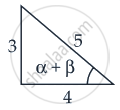
And sin(α – β) = `5/13`
∴ tan(α – β) = `5/12`
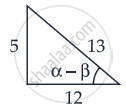
Now tan 2α = tan[α + β + α – β]
= tan[(α + β) + (α – β)]
= `(tan(alpha + beta) + tan(alpha - beta))/(1 - tan(alpha + beta).tan(alpha - beta))`
= `(3/4 + 5/12)/(1 - 3/4 xx 5/12)`
= `((9 + 5)/12)/((48 - 15)/48)`
= `14/12 xx 48/33`
= `56/33`
Hence, tan 2α = `56/33`.
Prove that:
\[\tan x \tan \left( \frac{\pi}{3} - x \right) \tan \left( \frac{\pi}{3} + x \right) = \tan 3x\]
L.H.S = `tanx tan(pi/3 - x) tan (pi/3 + x)`
= `tanx . (sin(pi/3 - x))/(cos(pi/3 - x)).sin(pi/3 + x)/(cos(pi/3 + x))`
= `(sinx . sin(pi/3 - x). sin(pi/3 + x))/(cosx . cos(pi/3 - x) . cos(pi/3 + x))`
= `(sinx . (sin^2 pi/3 - sin^2x))/(cosx . (cos^2 pi/3 - sin^2x))`
= `sinx/cosx((sqrt3/2)^2 - sin^2x)/((1/2)^2 - sin^2x)`
= `sinx/cosx ((3/4) - sin^2x)/((1/4) - sin^2x)`
= `sinx/cosx ((3 - 4sin^2x)/(1 - 4sin^2x))`
= `sinx/cosx ((3 - 4sin^2x)/(1 - 4(1 - cos^2x)))`
= `sinx/cosx ((3 - 4sin^2x)/(4 cos^2x - 3))`
= `(3 sinx - 4 sin^3x)/(4cos^2 - 3cosx)`
= `(sin3x)/(cos3x)`
= `tanx`
Prove that sin 4A = 4sinA cos3A – 4 cosA sin3A
sin4A = sin(2A + 2A)
We know that,
sin(A + B) = sinA cosB + cosA sinB
Therefore, sin4A = sin2A cos2A + cos2A sin2A
⇒ sin4A = 2sin2A cos2A
From T-ratios of multiple angles,
We get,
sin2A = 2sinA cosA and cos2A = cos2A – sin2A
⇒ sin4A = 2(2sinA cosA)(cos2A – sin2A)
⇒ sin4A = 4sinA cos3A – 4cosA sin3A
Hence, sin4A = 4sin A cos3A – 4cosA sin3A
If tan(A + B) = p, tan(A – B) = q, then show that tan 2A = `(p + q)/(1 - pq)`
Given that: tan(A + B) = p, tan(A – B) = q
tan 2A = tan(A + B + A – B)
= tan[(A + B) + (A – B)]
= `(tan(A + B) + tan(A - B))/(1 - tan(A + B).tan(A - B))`
= `(p + q)/(1 - pq)`
Hence proved.
If acos2θ + bsin2θ = c has α and β as its roots, then prove that tanα + tanβ = `(2b)/(a + c)`.
`["Hint: Use the identities" cos2theta = (1 - tan^2theta)/(1 + tan^2theta) "and" sin2theta = (2tantheta)/(1 + tan^2theta)]`.
acos2θ + bsin2θ = c
α and β are the roots of the equation.
Using the formula of multiple angles,
We know that,
cos2θ = `(1 - tan^2theta)/(1 + tan^2theta)` and sin2θ = `(2tantheta)/(1 + tan^2theta)`
∴ `a((1 - tan^2theta)/(1 + tan^2theta)) + b((2tantheta)/(1 + tan^2theta)) - c` = 0
We know that,
The sum of roots of a quadratic equation,
ax2 + bx + c = 0 is given by `((-b)/a)`.
Therefore,
tanα + tanβ = `(-2b)/(-(c + a)`
= `(2b)/((c + a))`
Hence, tanα + tanβ = `(2b)/((c + a))`
If tanθ + sinθ = m and tanθ – sinθ = n, then prove that m2 – n2 = 4sinθ tanθ
[Hint: m + n = 2tanθ, m – n = 2sinθ, then use m2 – n2 = (m + n)(m – n)]
tanθ + sinθ = m ......(i)
tanθ – sinθ = n ......(ii)
Adding equations i and ii
2tanθ = m + n ......(iii)
Subtracting equation ii from i
We get,
2sinθ = m – n ......(iv)
Multiplying equations (iii) and (iv)
2sinθ(2tanθ) = (m + n)(m – n)
⇒ 4sinθ tanθ = m2 – n2
Hence,
m2 – n2 = 4sinθ tanθ
If x = sec Φ – tan Φ and y = cosec Φ + cot Φ then show that xy + x – y + 1 = 0
[Hint: Find xy + 1 and then show that x – y = –(xy + 1)]
Given that: x = sec Φ – tan Φ
And y = cosec Φ + cot Φ
xy + x – y + 1 = 0
L.H.S. xy + x – y + 1
= (sec Φ – tan Φ) (cosec Φ + cot Φ) + (sec Φ – tan Φ) – (cosec Φ + cot Φ) + 1
= `(1/cosphi - sinphi/cosphi) (1/sinphi + cosphi/sinphi) + (1/cosphi - sinphi/cosphi) - (1/sinphi - sinphi/cosphi) + 1`
= `((1 - sin phi)/cos phi) ((1 + cos phi)/sinphi) + (1 - sin phi)/cosphi - (1 + cosphi)/sinphi + 1`
= `(1 - sinphi + cosphi - sinphi cosphi)/(cosphisinphi) + (sinphi - sin^2 phi - cos phi - cos^2 phi)/(cos phi sin phi) + 1`
= `(1 - sin phi + cosphi - sinphi cosphi + sinphi - cosphi - (sin^2 phi + cos^2 phi) + sin phi cos phi)/(cosphi sin phi)`
= `(1 - 1)/(cos phi sin phi)`
= 0. R.H.S.
L.H.S. = R.H.S.
Hence proved.
Key Points
For an acute angle A in a right-angled triangle:
-
Hypotenuse is the side opposite the right angle.
-
Perpendicular is the side opposite angle A.
-
Base is the side adjacent to angle A.
Concepts [19]
- Angles and Their Measurement in Higher Mathematics
- Trigonometric Ratios
- Signs of Trigonometric Functions
- Domain and Range of Trigonometric Functions
- Trigonometric Functions of Sum and Difference of Two Angles
- Trigonometric Equations
- Trigonometric Functions
- Truth of the Identity
- Negative Function Or Trigonometric Functions of Negative Angles
- 90 Degree Plusminus X Function
- Conversion from One Measure to Another
- 180 Degree Plusminus X Function
- 2X Function
- 3X Function
- Expressing Sin (X±Y) and Cos (X±Y) in Terms of Sinx, Siny, Cosx and Cosy and Their Simple Applications
- Graphs of Trigonometric Functions
- Transformation Formulae
- Values of Trigonometric Functions at Multiples and Submultiples of an Angle
- Sine and Cosine Formulae and Their Applications
