Definitions [4]
The compounds having this characteristic unit in their structure are called aromatic compounds.
The compounds having this characteristic unit in their structure are called aromatic compounds.
Define Allotrophy
When an element possess 2 or more different forms in the same state, they are called allotropes and the phenomenon is known as allotropy. Diamond and graphite are the 2 allotropes of carbon.
Define Allotrophy
When an element possess 2 or more different forms in the same state, they are called allotropes and the phenomenon is known as allotropy. Diamond and graphite are the 2 allotropes of carbon.
Key Points
General electronic configuration: ns² np¹.
| Element | Symbol | Electronic Configuration |
|---|---|---|
| Boron | B | [He] 2s² 2p¹ |
| Aluminium | Al | [Ne] 3s² 3p¹ |
| Gallium | Ga | [Ar] 3d¹⁰ 4s² 4p¹ |
| Indium | In | [Kr] 4d¹⁰ 5s² 5p¹ |
| Thallium | Tl | [Xe] 4f¹⁴ 5d¹⁰ 6s² 6p¹ |
- All group 13 elements predominantly show a +3 oxidation state.
- Aluminium is the third most abundant element in Earth's crust (after oxygen and silicon).
- Boron is non-metallic; it does not react with non-oxidising acids but dissolves in strong oxidising acids like HNO₃ (conc.) and H₂SO₄ (conc.).
Trends in Physical Properties:
| Property | Down the Group | Exceptions |
|---|---|---|
| Atomic/ionic radii | Increases | Atomic size of Ga < Al |
| Ionisation enthalpy | Decreases | IE₁ of Tl > In; IE₁ of Ga = Al |
| Tendency to show +1 oxidation state | Increases (inert pair effect) | — |
| Melting point | Decreases (Ga to Tl) | B has very high melting point |
| Lewis acid strength | Increases | — |
| Tendency to form ionic compounds | Increases | — |
| Tendency to form covalent compounds | Decreases | — |
Trends in Chemical Properties:
- Group 13 elements are less reactive than Group 1 and 2 elements.
- All Group 13 elements form ionic compounds except boron, which forms covalent compounds.
- Reaction with oxygen: Boron forms a mixture of oxide (B₂O₃) and nitride (BN) when heated at 700°C in air. Oxygen has no effect on aluminium in normal conditions, but in moist air, a thin protective oxide layer forms on its surface.
- Reaction with water: Except for boron, Group 13 elements decompose in boiling water to produce hydrogen gas. Example: 2Al + 6H2O → 2Al(OH)3 + 3H2↑
- Reaction with halogens: All Group 13 elements react with halogens to form trihalides (MX₃), except thallium (which prefers monohalides due to the inert pair effect).
Anomalous Properties of Boron:
Boron behaves differently from the rest of Group 13 because of:
- Small size – high polarising power
- High ionisation energy – does not form B³⁺ ions easily
- High electronegativity
- Absence of vacant d-orbitals – cannot expand its coordination number beyond 4
| Compound Name | Molecular Formula | Structural Feature | Important Uses |
|---|---|---|---|
| Borax | Na₂[B₄O₅(OH)₄]·8H₂O | 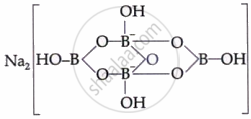 |
|
| Boric Acid | H₃BO₃ | 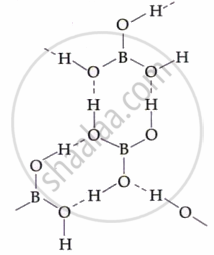 |
|
| Diborane | B₂H₆ | 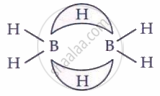 |
|
General electronic configuration: ns² np²
| Element | Symbol | Configuration |
|---|---|---|
| Carbon | C | [He] 2s² 2p² |
| Silicon | Si | [Ne] 3s² 3p² |
| Germanium | Ge | [Ar] 3d¹⁰ 4s² 4p² |
| Tin | Sn | [Kr] 4d¹⁰ 5s² 5p² |
| Lead | Pb | [Xe] 4f¹⁴ 5d¹⁰ 6s² 6p² |
- Size & Energy Trends: Down the group, atomic and ionic radii increase, while ionisation energy decreases.
- Oxidation States: Show +4 and +2 states → +4 stable at top (C, Si), +2 becomes stable down the group (Sn, Pb) due to inert pair effect.
- Metallic Character: Increases down the group → C is non-metal, Si/Ge metalloids, Sn/Pb metals.
- Covalent Nature: Tendency to form covalent compounds decreases down the group as metallic character increases.
- Anomalous Behaviour of Carbon: Due to small size, high electronegativity, absence of d-orbitals, and high catenation.
- Catenation & Bonding: Carbon shows maximum catenation and strong covalent bonding, forming chains and rings.
Allotropes of Carbon:
- Crystalline: Diamond (hardest), Graphite (conducts electricity), Fullerene (spherical)
- Amorphous: Coke, Charcoal (adsorbent), Lampblack (~98–99% carbon)
- Carbon compounds can have straight, branched, or ring chains of carbon atoms.
- Isomers have the same formula but different structures (e.g., butane).
- Crude oil is a mix of hydrocarbons; fuels like LPG and petrol are separated by fractional distillation.
- Saturated hydrocarbons have single bonds, while unsaturated ones have double or triple bonds.
- Aromatic compounds, such as benzene, have rings with alternating double bonds.
- Carbon compounds can have straight, branched, or ring chains of carbon atoms.
- Isomers have the same formula but different structures (e.g., butane).
- Crude oil is a mix of hydrocarbons; fuels like LPG and petrol are separated by fractional distillation.
- Saturated hydrocarbons have single bonds, while unsaturated ones have double or triple bonds.
- Aromatic compounds, such as benzene, have rings with alternating double bonds.
Concepts [21]
- Introduction to p-block Elements
- Group 13 Elements - The Boron Family
- Important Trends and Anomalous Properties of Boron
- Important Compounds of Boron
- Preparation and Properties of Aluminium
- Uses of Boron and Aluminium
- Group 14 Elements - The Carbon Family
- Important Trends and Anomalous Behaviour of Carbon
- Straight chains, Branched chains, and Rings of Carbon atoms
- Straight chains, Branched chains, and Rings of Carbon atoms
- Allotropes of Carbon > Diamond
- Allotropes of Carbon > Graphite
- Allotropes of Carbon > Fullerene
- Allotropes of Carbon > Diamond
- Some Important Compounds of Carbon and Silicon - Carbon Monoxide
- Some Important Compounds of Carbon and Silicon - Carbon Dioxide
- Some Important Compounds of Carbon and Silicon - Silicon Tetrachloride
- Some Important Compounds of Carbon and Silicon - Silicon Dioxide
- Some Important Compounds of Carbon and Silicon - Silicones
- Some Important Compounds of Carbon and Silicon - Silicates
- Some Important Compounds of Carbon and Silicon - Zeolites
