Definitions [6]
Define the following as related to proteins:
Peptide linkage
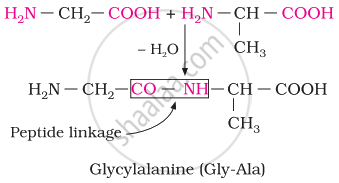
Chemically, peptide linkage is an amide formed between the –COOH group and –NH2 group. The reaction between two molecules of similar or different amino acids proceeds through the combination of the amino group of one molecule with the carboxyl group of the other. This results in the elimination of a water molecule and the formation of a peptide bond –CO–NH–. The product of the reaction is called a dipeptide because it is made up of two amino acids.
For example, when the carboxyl group of glycine combines with the amino group of alanine, we get a dipeptide, glycylalanine.
Define carbohydrates.
Carbohydrates are optically active polyhydroxy aldehydes or polyhydroxy ketones or compounds that can be hydrolysed to polyhydroxy aldehydes or polyhydroxy ketones.
The sugars that reduce the Tollen's reagent and Fehling's solution are called reducing sugars.
Carbohydrates may be defined as optically active polyhydroxy aldehydes or ketones or compounds which produce such units on hydrolysis, such as cellulose, glycogen, starch, etc.
Carbohydrates that are crystalline solids, sweet in taste and soluble in water are called sugars.
Carbohydrates that are amorphous solids, tasteless and insoluble in water are catled non-sugars.
Key Points
| Level | Description | Stabilising Forces |
|---|---|---|
| Primary | Linear sequence of amino acids linked by peptide bonds | Peptide bonds |
| Secondary | α-helix (right-handed coil, –NH of one AA H-bonded to C=O of 4th residue) OR β-pleated sheet (when R group is small) | Hydrogen bonds |
| Tertiary | Further folding of secondary structure; 3D shape | Hydrophobic interactions, H-bonds, disulphide bonds, van der Waals, ionic interactions |
| Quaternary | Two or more polypeptide chains arranged spatially | All forces present in tertiary structure |
- Carbohydrates are organic biomolecules made of C, H and O, usually fitting the general formula Cx(H₂O)y and existing as aldoses or ketoses.
- They are classified into monosaccharides, disaccharides and polysaccharides; monosaccharides cannot be hydrolysed further, disaccharides are formed by two monosaccharides via glycosidic bonds, and polysaccharides are long polymers.
- Some sugars like digitoxose (C₆H₁₂O₄) and rhamnose (C₆H₁₂O₅) do not obey the typical Cx(H₂O)y formula.
- All monosaccharides are reducing sugars because they possess a free aldehyde or ketone group.
- Cellulose is a linear polymer of β‑D‑glucose, unlike starch and glycogen, which are polymers of α‑glucose and show branching.
- Biologically, carbohydrates supply energy for metabolism; glucose is the main substrate for ATP synthesis, and lactose provides energy to infants.
- Polysaccharides such as starch and glycogen act as storage products and also contribute to structural components of cell membranes and cell walls.
- Increasing substrate concentration raises enzyme activity only up to a maximum, after which the rate levels off because all active sites become saturated.
- Increasing enzyme concentration generally increases the reaction rate, as more active sites are available for substrate binding.
- Enzyme activity is highest at an optimum temperature; high temperatures denature enzymes (destroy higher‑level structure), while low temperatures reduce their activity.
- Each enzyme has its own optimum pH range; outside this range, activity falls sharply and the enzyme may not function.
- Co‑enzymes, activators and inhibitors also affect enzyme activity: activators (often inorganic ions) enhance activity, inhibitors decrease it, and many enzymes function as a combination of apoenzyme plus co‑enzyme.
Concepts [4]
- Structure of Proteins
- Biomolecules in the Cell > Carbohydrates
- Structure and Function of Lipids
- Factors Affecting Enzyme Activity
