Definitions [11]
The work done per unit charge to move a charge between two points in a circuit; it is the driving force for current flow.
An intrinsic property of a material that determines its resistance per unit length and cross-sectional area.
The opposition offered by a conductor to the flow of electric current.
The rate of flow of electric charge through a cross-section of a conductor.
An arrangement of four resistors used to measure the resistance of one of them in terms of the other three, invented by Samuel Hunter Christie in 1833 and made famous by Sir Charles Wheatstone, is called a Wheatstone bridge.
The condition of the Wheatstone bridge under which the galvanometer shows zero (null) deflection, i.e., Ig = 0, is called the balance condition of the bridge.
A metre bridge (slide-wire bridge) is a practical laboratory device based on the Wheatstone bridge principle, used to measure an unknown electrical resistance by achieving a null-point (balance) condition on a one-metre-long uniform resistance wire.
A potentiometer is an instrument used to measure the EMF of a cell, compare EMFs of two cells, or find a cell's internal resistance — all without drawing any current from the cell being measured, making it more accurate than a voltmeter.
Define a Potentiometer.
A potentiometer is a manually adjustable, variable resistor with three terminals. Two terminals are connected to the ends of a resistive element, and the third terminal is connected to an adjustable wiper. The position of the wiper sets the resistive divider ratio.
Define potential gradient of the potentiometer wire.
The potential gradient of a potentiometer wire is defined as the change in electric potential (voltage) per unit length of the wire.
Mathematically,
Potential Gradient = `V/L`
An electromechanical, sensitive instrument which is used to detect and measure small electric currents in a circuit is called a galvanometer.
Formulae [3]
Balance condition (when Ig = 0):
- AC → battery arm
- BD → galvanometer arm
- R4 → unknown resistance measured in terms of the other three.
S = \[\frac{G\cdot I_g}{I-I_g}\]
If current I = nIg: S = \[\frac {G}{n-1}\]
\[R_A=\frac{S\cdot G}{S+G}=\frac{G}{n}\]
Theorems and Laws [7]
At any junction, the sum of currents entering = the sum of currents leaving.
Example: I1 + I3 = I2 + I4. Based on conservation of charge.
The algebraic sum of potential differences in a closed loop is zero.
Based on conservation of energy.
Statement
At any junction in an electric circuit, the sum of currents entering the junction is equal to the sum of currents leaving the junction.
Derivation
When the current in a circuit is steady, charge does not accumulate at any junction. Therefore, the amount of charge entering the junction per second must be equal to the amount of charge leaving the junction per second.
If currents I1 and I2 enter a junction and currents I3 and I4 leave it, then
or
Hence,
Conclusion
Kirchhoff's First Law is a direct consequence of the conservation of charge.
Statement
In any closed loop of an electric circuit, the algebraic sum of all changes in potential is zero.
Derivation
Consider a charge moving around a closed loop. After completing one full loop, the charge returns to its starting point. Since electric potential depends only on position, the net change in potential over a complete loop must be zero.
Therefore, in a closed loop,
If a loop contains cells and resistors, then the total emf supplied by the sources is equal to the total potential drop across the resistors. Thus,
Conclusion
Kirchhoff's Second Law is a direct consequence of the conservation of energy.
Obtain the balancing condition for the Wheatstone bridge arrangements as shown in Figure 4 below:
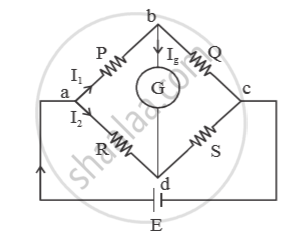
Let `I_3` and `I_4` be the currents in resistors Q and S respectively . Let `I_g` be the current through galvanometer. For balanced condition,
`I_g = 0`
Applying junction law at ‘b’ we get
`I_1 = I_3 + I_g`
`because I_g = 0 , I_1 = I_3` ....(i)
Applying junction law at ‘d’, we get
`I_2 + I_g = I_4`
`because I_g = 0 , I_2 = I_4` ....(ii)
Applying loop law in the loop abda, we get
`-I_1·P - I_g·Q + -I_2·R = 0`
⇒ `-I_1P + I_2R = 0` (`because I_g = 0`)
⇒ `I_1P = I_2R`
⇒ `P/R = I_2/I_1` ....(iii)
Applying loop law in the loop bcdb, we get
`-I_3·Q + I_4·S + I_g·6 = 0`
⇒ `-I_3·Q + I_4·S + 0 = 0 (because I_g =0)`
⇒ `-I_3Q = I_4S`
⇒ `Q/S = I_4/I_3`
⇒ `Q/S = I_2/I_1` ...(iv) [using eq.(i) and (ii)]
From eq. (iii) and (iv), `P/ R = Q/s`
⇒ `P/Q = R/S`
This is the balanced condition.
The metre bridge works on the Wheatstone bridge principle: a bridge circuit is said to be balanced when no current flows through the galvanometer, i.e., points B and D are at the same potential.
The potential drop across any length of a uniform wire is directly proportional to that length, provided a constant current flows through it.
- V = K ⋅ l
where K is the potential gradient (potential drop per unit length, in V/m), and l is the length of wire from the starting point A.
At the null point, the unknown EMF exactly equals the potential drop across the balancing length:
- E = K ⋅ l
Key Points
- Kirchhoff's laws are used for complex circuits.
- Kirchhoff's First Law: Total current entering a junction = total current leaving a junction.
- Kirchhoff's Second Law: Total potential rise in a closed loop = total potential drop in the loop.
- KCL is based on conservation of charge.
- KVL is based on conservation of energy.
- Mathematical forms are ∑I = 0 and ∑V = 0.
- The correct sign convention is essential in numericals.
- Potentiometer principle: V ∝ l for a uniform wire carrying constant current.
- At the null point, no current flows through the test cell — giving the true EMF, not just terminal voltage.
- Sensitivity increases with a longer wire (lower potential gradient).
- Three major uses: measuring EMF, comparing two EMFs, and finding internal resistance.
- A potentiometer behaves like an ideal (infinite-resistance) voltmeter, making it more accurate than a real voltmeter.
