English Medium
Academic Year: 2024-2025
Date & Time: 25th February 2025, 10:30 am
Duration: 3h
Advertisements
GENERAL INSTRUCTIONS:
Read the following instructions carefully and follow them:
- This question paper contains 37 questions. All questions are compulsory.
- Question paper is divided into SIX sections - Section A, B, C, D, E and F.
- Section A - question number 1 to 20 are multiple choice type questions. Each question carries 1 mark.
- Section B - question number 21 to 24 are Very Short Answer type questions. Each question carries 2 marks. Answer to these questions should not exceed 40 words.
- Section C - question number 25 to 29 are Short Answer type questions. Each question carries 3 marks. Answer to these questions should not exceed 60 words.
- Section D - question number 30 to 33 are Long Answer(LA) type questions. Each question carries 5 marks. Answer to these questions should not exceed 120 words.
- Section E - question number 34 to 36 are Case-based/Source-based questions with three sub-questions. Each question carries 4 marks.
- In Section F - question number 37 is Map skill based question with two parts - 37(i) History (2 marks) and 37(ii) Geography (3 marks). This question carries total 5 marks.
- In addition to this, NOTE that a separate question has been provided for the Visually Impaired Candidates in lieu of questions having visual inputs, Map etc. Such questions are to be attempted by the Visually Impaired Candidates only.
Read the following developmental goals and choose correct option of goals related to a student studying in university.
- Good opportunities for research.
- Opportunities to pursue higher education abroad.
- Opportunities for independence.
- Opportunities for good employment.
Only (i), (ii) and (iii) are correct.
Only (ii), (iii) and (iv) are correct.
Only (i), (ii) and (iv) are correct.
Only (i), (iii) and (iv) are correct.
Chapter:
The growth of digital technology has greatly influenced globalization. Which of the following is its main benefit?
Increased Communication Cost
Limited Access to Information
Enhanced Connectivity
Slower Transaction Speed
Chapter:
Read the following sources of loan carefully and choose the correct option related to formal sources of credit.
- Commercial Bank
- Landlords
- Government
- Money Lender
(i) and (iii) are correct.
(ii) and (iv) are correct.
(i) and (ii) are correct.
(ii) and (iii) are correct.
Chapter:
Choose the correct option to fill the blank:
| Sector | Criteria Used |
| Primary, Secondary and Tertiary | ______ |
| Organized and Unorganized Sectors | Nature of Employment Activities |
Nature of social activities
Nature of political activities
Nature of production activities
Nature of government activities
Chapter:
Choose the odd one out from the following options regarding the sectors of economy:
Pilot, Driver, Gardener
Fisherman, Teacher, Lawyer
Engineer, Professor, Farmer
Doctor, Teacher, Lawyer
Chapter:
The World Bank’s development report is prepared on the basis of which of the following:
Per Capita Income
Health Services
Literacy
Freedom
Chapter:
Read the table given below carefully and answer the question that follow:
| Data of few Countries | ||||
| Country | Gross National Income (GNI) per capita (2017 PPP) in US $ | Life Expectancy at birth | Mean Years of Schooling of People aged 25 and above | HDI Rank in the world (2021-22) |
| A | 12,578 | 76.4 | 10.8 | 73 |
| B | 6,590 | 67.2 | 6.7 | 132 |
| C | 3,851 | 65.7 | 6.4 | 149 |
| D | 4,624 | 66.1 | 4.5 | 161 |
| E | 3,877 | 68.4 | 5.1 | 143 |
| F | 5,472 | 72.4 | 7.4 | 129 |
Which of the following countries has high per capita income, life expectancy at birth and high rank in human development index?
A
C
E
F
Chapter:
In which year the constitutional amendment providing for 33% representation of women in the local self governance system in India was made? Choose the correct option:
1990
1984
1992
1988
Chapter:
In a democratic country the government adopts environment friendly policies with the help of citizens and experts. Which one of the following is a positive outcome of this process?
The government is capable of determining policies on its own.
Citizens feel empowered to determine policies.
Corporates protect their own interest in determining policies.
Market forces also influence the government for their interests.
Chapter:
Which one of the following pairs is correctly matched?
| List-I (Regional Parties) | List-II (Regions) |
| Rashtriya Janta Dal | Uttar Pradesh |
| List-I (Regional Parties) | List-II (Regions) |
| Janta Dal (Secular) | Bihar |
| List-I (Regional Parties) | List-II (Regions) |
| Rashtriya Lok Dal | Assam |
| List-I (Regional Parties) | List-II (Regions) |
| Biju Janta Dal | Odisha |
Chapter:
Which of the following is an example of horizontal power sharing in Indian democracy?
Division of power between Central and State Governments.
Division of power between Rural and Urban Governments.
Division of power among Administration, Judiciary and Army.
Division of power among Legislative, Executive and Judiciary.
Chapter:
How does the Indian federal structure promote balance governance across the nation? Choose the most suitable option from the following:
By allowing states to exercise complete autonomy on all issues.
By ensuring a division of power between centre and states.
By allowing all decision making processes under the Union Government.
By giving more powers to local governments in comparison to states.
Chapter:
Assertion (A): The French speaking community was rich in comparison to Dutch speaking community in Belgium.
Reason (R): Dutch speaking community got the benefit of economic development and education much later.
Both (A) and (R) are correct and (R) is the correct explanation of (A).
Both (A) and (R) are correct but (R) is not the correct explanation of (A).
(A) is correct but (R) is incorrect.
(A) is incorrect but (R) is correct.
Chapter:
Match Column-I with Column-II and choose the correct option:
| Column-I (Minerals) | Column-II (Features) |
| A. Copper | (i) Used in manufacturing of steel and paints |
| B. Bauxite | (ii) Used in electric and electronic industries |
| C. Mica | (iii) Used in electric cables and utensils |
| D. Manganese | (iv) Used in aluminium production |
A - (i), B - (iii), C - (iv), D - (ii)
A - (ii), B - (i), C - (iii), D - (iv)
A - (iv), B - (ii), C - (i), D - (iii)
A - (iii), B - (iv), C - (ii), D - (i)
Chapter:
Advertisements
Identify the crop with the help of information given in the box.
|
Tea
Coffee
Jute
Cotton
Chapter:
A researcher is examining a soil type which is formed by the weathering of volcanic rock and is rich in minerals. Which one of the following soils is it?
Laterite soil
Alluvial soil
Black soil
Desert soil
Chapter:
Arrange the following events in chronological order and choose the correct option:
- The Treaty of Vienna.
- The beginning of Napoleonic wars.
- Proclamation of the Prussian King William I as German Emperor.
- Proclamation of Victor Emmanuel II as the King of Italy.
I, III, IV and II
II, IV, I and III
II, I, IV and III
III, II, IV and I
Chapter:
Look at the given picture and identify the name of the painter of this painting from the following options:
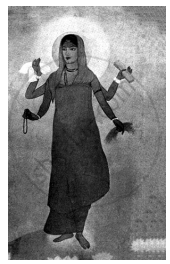
Rabindranath Tagore
Abanindranath Tagore
Debindranath Tagore
Satyendranath Tagore
Chapter:
How did the British East India Company use print culture to promote its interests in India? Choose the correct option from the following:
By censoring the Indian newspapers
By funding the regional language newspapers
By encouraging the development of independent Press
By using print media to spread eastern culture
Chapter:
Why was the silk route considered a good example of vibrant pre-modern trade? Choose the most appropriate option from the following:
Due to movement of silk cargoes
Due to flow of silver and gold
Due to linkage of China with Australia
Due to trade and cultural exchange
Chapter:
“Planning is the widely accepted strategy for judicious use of resources.” Explain the statement.
Chapter:
“An equitable distribution of resources has become essential for a sustained quality of human life.” Explain the statement.
Chapter:
How did the feminist movements help to enhance the role of women in public life? Explain.
Chapter:
Explain the role of public facilities for quality of life.
Chapter:
Why was the Indian subcontinent significant to trade networks before European intervention? Explain.
Chapter:
How did the trade policy implemented in 1991 stimulated the globalization in India? Explain with example.
Chapter:
Describe the steps taken by French revolutionaries to create a sense of national unity and belonging.
Chapter:
Describe the historical factors that contributed to the emergence of nationalist tensions in the Balkans.
Chapter:
Advertisements
Examine the measures taken by the government to make agriculture profitable in India.
Chapter:
Examine the role of government policies in promoting economic growth in India.
Chapter:
Explain the role of Gandhiji in the Non-cooperation Movement with examples.
Chapter:
How did the Civil Disobedience Movement able to bring all communities together in India? Explain with examples.
Chapter:
“It would be beneficial to develop sustainable way to meet the growing energy demand in India.” Support the statement by giving suitable arguments.
Chapter:
“We have to use a planned and sustainable manner to conserve our minerals.” Support the statement by giving suitable arguments.
Chapter:
“Democracy elevates humans from the status of subject to citizen.” Justify the statement with suitable arguments.
Chapter:
“Democracy and development go together.” Justify the statement with suitable arguments.
Chapter:
Analyse the role of credit in the rural economy.
Chapter:
Distinguish between formal and informal sources of credit.
Chapter: [4.3] Money and Credit
Read the following source and answer the questions that follow:
|
Local Self Government The local government structure goes right up to the district level. A few gram panchayats are grouped together to form what is usually called a panchayat samiti or block or mandal. The members of this representative body are elected by all the panchayat members in that area. All the panchayat samitis or mandals in a district together constitute the zilla (district) parishad. Most members of the zilla parishad are elected. Members of the Lok Sabha and MLAs of that district and some other officials of other district level bodies are also its members. Zilla parishad chairperson is the political head of the zilla parishad. Similarly, local government bodies exist for urban areas as well. Municipalities are set up in towns. Big cities are constituted into municipal corporations. Both municipalities and municipal corporations are controlled by elected bodies consisting of people’s representatives. Municipal chairperson is the political head of the municipality. In a municipal corporation, such an officer is called the mayor. This new system of local government is the largest experiment in democracy conducted anywhere in the world. |
- Explain the relationship between gram panchayats and panchayat samitis. (1)
- How is the structure of a municipal corporation different from municipality? (1)
- How does the local government structure promote democracy? Examine. (2)
Chapter:
Read the source given below and answer the questions that follow:
|
New Forms of Publication By the end of the nineteenth century, a new visual culture was taking shape. With the setting up of an increasing number of printing presses, visual images could be easily reproduced in multiple copies. Painters like Raja Ravi Varma produced images for mass circulation. Poor wood engravers who made woodblocks set up shop near the letterpresses and were employed by print shops. Cheap prints and calendars, easily available in the bazaar, could be bought even by the poor to decorate the walls of their homes or places of work. These prints began shaping popular ideas about modernity and tradition, religion and politics, and society and culture. By the 1870s, caricatures and cartoons were being published in journals and newspapers, commenting on social and political issues. Some caricatures ridiculed the educated Indians’ fascination with Western tastes and clothes, while others expressed the fear of social change. There were imperial caricatures lampooning nationalists, as well as nationalist cartoons criticising imperial rule. |
- How did the development of printing technology impact visual culture? (1)
- How did Raja Ravi Varma contribute to the mass circulation of art in India? (1)
- How did visual culture shape the memory of the 19th century social landscape? Explain. (2)
Chapter:
Read the given source and answer the questions that follow:
|
Sacred Groves - a wealth of diverse and rare species Nature worship is an age old tribal belief based on the premise that all creations of nature have to be protected. Such beliefs have preserved several virgin forests in pristine form called Sacred Groves (the forests of God and Goddesses). These patches of forest or parts of large forests have been left untouched by the local people and any interference with them is banned. Certain societies revere a particular tree which they have preserved from time immemorial. The Mundas and the Santhal of Chota Nagpur region worship mahua (Bassia latifolia) and kadamba (Anthocaphalus cadamba) trees, and the tribals of Odisha and Bihar worship the tamarind (Tamarindus indica) and mango (Mangifera indica) trees during weddings. To many of us, peepal and banyan trees are considered sacred. Indian society comprises several cultures, each with its own set of traditional methods of conserving nature and its creations. Sacred qualities are often ascribed to springs, mountain peaks, plants and animals which are closely protected. You will find troops of macaques and langurs around many temples. They are fed daily and treated as a part of temple devotees. In and around Bishnoi villages in Rajasthan, herds of blackbuck (chinkara), nilgai and peacocks can be seen as an integral part of the community and nobody harms them. |
- How do sacred groves show the inter-connectivity of spirituality and ecology? (1)
- How do tribal practices promote conservation of forests? (1)
- Why is conservation of wildlife important for all of us? Explain. (2)
Chapter:
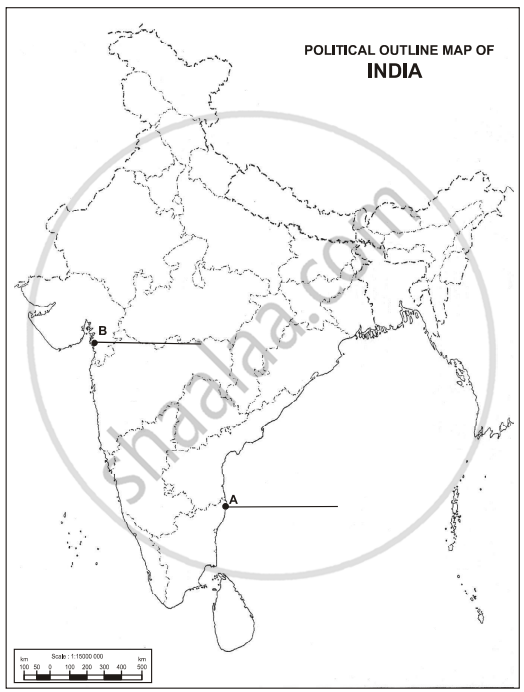
Two places (A) and (B) have been marked on the given political outline map of India. Identify them with the help of the following information and write their correct names on the lines drawn near them:
- The place where the Session of Indian National Congress was held in 1927.
- The place where Gandhiji broke the Salt Law.
Chapter:
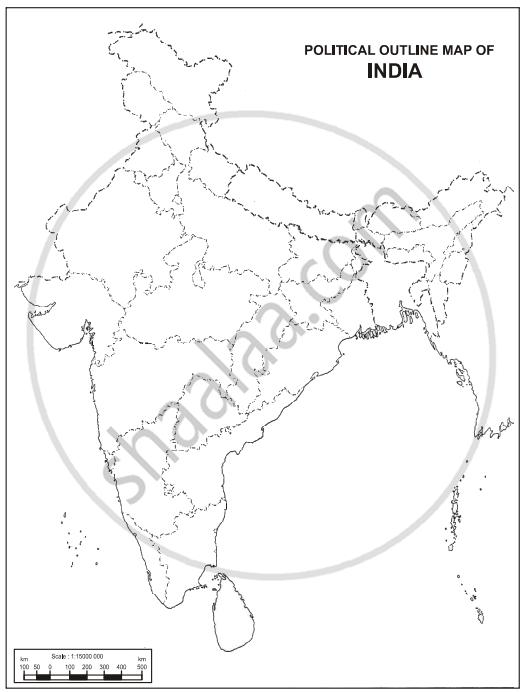
On the given political outline map of India, locate and label any three of the following with suitable symbols:
- A major dam on the Chenab river.
- Nuclear Power Plant located in Uttar Pradesh.
- A major Software Technology Park located in Karnataka.
- A major seaport located in Odisha.
Chapter:
Other Solutions
Submit Question Paper
Help us maintain new question papers on Shaalaa.com, so we can continue to help studentsonly jpg, png and pdf files
CBSE previous year question papers Class 10 Social Science with solutions 2024 - 2025
Previous year Question paper for CBSE Class 10 Social Science-2025 is solved by experts. Solved question papers gives you the chance to check yourself after your mock test.
By referring the question paper Solutions for Social Science, you can scale your preparation level and work on your weak areas. It will also help the candidates in developing the time-management skills. Practice makes perfect, and there is no better way to practice than to attempt previous year question paper solutions of CBSE Class 10.
How CBSE Class 10 Question Paper solutions Help Students ?
• Question paper solutions for Social Science will helps students to prepare for exam.
• Question paper with answer will boost students confidence in exam time and also give you an idea About the important questions and topics to be prepared for the board exam.
• For finding solution of question papers no need to refer so multiple sources like textbook or guides.
