Commerce (English Medium)
Arts (English Medium)
Academic Year: 2025-2026
Date & Time: 18th March 2026, 10:30 am
Duration: 3h
Advertisements
General Instructions:
Read the following instructions carefully and follow them:
- This question paper contains 34 questions. All questions are compulsory.
- This question paper contains two sections:
Section - A: Macro Economics
Section - B: Indian Economic Development - This Question paper contains 20 Multiple Choice type questions. Each question carries 1 mark.
- This Question paper contains 4 Short Answer Type - I questions. Each question carries 3 marks. Answer these questions in 60 to 80 words.
- This Question paper contains 6 Short Answer Type - II questions. Each question carries 4 marks. Answer these questions in 80 to 100 words.
- This Question paper contains 4 Long Answer type questions. Each question carries 6 marks. Answer these questions in 100 to 150 words.
- Attempt all parts of a question together.
- In addition to this, NOTE that a separate question has been provided for Visually Impaired candidates in lieu of questions having visual inputs, map etc. Such questions are to be attempted by Visually Impaired candidates only.
- There is no overall choice in the question paper. However, an internal choice has been provided in few questions. Only one of the choices in such questions has to be attempted.
In an economy, when ______ is insufficient to achieve the level of output corresponding to the full employment, the difference is termed a deflationary gap.
ex-ante Aggregate Demand
ex-post Aggregate Demand
ex-ante Aggregate Supply
ex-post Aggregate Supply
Chapter:
In an economy, exclusion of ______ may lead to under estimation of the value of Gross Domestic Product (GDP).
- Barter Transactions
- Services provided by family members
- Illegal activities
- Depreciation of Assets
(i) and (ii)
(ii) and (iii)
(iii) and (iv)
(i), (ii) and (iii)
Chapter:
Identify, which of the following is true at the Break Even level of Income.
Slope of Consumption Curve = Slope of Saving Curve
Average Propensity to Consume (APC) = Average Propensity to Save (APS)
Slope of Saving Curve = Unity (1)
Average Propensity to Consume (APC) = Unity (1)
Chapter:
Read the following statements carefully:
Statement 1: Final goods are those goods which normally lose their identity in the production process.
Statement 2: Final goods may get transformed during the consumption process by a consumer.
Statement 1 is true and statement 2 is false.
Statement 1 is false and statement 2 is true.
Both statements 1 and 2 are true.
Both statements 1 and 2 are false.
Chapter:
Assertion (A): Unilateral Transfers are recorded in the Current Account of the Balance of Payments (BoP) of a nation.
Reason (R): Capital account records transactions which cause a change in the assets or liabilities of the country.
Both Assertion (A) and Reason (R) are true, and Reason (R) is the correct explanation of Assertion (A).
Both Assertion (A) and Reason (R) are true, but Reason (R) is not the correct explanation of Assertion (A).
Assertion (A) is true, but Reason (R) is false.
Assertion (A) is false, but Reason (R) is true.
Chapter:
“In the Indian Banking System, the Statutory Liquidity Ratio (SLR) plays a vital role in controlling the credit creation capacity of the Commercial Banks, as it ______.”
ensures that all the deposits are converted into liquid assets.
requires banks to maintain a percentage of deposits in the form of liquid assets.
sets the maximum interest rate which the banks can charge on loans.
promote banks from lending beyond a specific proportion of their total reserves.
Chapter:
In an economy, the currency held by the public, Net Demand Deposits with Commercial Banks and Net Time Deposits with Commercial Banks stand at ₹ 1,42,000 crore, ₹ 22,000 crore and ₹ 86,000 crore respectively. The value of Money Supply (M1) would be ₹ ______ crore.
2,50,000
86,000
1,64,000
1,42,000
Chapter:
In a two sector economy, the flow of factor payments moves from ______ to ______.
firms, households
firms, government
banks, households
households, firms
Chapter:
Assertion (A): Money is of perishable nature and is generally accepted by all at any point of time.
Reason (R): Money serves as a store of value, facilitating individuals to transfer purchasing power from the present to the future.
Both Assertion (A) and Reason (R) are true, and Reason (R) is the correct explanation of Assertion (A).
Both Assertion (A) and Reason (R) are true, but Reason (R) is not the correct explanation of Assertion (A).
Assertion (A) is true, but Reason (R) is false.
Assertion (A) is false, but Reason (R) is true.
Chapter:
Read the following statements carefully:
Statement 1: Depreciation of currency is an economic action undertaken by the government of a nation under the fixed exchange rate system.
Statement 2: Under the floating exchange Rate system, authorities actively intervene in the foreign exchange market by way of maintaining foreign exchange reserves.
In the light of the given statements, choose the correct option from the following:
Statement 1 is true and statement 2 is false.
Statement 1 is false and statement 2 is true.
Both statements 1 and 2 are true.
Both statements 1 and 2 are false.
Chapter:
“Under the provisions stated in the Section 20 and Section 21 of the Reserve Bank of India (RBI) Act, 1934, the RBI is mandated to handle the banking operations of the Government of India.”
In the light of the given statement, elaborate the indicated function of the Reserve Bank of India.
Chapter:
Two friends, Devanshi and Harshit, were discussing whether prize money from lottery winnings, should be included in India’s National income.
Harshit was of the view that it should be included, while Devanshi did not agree with him.
As their Economics teacher, guide them with correct treatment of the same with valid argument.
Chapter:
Meera and Shahid are two classmates, who were comparing India’s economic growth over the years.
Meera referred to the increase in Gross Domestic Product (GDP) at current prices prevailing in market, while Sahid insisted on considering GDP after adjusting for inflation. Their debate on which of the two measures gives a true picture of people’s well-being, remained inconclusive.
Considering the above mentioned situation, elaborate with valid reason, which of the two variables is considered a better indicator of welfare and why?
Chapter:
Ms. Reeta D’Costa, retired from the post of Income Tax Commissioner in the year 2023.
Apart from her pension, she also receives the following from various sources:
- Rental income from a flat she owns.
- Interest income from her fixed deposits.
- Money sent by her children settled abroad.
Identify and classify, her monthly incomes into ‘factor income’ and ‘transfer income’, with valid reasons.
Chapter:
Advertisements
For a hypothetical economy, assuming there are only two firm (X and Y) with equal values of Gross Value Added (GVA).
On the basis of the following data, estimate the values of Domestic Sales by firm X:
| S. No. | Items | Amount (in crore) |
| (i) | Value of Output of firm Y | 1,400 |
| (ii) | Purchases by firm X from firm Y | 400 |
| (iii) | Exports by firm X | 200 |
| (iv) | Purchases by firm Y from firm X | 300 |
| (v) | Additions to Stock of firm X | 100 |
| (vi) | Consumption of fixed capital | 100 |
Chapter:
Refer the given image carefully:
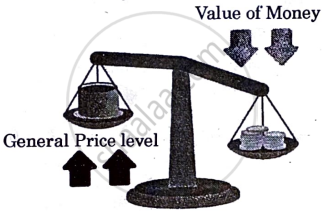
Explain any two measures that can be taken by the Central Bank to control the indicated macroeconomic problem.
Chapter:
Michel, an entrepreneur of Country Zeta, borrowed $ 5 million from overseas bank to expand his textile business.
During the same financial year, the Government of Country Zeta secured a loan of $ 30 Billion from an International Financial Institution to manage the ongoing Balance of Payments.
Samuel, an Economics student categorised both of these transactions as ‘autonomous transactions’ in the BoP account of the country.
Do you agree with his classification? Justify your answer with valid reasons.
Chapter:
Refer the given text carefully:
| According to the Economic Survey 2024-25, the government budget’s projections for the fiscal year 2025-26 indicate that gross direct tax revenue will rise by 12.7%, while gross indirect tax collections are expected to grow by 8.3% relative to FY 2024-25. Direct taxes include income tax and corporate tax, reflecting earnings and profits of households and firms. It plays a key role in revenue growth of the government. Indirect taxes encompass Goods and Services Tax (GST), custom duties and other transaction-based levies. Higher growth rate projected for direct taxes suggests a push to enhance tax buoyancy through improved compliance and reforms. On the other hand, indirect taxes are expected to benefit from consumption trends and Goods and Services Tax (GST) administration improvements. The balance tax strategy aims to mobilise resources while supporting fiscal consolidation and sustainable economic growth. |
On the basis of the above passage and common understanding, answer the following questions:
- Differentiate between the two types of taxes indicated in the above text, with suitable examples. [4]
- Elaborate the likely consequences of the tax projections made by the government. [2]
Chapter:
Income of an economy increased from ₹ 40,000 to ₹ 1,00,000 crore. Savings of the economy increased from ₹ 4,000 crore to ₹ 20,000 crore.
- Calculate Average Propensity to Consume (APC) and Average Propensity to Save (APS) before and after the rise in income. [4]
- Draw appropriate conclusion regarding the behaviour of Average Propensity to Save (APS) as his income increases. [2]
Chapter:
“Under a study, examining the spending habits of a hypothetical economy, it was observed that even households with zero income managed to consume basic necessities.
As the income of people increased, their consumption also increased, but not as rapidly as income.”
Based on the given text and common understanding, answer the following questions:
- Identify and elaborate the type of consumption indicated in the first para of the above text. [3]
- Explain, the reason behind the positive slope of Aggregate Demand Curve. [3]
Chapter:
Read the following text carefully:
“In the recent times, the Government of India, has introduced several measures to encourage greater public participation in the capital market, including both primary and secondary stock markets.”
Under which sector have the above mentioned reforms been introduced?
Industrial
Financial
Taxation
Foreign Trade
Chapter:
The Montreal Protocol was signed in the year 1987 committing nations to ______.
protect biodiversity from any further losses.
reduce the impact of global warming.
protect ozone layer from depletion incurred due to chlorofluoro carbons.
reduce the impact of deforestation.
Chapter:
Assertion (A): The notion of rural development encompasses a far wider spectrum than agricultural advancement.
Reason (R): Government interventions in the agricultural sector remain imperative, as it constitutes the primary means of sustanance for the rural population.
Both Assertion (A) and Reason (R) are true, and Reason (R) is the correct explanation of Assertion (A).
Both Assertion (A) and Reason (R) are true, but Reason (R) is not the correct explanation of Assertion (A).
Assertion (A) is true, but Reason (R) is false.
Assertion (A) is false, but Reason (R) is true.
Chapter:
Identify, which of the following, highlights a highly relevant issue associated with evolving employment trends in India’s labour market?
Progressive increase in the share of permanent salaried employees.
Increase in the proportion of casually employed individuals.
Expansion of self-employment avenues in all regions.
Significant rise in job opportunities within the formal sector.
Chapter:
Match the terms given in Column - I with their respective meaning in Column - II. Select the correct option:
| Column - I | Column - II | ||
| (i) | Seasonal Unemployment | (a) | Private enterprises hiring less than 10 employees |
| (ii) | Self-employed | (b) | Workers using their own resources to earn livelihood |
| (iii) | Unorganised sector | (c) | Unemployment occurring in specific season |
| (iv) | Disguised Unemployment | (d) | Zero Marginal Productivity |
(i) - (d); (ii) - (a); (ii) - (b); (iv) - (c)
(i) - (b); (ii) - (a); (ii) - (c); (iv) - (d)
(i) - (c); (ii) - (b); (iii) - (a); (iv) - (d)
(i) - (c); (ii) - (d); (iii) - (a); (iv) - (b)
Chapter:
Assertion (A): The Government of India adopted the measure of regulation of markets to improve marketing conditions for agricultural products.
Reason (R): Regulation of market ensured transparent pricing, fair trade practices, and protection for farmers against exploitation in agricultural marketing.
Both Assertion (A) and Reason (R) are true, and Reason (R) is the correct explanation of Assertion (A).
Both Assertion (A) and Reason (R) are true, but Reason (R) is not the correct explanation of Assertion (A).
Assertion (A) is true, but Reason (R) is false.
Assertion (A) is false, but Reason (R) is true.
Chapter:
Arrange the following events in China’s economic development history in correct chronological sequence and select the correct option:
- Great Proletarian Cultural Revolution.
- Great leap forward
- Introduction of Economic Reforms
- Launch of the First Five Year Plan
II, IV, III, I
IV, II, I, III
II, IV, I, III
IV, I, II, III
Chapter:
Read the following statements carefully:
Statement 1: During the British rule in India, the export surplus was utilised to import of invisible items from Britain.
Statement 2: Indians paid for the expenses incurred by an office set up by the colonial government in Britain.
In the light of above statements, choose the correct option from the following:
Statement 1 is true and statement 2 is false.
Statement 1 is false and statement 2 is true.
Both statements 1 and 2 are true.
Both statements 1 and 2 are false.
Chapter:
Advertisements
Assertion (A): Education facilitates the assimilation of knowledge and competencies. It also fosters inventive capacities and enhances the aptitude to integrate advance technology.
Reason (R): Education plays a pivotal role in transforming cognitive perspectives and serves as a catalyst for the economic advancement of a nation.
Both Assertion (A) and Reason (R) are true, and Reason (R) is the correct explanation of Assertion (A).
Both Assertion (A) and Reason (R) are true, but Reason (R) is not the correct explanation of Assertion (A).
Assertion (A) is true, but Reason (R) is false.
Assertion (A) is false, but Reason (R) is true.
Chapter:
“Sustainable development refers to the development that meets the need of the present generation without compromising the ability of the future generations, to meet their own needs.”
The above mentioned definition has been given by ______.
United Nations Conference on Environment and Development
United Nations Committee on Environment and Development
United Nations Committee on Protection of Environment
United Nations Conference on Protection of Environment
Chapter:
During the ‘Mann ki Baat’ program aired on 29th June, 2025, Prime Minister shared that World Health Organisation (WHO) has declared India as a Trachoma free (an eye disease). This achievement, he shared, is a result of sustained efforts in health care, sanitation, awareness and medical access.
In the light of the above statement, explain how investments in health care contributes to a nation’s development. Support your answer with valid arguments.
Chapter:
“Employment within the formal sector ensures better income and social benefits as against the informal sector.”
Defend or refute the above statement with valid reason and example.
Chapter:
“In the late 1970’s China’s population growth rate has sharply declined as compared to India.”
Elucidate the reasons and impacts of this situation.
Chapter:
“At the time of independence, both India and Pakistan inherited similar colonial economic structures. Both the nations adopted many similar economic planning strategies.”
Explain any two such similarities in the developmental path of India and Pakistan.
Chapter:
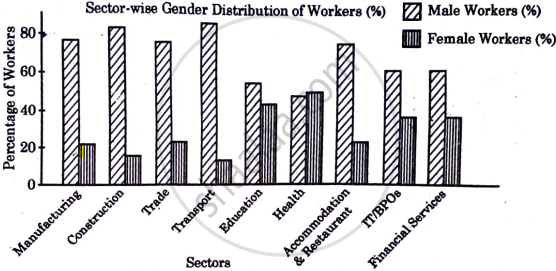
In the light of the given chart, analyse the gender-wise sectoral distribution of workers.
Chapter:
State and explain any two features which were observed in the demographic profile of India during the British rule.
Chapter:
“The British sought to achieve their vested interest through their policies of infrastructural development in India.”
Do you agree with the given statement? Justify your answer with a valid explanation.
Chapter:
Read the following text carefully:
| To ensure inclusive and quality education for all, the Indian government has launched several important schemes. These schemes aimed at improving access, equity and learning outcomes, especially among, disadvantaged group. The Right to Education (RTE) Act, passed by the India Parliament on August 4, 2009, guarantees free and compulsory education to every child between 6-14 years of age. It ensures that all children have access to education in neightbourhood schools, until they complete elementary education. Another key initiative is Sarva Siksha Abhiyan (SSA). It was introduced in 2001. It is one of India’s flagship programmes for the Universalisation of Elementary Education. Digital India Campaign, launched on July 1, 2015, focuses on transforming India into a digitally empowered society by improving mobile and internet connectivity, particularly in rural and remote regions. This initiative supports digital learning & access to educational resources. Through these initiatives, the government strives to create an equitable, accessible & quality driven educational environment for all children, laying a strong foundation for national development. |
On the basis of the given text and common understanding, answer the following questions:
- Identify, which law guarantees free and compulsory education upto the age of 14 years. Explain, how does it help in enhancing access to education. [3]
- In your opinion, how has the increase in public spending on education contributed to India’s social and economic transformation? Support your answer with valid arguments. [3]
Chapter:
Discuss any two objectives which were aimed at, by the introduction of Financial sector reforms by the Government of India during economic reforms of 1991.
Chapter:
Mr. Ravi, an IT entrepreneur from Bengaluru, observed that several MNC's prefer India as their outsourcing Hub for services like software development, customer support, data management etc.
His friend Priya believes this is due to certain inherent advantages of the Indian economy.
In your opinion, state and explain any two factors that make India a preferred outsourcing destination.
Chapter:
“Although the subsidies play a crucial role in giving incentive to farmers to adopt modern agricultural technologies, they simultaneously impose a significant fiscal strain on the resources of the Government.”
Justify the given statement with valid argument.
Chapter:
“The strategic sale of a public sector undertaking and the minority sale of its equity are both established instruments of disinvestment.”
Defend or refute, the given statement with valid arguments.
Chapter:
Other Solutions
Submit Question Paper
Help us maintain new question papers on Shaalaa.com, so we can continue to help studentsonly jpg, png and pdf files
CBSE previous year question papers Class 12 Economics with solutions 2025 - 2026
Previous year Question paper for CBSE Class 12 Economics-2026 is solved by experts. Solved question papers gives you the chance to check yourself after your mock test.
By referring the question paper Solutions for Economics, you can scale your preparation level and work on your weak areas. It will also help the candidates in developing the time-management skills. Practice makes perfect, and there is no better way to practice than to attempt previous year question paper solutions of CBSE Class 12.
How CBSE Class 12 Question Paper solutions Help Students ?
• Question paper solutions for Economics will helps students to prepare for exam.
• Question paper with answer will boost students confidence in exam time and also give you an idea About the important questions and topics to be prepared for the board exam.
• For finding solution of question papers no need to refer so multiple sources like textbook or guides.
