Commerce (English Medium)
Arts (English Medium)
Academic Year: 2024-2025
Date & Time: 19th March 2025, 10:30 am
Duration: 3h
Advertisements
General Instructions:
Read the following instructions carefully and follow them:
- This question paper contains 34 questions. All questions are compulsory.
- This question paper contains two sections:
Section - A: Macro Economics
Section - B: Indian Economic Development - This Question paper contains 20 Multiple Choice type questions. Each question carries 1 mark.
- This Question paper contains 4 Short Answer Type-I questions. Each question carries 3 marks. Answer these questions in 60 to 80 words.
- This Question paper contains 6 Short Answer Type-II questions. Each question carries 4 marks. Answer these questions in 80 to 100 words.
- This Question paper contains 4 Long Answer Type Questions. Each question carries 6 marks. Answer these questions in 100 to 150 words.
- Attempt all parts of a question together.
- In addition to this, NOTE that a separate question has been provided for Visually Impaired candidates in lieu of questions having visual inputs, maps, etc. Such questions are to be attempted by Visually Impaired candidates only.
- There is no overall choice in the question paper. However, an internal choice has been provided in a few questions. Only one of the choices in such questions has to be attempted.
The monetary policy is formulated by the ______ in the Indian economy.
Central Government
State Governments
Reserve Bank of India
World Bank
Chapter:
Identify which of the following is not to be considered while estimating revenue deficit of a country.
Wages and salaries paid by the government.
Interest payments made by the Central Government.
Direct Tax Collection.
Expenditure incurred on construction of flyover.
Chapter:
In the Keynesian Economics, ______ starts from the origin and is always drawn at an angle of 45°.
Consumption curve
Aggregate demand curve
Reference line
Investment curve
Chapter:
Assertion (A): In case of public goods, no one can be excluded from enjoying the benefits.
Reason (R): Public goods are non-rivalrous and non-excludable in nature.
Both Assertion (A) and Reason (R) are true, and Reason (R) is the correct explanation of Assertion (A).
Both Assertion (A) and Reason (R) are true, but Reason (R) is not the correct explanation of Assertion (A).
Assertion (A) is true, but Reason (R) is false.
Assertion (A) is false, but Reason (R) is true.
Chapter:
Value Addition = ______ − Value of Intermediate Consumption.
- Domestic sales
- Sales − change in stock
- Value of output
- (Number of units produced) × (Price per unit)
(i) and (ii)
(ii), (iii) and (iv)
(ii) and (iii)
(iii) and (iv)
Chapter:
Suppose for an economy, autonomous consumption stands as ₹ 100 crore and total consumption is ₹ 130 crores. The value of induced consumption would be ₹ ______ crore.
30
80
100
130
Chapter:
As the Banker to the Bank, Reserve Bank of India performs all functions except ______.
Purchase and sale of securities on behalf of general public
Maintaining current account for Commercial Banks
Clearing and settlement of Interbank transactions
Facilitating governmental transactions
Chapter:
Assertion (A): If the value of marginal propensity to save is 0.5, marginal propensity to consume will be equal to marginal propensity to save.
Reason (R): Sum of marginal propensity to consume and marginal propensity to save always equals to unity.
Both Assertion (A) and Reason (R) are true, and Reason (R) is the correct explanation of Assertion (А).
Both Assertion (A) and Reason (R) are true, but Reason (R) is not the correct explanation of Assertion (A).
Assertion (A) is true, but Reason (R) is false.
Assertion (A) is false, but Reason (R) is true.
Chapter:
The budget under which the government may spend an amount equal to the revenue it collects is referred as ______ Budget.
Surplus
Deficit
Balanced
Deflationary
Chapter:
To arrive at the value of equilibrium level of income, there must exists an equality between ex-ante ______ and ex-ante ______.
- Aggregate Demand, Aggregate Supply
- Aggregate Demand, Savings
- Aggregate Demand, Investment
- Savings, Investment
(i) and (ii)
(i) and (iv)
(ii) and (iii)
(iii) and (iv)
Chapter:
State the meaning and significance of Gross Domestic Product (GDP) deflator.
Chapter:
“The government generally levies higher Goods and Services Tax (GST) on socially undesirable products like cigarettes, tobacсо, liquor, etc.”
Identify and explain the indicated government budget objective in the above statement.
Chapter:
Two friends, Ramesh (a software engineer) and Pihu (a bakery owner), are discussing their contribution to the nation’s economy through tax payments. Ramesh earns ₹ 8,00,000 per year, which makes him liable to pay income tax. Pihu pays Goods and Service Tax (GST) on the sale of cakes and pastries.
On the basis of the given text, identify whether Ramesh is paying a direct tax or an indirect tax. Explain valid differences between two types of taxes.
Chapter:
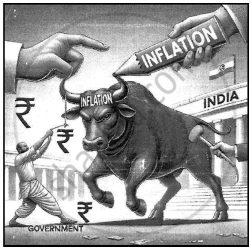
On the basis of the given image, explain the steps which may be taken by the Government of India to control the indicated macroeconomic issue.
Chapter:
Define the following concept.
Open Market Operation
Chapter:
Advertisements
Justify the following statement with valid arguments:
Money supply in an economy is an example of a stock variable.
Chapter:
Justify the following statement with valid arguments:
The Central Bank provides several Banking services to the government.
Chapter:
Assuming for a hypothetical economy, Central Bank increases the Reserve Ratio from 20% to 25%, and the total primary deposits stand at ₹ 1,000.
Explain the effect of rise in Reserve Ratio on credit creation by commercial banks.
Chapter:
Suppose for an economy, government proposes project for construction of expressways with an incremental investment of ₹ 1200 crore. Assuming, 80% of increase in income is spent on consumption. Estimate the following on the basis of above information:
- Change in income (ΔY). [2]
- Change in consumption (ΔС). [2]
Chapter:
On the basis of the data given below, estimate the value of National Income (NNPFC).
| S. No. |
Items | Amount (₹ in crore) |
| (1) | Private final consumption expenditure | 2,000 |
| (2) | Government final consumption expenditure | 1,500 |
| (3) | Gross domestic fixed capital formation | 1,000 |
| (4) | Addition to stock | 400 |
| (5) | Consumption of fixed capital | 50 |
| (6) | Net factor income from abroad | 100 |
| (7) | Net indirect Taxes | 200 |
| (8) | Net Exports | 700 |
Chapter:
Distinguish between real flows and money flows.
Chapter:
Gauhar has recently completed her fashion designing studies and started a boutique. To produce dresses for sale, she purchased various materials, including a sewing machine, fabric, buttons, and thread. These items are essential for producing the dresses.
Classify the material purchased by Gauhar as Final or Intermediate goods, giving valid reasons in support of the classifications.
Chapter:
“National Income is always equal to Domestic income in a two-sector economy.”
Defend or refute the given statement with valid reasons.
Chapter:
Read the following text carefully:
|
Balance of Payments (BoP) systematically summarise, the economic transactions of an economy with the rest of the world, over a given period of time. The BoP can be broadly divided into two accounts namely:
The current account measures the transfer of goods, services, income, and transfers between an economy and rest of the world. The current account may be subdivided into merchandise account and invisible account. Merchandise account consists of transactions related to export and import of goods. In the invisible account, there are three broad categories:
The capital account reflects the net changes in financial claims on rest of the world. The capital account can be broadly broken up into two categories:
The sum of the two accounts indicates the overall balance, which could be either be in surplus or deficit. The movement in overall balance is reflected in changes in international reserves of the country. Source: https : // mospi.gov.in/109-balance – payments |
On the basis of the given text and common understanding, answer the following questions:
- Define Balance of Payments. [1]
- Differentiate between the two accounts of ablorde Balance of Payments. [3]
- Give the meaning of Balance of Payments deficit with formula. [2]
Chapter:
______ of agriculture refers to production of crops for sale in the open market rather than for self consumption purpose.
Commercialisation
Diversification
Digitisation
Modernisation
Chapter:
Statement 1: In 1978, commune lands were divided into small plots to the individual households for cultivation.
Statement 2: Under commune system, professionals were sent to work and learn from the country side.
In the light of the given statements, choose the correct option from the following:
Statement 1 is true, and Statement 2 is false.
Statement 1 is false, and Statement 2 is true.
Both statements 1 and 2 are true.
Both statements 1 and 2 are false.
Chapter:
Identify the options that emphasize the role of information and technology.
- Achieving sustainable development.
- Attainment of food security.
- Disseminates information regarding emerging technologies.
Only (i)
Only (ii)
(i) and (ii)
(i), (ii), and (iii)
Chapter:
Assertion (A): Under the land reforms, Indian government fixed the minimum land size which could be owned by an individual.
Reason (R): The purpose of land ceiling was to avoid the concentration of land ownership in a few hands.
Both Assertion (A) and Reason (R) are true, and Reason (R) is the correct explanation of Assertion (A).
Both Assertion (A) and Reason (R) are true, but Reason (R) is not the correct explanation of Assertion (A).
Assertion (A) is true, but Reason (R) is false.
Assertion (A) is false, but Reason (R) is true.
Chapter:
______ are the people who operate their own farms / enterprises.
Hired Workers
Casual Wage Workers
Regular Salaried Employees
Self-Employed
Chapter:
Agricultural marketing is a process that involves the ______ of agricultural commodities.
- Privatisation
- Processing
- Assembling
- Grading
(i) and (ii)
(ii) and (iii)
(i), (ii), and (iii)
(ii), (iii), and (iv)
Chapter:
Advertisements
______ is based on the idea that education and health are integral to human well-being.
Human Resource
Human Development
Human Capital
Economic Development
Chapter:
In recent years, all the adults are encouraged to open bank accounts as a part of a scheme known as ______.
Jan-Dhan Yojana
Jan-Aushadhi Yojana
Jan-Soochna Yojana
Jan-Arogya Yojana
Chapter:
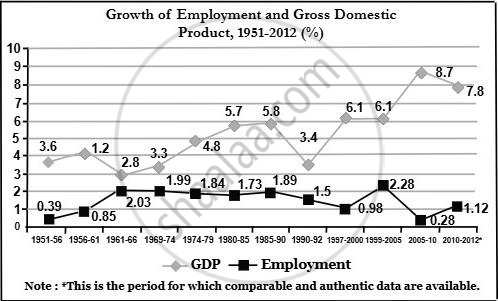
The given chart indicates the problem of ______ in the Indian economy, post-1990-92.
Informalisation of Workforce
Casualisation of Workforce
Jobless Growth
Formalisation of Workforce
Chapter:
Statement 1: Environmental concerns of waste generation and pollution have become critical, due to reversal of demand and supply relationship.
Statement 2: Environmental crisis happens when the rate of resource extraction is less than that of regeneration of resource.
In the light of the given statements, choose the correct option from the following:
Statement 1 is true, and Statement 2 is false.
Statement 1 is false, and Statement 2 is true.
Both statements 1 and 2 are true.
Both statements 1 and 2 are false.
Chapter:
Define liberty indicator.
Chapter: [3] Development Experience of India – a Comparison with Neighbours
|
Medhya and Danish both had their own farms. Medhya invested in a few agricultural courses, learnt modern farming techniques, and trained her labourers on best practices related to soil fertility, crop management, pest control, etc. Whereas, Danish invested heavily in, by purchasing advanced farming machinery, irrigation systems, and high-quality seeds. |
Do you agree that, Danish had made investment in human capital? Give valid reason in support of your answer.
Chapter:
“Expenditure on preventive medicine, curative medicine, and social medicine helps in building human capital and economic development.”
Do you agree with the given statement? Give valid arguments in support of your answer.
Chapter:
“The British introduced many infrastructural development project, which was largely driven by its own self-serving interest.”
Briefly explain any two main causes behind the infrastructural development undertaken by the colonial government.
Chapter:
“In the recent times, through various schemes and policies, the Government of India has taken vital initiatives to generate employment directly/indirectly.”
Justify the statement giving valid arguments.
Chapter:
“Micro credit programmes have been very helpful in supporting rural development and improving livelihoods in India.”
Do you agree with the given statement? Give valid reasons in support of your answer.
Chapter:
On the basis of the given data, compare and analyse the Distribution of workforce and its contribution to Gross Value added in India and China.
| Sectoral Share of Employment and GVA (%) in 2018-2019 | ||||||
| Sector | Contribution to GVA | Distribution of Workforce | ||||
| India | China | Pakistan | India | China | Pakistan | |
| Agriculture | 16 | 7 | 24 | 43 | 26 | 41 |
| Industry | 30 | 41 | 19 | 25 | 28 | 24 |
| Services | 54 | 52 | 57 | 32 | 46 | 35 |
| Total | 100 | 100 | 100 | 100 | 100 | 100 |
Source: Human Development Report 2019: Key Indicators of Asia and Pacific 2019.
Chapter:
“To promote green revolution, the Indian Government provided fertilizer subsidies to the farmers.”
Briefly explain any two arguments in favour of such subsidies.
Chapter:
As per a news report dated 8th Oct. 2021, the Government of India sold its entire 100% stake in Air India. Tata Sons, the original founder of Air India, won the bid and purchased the airline for ₹ 18,000 crore.
- Identify the step taken by the Government of India. [1]
- State any two ways in which identified step can be executed by the government. [2]
Chapter:
“After 1991, reforms in external sector led to an increase in foreign exchange inflows”.
Justify the given statement with valid argument.
Chapter:
“During the planning period, public sector was given a dominant role in Indian Economy.”
Justify the rationale behind this step taken by the Government of India.
Chapter:
Read the following text carefully:
|
Climate change and sustainability of environment are two pressing issues that have captured global attention. In recent years, the world has witnessed a surge in extreme weather events, including severe droughts, cloud bursts, floods, landslides, receding coastlines, and the alarming melting of Arctic ice and Himalayan Glaciers. Wildfires have become more frequent and intense. In this context, sustainable agriculture emerges as a crucial solution. This refers to those farming practices that meet today’s requirements while preserving resources for the future generation. This means adopting methods that protect the environment, reduce dependence on chemical inputs, efficiently using water and land, and ensuring socio-economic equity for farmers. On one hand, sustainable agricultural practices are necessary; on the other, they are often more expensive to implement compared to conventional methods. Sustainable practices like organic farming, climate - smart technologies, modern irrigation system may seem costly upfront, but they offer long-term benefits by improving productivity and environmental stewardship. Without accessible and affordable financing options, the much-needed shift to sustainable farming practices will remain a distant dream for many. Therefore, sustainable finance should not only promote eco-friendly practices but also ensure that financial resources are available to the farmers who need it. Source: https://website.vbi.org.in/web/rbi/-/speches - interview/financing-for- sustainable-agriculture (adopted and modified) |
On the basis of the given text and common understanding, answer the following questions:
- Define Sustainable Agriculture. [1]
- “Sustainable Agriculture practices, like organic farming, may seem costly initially, but offer long-term benefits.”
Discuss the long term benefits these practices can offer. [3] - State any two strategies to promote sustainable development in a developing country like India. [2]
Chapter:
Other Solutions
Submit Question Paper
Help us maintain new question papers on Shaalaa.com, so we can continue to help studentsonly jpg, png and pdf files
CBSE previous year question papers Class 12 Economics with solutions 2024 - 2025
Previous year Question paper for CBSE Class 12 Economics-2025 is solved by experts. Solved question papers gives you the chance to check yourself after your mock test.
By referring the question paper Solutions for Economics, you can scale your preparation level and work on your weak areas. It will also help the candidates in developing the time-management skills. Practice makes perfect, and there is no better way to practice than to attempt previous year question paper solutions of CBSE Class 12.
How CBSE Class 12 Question Paper solutions Help Students ?
• Question paper solutions for Economics will helps students to prepare for exam.
• Question paper with answer will boost students confidence in exam time and also give you an idea About the important questions and topics to be prepared for the board exam.
• For finding solution of question papers no need to refer so multiple sources like textbook or guides.
