Advertisements
Advertisements
प्रश्न
You would have seen lovely packets of tea on the shelves in supermarkets and shops. Have you ever wondered how tea powder is obtained from the plants? Look at the pictures and describe the process.
Advertisements
उत्तर
- The selected young Leaves are Plucked manually. Nowadays machines are available
- It is then left for drying.
- The dried leaves are then powdered and packed.
APPEARS IN
संबंधित प्रश्न
Why did the driver not approve of the narrator buying fruits from the boys?
Why did the author avoid going to Lucia’s room?
Describe the appearance of Nicola and Jacopo.
Recount the untold sufferings undergone by the siblings after they were rendered homeless.
Here are a few varieties of tea. How many of these have you tasted? Tick the boxes.

| Herbal Tea | |
| Ice Tea | |
| Lemon Tea | |
| Green Tea | |
| Black Tea | |
| Tea with Milk |
What seems ‘curious’ to the author?
Why does the author say that it is important to include a tea recipe in cookery books?
According to the author, what does the phrase ‘a nice cup of tea’ refer to?
Do tea lovers generally like strong tea or weak tea?
What are the author’s views on China tea?
What thoughts troubled Dr. Christiaan Barnard as he neared the end of his career as a heart surgeon?
When and where did the accident occur?
How did the hospitalization of Dr. Barnard and his wife affect their routine?
What does Dr. Barnard compare this entertainment to?
Describe the ‘Grand Prix’ at Cape Town’s Red Cross Children’s Hospital.
Adventures, expeditions, and explorations are always exciting. Especially when they are real and if it is the first of its kind, it is even more thrilling. The only question that comes to one’s mind is what makes one to take up such tasks that involve high risks. It is the spirit of formidable adventure and certain qualities which make them achieve such feats.
What did Hillary do with his wet boots?
What did Edmund Hillary do to escape the large overhanging ice cornices?
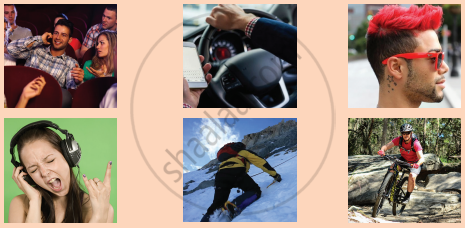
From the pictures given below, identity the actions that may cause inconvenience and discomfort to others. Discuss.
Why did the lady think she was entitled to walk down the middle of the road?
What would be the consequence of the old lady’s action?
What does the traffic policeman symbolize?
Explain in your own words, "What freedom means?"
Para 1
We started up our cooker and
drank large quantities of lemon juice and
sugar, and followed this with our last tin of
sardines on biscuits. I dragged our oxygen
sets into the tent, cleaned the ice off them,
and then rechecked and tested them.
Para 2
I had removed my boots, which
had become wet the day before, and they
were now frozen solid. So I cooked them
over the fierce flame of the Primus and
managed to soften them up. Over our
down clothing, we donned our windproof
and onto our hands, we pulled three pairs
of gloves – silk, woollen, and windproof.
Para 3
At 6.30 a.m. we crawled out of that
tent into the snow, hoisted our 30 lb. of
oxygen gear on to our backs, connected
up our masks and turned on the valves to
bring life-giving oxygen into our lungs. A
few good deep breaths and we were ready
to go. Still a little worried about my cold
feet, I asked Tenzing to move off.
How did Hillary and Tenzing prepare themselves before they set off to the summit? (Para 1, 2, and 3)
Para 18
My first feelings were of relief–
relief that there were no more steps to
cut, no more ridges to traverse, and no
more humps to tantalize us with hopes
of success. I looked at Tenzing. In spite of
the balaclava helmet, goggles, and oxygen
mask – all encrusted with long icicles–that
concealed his face, there was no disguising
his grin of delight as he looked all around
him. We shook hands, and then Tenzing
threw his arm around my shoulders and
we thumped each other on the back until
we were almost breathless. It was 11.30
a.m. The ridge had taken us two and a
half hours, but it seemed like a lifetime
To the east was our giant
Describe the feelings of Edmund Hillary and Tenzing as they reached the top of the Summit. (Para 18)
Para 15
For a few moments, I lay regaining
my breath, and for the first time really
felt the fierce determination that nothing
now could stop us from reaching the top. I took
a firm stance on the ledge and signaled
to Tenzing to come on up. As I heaved
hard on the rope, Tenzing wriggled his
way up the crack, and finally collapsed at
the top like a giant fish when it has just
been hauled from the sea after a terrible
struggle.
Para 16
The ridge continued as before:
giant cornices on the right; steep rock
sloped on the left. The ridge curved away
to the right and we have no idea where the
top was. As I cut around the back of one
hump, another higher one would swing
into view. Time was passing and the ridge
seemed never-ending.
Para 17
Our original zest had now quite
gone, and it was turning more into a grim
struggle. I then realized that the ridge
ahead, instead of rising, now dropped
sharply away. I looked upwards to see a
narrow snow ridge running up to a snowy
summit. A few more whacks of the ice-ax
in the firm snow and we stood on top.
The ridge had taken us two and half hours, but it seemed like lifetime. Why? (Para 15 to 17)
Para 19
neighbour Makalu, unexplored and
unclimbed. Far away across the clouds,
the great bulk of Kanchenjunga loomed
on the horizon. To the west, we could
see the great unexplored ranges of Nepal
stretching off into the distance.
Para 20
The most important photograph,
I felt, was a shot down the North Ridge,
showing the North Col and the old route
which had been made famous by the
struggles of those great climbers of the
1920’s and 1930’s. After ten minutes,
I realized that I was becoming rather
clumsy-fingered and slow-moving. So I
quickly replaced my oxygen set
Describe the view from the top. What was the most important photograph? (Para 19 and 20)
How responsible and capable are you at home?
