Advertisements
Advertisements
प्रश्न
Write the Van der Waals equation for a real gas. Explain the correction term for pressure and volume.
Advertisements
उत्तर
Vander Waals equation for a real gas is given by
`("P" + ("an"^2)/("V"^2)) ("V" - "nb") = "nRT"`
Pressure Correction:
The pressure of a gas is directly proportional to the force created by the bombardment of molecules on the walls of the container. The speed of a molecule moving towards the wall of the container is reduced by the attractive forces exerted by its neighbours. Hence, the measured gas pressure is lower than the ideal pressure of the gas. Hence, van der Waals introduced a correction term to this effect.
Where n is the number of moles of gas and V is the volume of the container
`"p" ∝ "n"^2/"V"^2`
`"P" = "an"^2/"V"^2`
Where a is proportionality constant and depends on the nature of gas
Therefore, P = `"P" + "an"^2/"V"^2`
Volume Correction:
As every individual molecule of a gas occupies a certain volume, the actual volume is less than the volume of the container, V. Van der Waals introduced a correction factor V to this effect. Let us calculate the correction term by considering gas molecules as spheres.
V = excluded volume
Excluded volume for two molecules = `4/3` π(2r)3 = 8Vm
where Vm is a volume of a single molecule.
Excluded volume for single molecule = `(8"V"_m")/2` = 4Vm
Excluded volume for n molecule = n(4Vm) = nb
Where b is van der Waals constant which is equal to 4Vm
V’ = nb
Videal = V – nb
Replacing the corrected pressure and volume in the ideal gas equation PV = nRT we get the van der Waals equation of state for real gases as below,
`("P" + ("an"^2)/("V"^2)) ("V" - "nb") = "nRT"`
The constants a and b are van der Waals constants and their values vary with the nature of the gas.
APPEARS IN
संबंधित प्रश्न
The value of the universal gas constant depends upon
Maximum deviation from ideal gas is expected from
Which of the following diagrams correctly describes the behaviour of a fixed mass of an ideal gas? (T is measured in K)
In what way real gases differ from ideal gases.
Pressure versus volume graph for a real gas and an ideal gas are shown in figure. Answer the following questions on the basis of this graph.
(i) Interpret the behaviour of real gas with respect to ideal gas at low pressure.
(ii) Interpret the behaviour of real gas with respect to ideal gas at high pressure.
(iii) Mark the pressure and volume by drawing a line at the point where real gas behaves as an ideal gas.
Match the following graphs of ideal gas with their co-ordinates:
| Graphical representation | x and y co-ordinates |
(i) 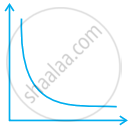 |
(a) pV vs. V |
(ii) 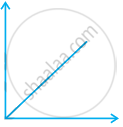 |
(b) p vs. V |
(iii) 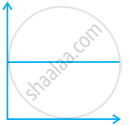 |
(c) p vs. `1/V` |
Assertion (A): At constant temperature, pV vs V plot for real gases is not a straight line.
Reason (R): At high pressure all gases have \[\ce{Z}\] > 1 but at intermediate pressure most gases have \[\ce{Z}\] < 1.
Isotherms of carbon dioxide gas are shown in figure. Mark a path for changing gas into liquid such that only one phase (i.e., either a gas or a liquid) exists at any time during the change. Explain how the temperature, volume and pressure should be changed to carry out the change.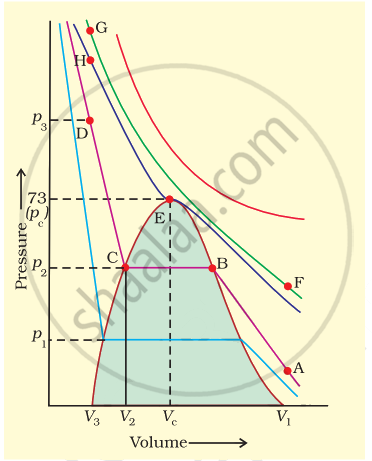
In van der Waal's equation for the real gas, the expression for the net force of attraction amongst the gas molecules is given by:
Choose the correct option for the total pressure (in atm.) in a mixture of 4g \[\ce{O2}\] and 2g \[\ce{H2}\] confined in a total volume of one litre at 0°C is ______.
[Given R = 0.082 L atm mol−1K−1, T = 273 K]
