Advertisements
Advertisements
प्रश्न
In what way real gases differ from ideal gases.
Advertisements
उत्तर
- Ideal gases are the gases that obey gas laws or gas equation PV = nRT.
- Real gases do not obey gas equation. PV = nRT.
- The deviation of real gases from ideal behaviour is measure in terms of a ratio of PV to nRT. This is termed as compression factor (Z). Z = `"PV"/"nRT"`
- For ideal gases Z = 1.
- For real gases Z > 1 or Z < 1. For example, at high-pressure real gases have Z >1 and at intermediate pressure Z < 1.
- Above the Boyle point Z > 1 for real gases and below the Boyle point, the real gases first show a decrease for Z, reach a minimum and then increase with the increase in pressure.
- So, it is clear that at low pressure and high temperature, the real gases behave as ideal gases.
APPEARS IN
संबंधित प्रश्न
Which of the following is the correct expression for the equation of state of van der Waals gas?
Which of the following diagrams correctly describes the behaviour of a fixed mass of an ideal gas? (T is measured in K)
Can a Van der Waals gas with a = 0 be liquefied? explain.
Suppose there is a tiny sticky area on the wall of a container of gas. Molecules hitting this area stick there permanently. Is the pressure greater or less than on the ordinary area of walls?
Explain whether a gas approaches ideal behavior or deviates from ideal behaviour if it is compressed to a smaller volume at a constant temperature.
Explain whether a gas approaches ideal behavior or deviates from ideal behaviour if more gas is introduced into the same volume and at the same temperature.
Which of the following gases would you expect to deviate from ideal behavior under conditions of low-temperature F2, Cl2, or Br2? Explain.
If 1 gram of each of the following gases are taken at STP, which of the gases will occupy (a) greatest volume and (b) smallest volume?
\[\ce{CO, H2O, CH4 , NO}\]
Compressibility factor, Z, of a gas is given as Z = `(pV)/(nRT)`. What is the value of Z for an ideal gas?
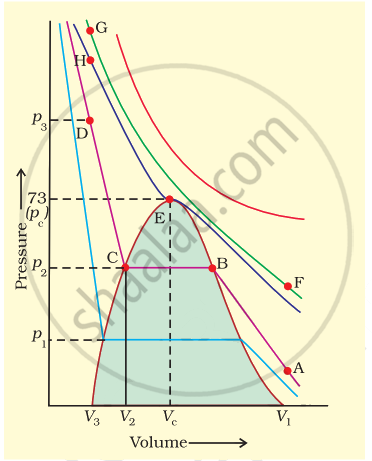
Isotherms of carbon dioxide gas are shown in figure. Mark a path for changing gas into liquid such that only one phase (i.e., either a gas or a liquid) exists at any time during the change. Explain how the temperature, volume and pressure should be changed to carry out the change.