Advertisements
Advertisements
प्रश्न
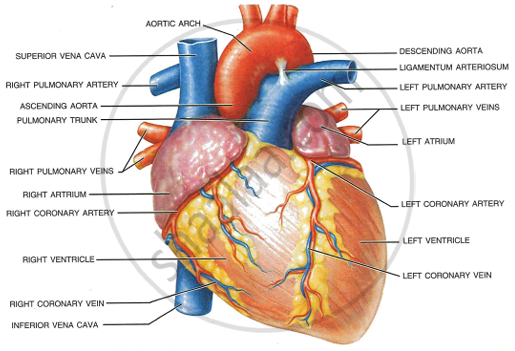
Write a short note on the human heart.
Advertisements
उत्तर
The heart is a pump that circulates blood to all parts of the body. It is about the size of a human fist and located to the left in chest cavity. It has four chambers – two upper chambers called auricles or atria and two lower chambers called ventricles. The auricles receive blood from different body parts and ventricles pump the blood out of the heart. The valves between auricle and ventricle on each side allow blood to flow in one direction only. Heart acts as a double pump. The right side of the heart carries deoxygenated blood to the lungs to be oxygenated. The left side of the heart pump oxygenated blood to the body.
APPEARS IN
संबंधित प्रश्न
Differentiate between members of the following pairs with reference to the aspect asked within bracket:
Tricuspid and bicuspid values (location)
Given below is a highly schematic diagram of the human blood circulatory system.
Which numbers represent the following respectively?
Aorta
Hepatic portal vein
Pulmonary artery
Superior vena cava
Renal vein
Stomach

Give any three differences between an artery and a vein
Name the main parts of the circulatory system.
Complete the following sentence with appropriate word:
Beside food, oxygen and waste materials, circulatory system transports ________ to various parts of the body.
Mention, if the following statement is True or False. If false rewrite the wrong statement in its correct form:
The walls of auricles are thicker than those of ventricles.
Which of the following is TRUE regarding leucocytosis?
______ WBCs are present per mm3 of blood.
The heart is covered by ______.
 |
Can you answer why the pulmonary artery shown in Fig. is blue in colour?
