Advertisements
Advertisements
प्रश्न
Write a note on coagulation of blood.
Advertisements
उत्तर
- Clotting or coagulation is the process of converting the liquid blood into a solid form. This process may be initiated by contact of blood with any foreign surface (intrinsic process) or with damaged tissue (extrinsic process).
- Intrinsic and extrinsic processes involve interaction of various substances called clotting factors by a step wise or cascade mechanism.
- There are in all twelve clotting factors numbered as I to XIII (factor VI is not in active use). Interaction of these factors occurs in cascade manner leading to formation of the enzyme thrombin.
- Thromboplastin helps in the formation of enzyme prothrombinase. This enzyme inactivates heparin and it also converts inactive prothrombin into its active thrombin.
- Thrombin converts soluble blood protein fibrinogen into insoluble fibrin. Fibrin forms a mesh in which platelets and other blood cells are trapped to form the clot.
APPEARS IN
संबंधित प्रश्न
Differentiate between the RBC and WBC (Shape)
What are the functions of blood plasma?
Name the following:
The phase of the cardiac cycle in which the ventricles get filled with blood from the atrium.
Choose the correct answer:
How much blood is present in an average person?
Choose the correct answer:
Which of the following is termed as the 'graveyard' of R.B.C.?
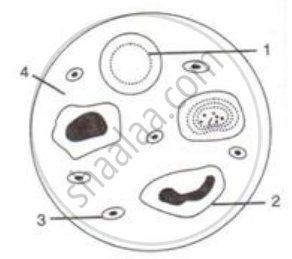
Given below is a diagram of a smear of human blood. Study the same and answer the question that follow:
Name a soluble protein found in "4" which helps in clotting of blood.
Name the Following
The number of RBCs in men.
Complete the following sentence with appropriate word:
The site of production of W.B.Cs in the embryo is _________
Intrinsic and extrinsic processes involve interaction of various substances called _______ by a step-wise or cascade mechanism.
The kind of cells that initiate blood coagulation:
