Advertisements
Advertisements
प्रश्न
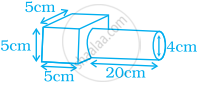
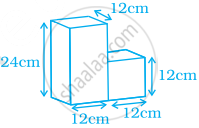
Work out the surface area of following shape (use π = 3.14).
Advertisements
उत्तर
In the given figure, there is a cube of side 5 cm and a cylinder of height 20 cm and radius is 2 cm.
So, total surface area = surface area of the cube + curved surface area of cylinder
= 6(5)2 + 2π(2) × 20 ...`[(∵ "Surface area of cube" = 6a^2),(∴ "Surface area of cylinder" = 2 pirh)]`
= 150 + 80π
Total surface area = 150 + 251.2 = 401.2 cm2
Notes
In this question assume that cylinder is at end open.
APPEARS IN
संबंधित प्रश्न
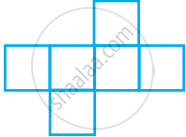
Identify the net which can be used to make cube (cut out copies of the net and try it):
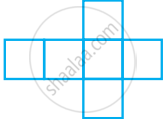
Identify the net which can be used to make cube (cut out copies of the net and try it):
Match the nets with appropriate solids:
| (a) | 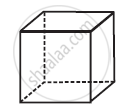 |
(i) | 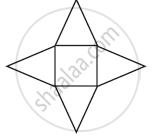 |
| (b) | 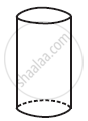 |
(ii) | 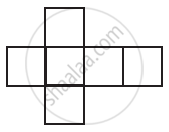 |
| (c) |  |
(iii) |  |
| (d) | 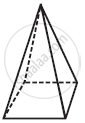 |
(iv) | 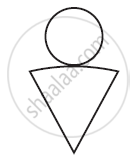 |
Make 8 triangles using 6 matchsticks. Try!
Every solid shape has a unique net.
In the given figure, identify the different shapes involved.

Use isometric dot paper to draw figure.
A tetrahedron
Use isometric dot paper to draw figure.
A rectangular prism with length 4 units, width 2 units and height 2 units.
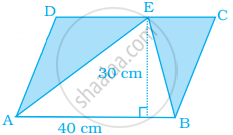
Find the area of the shaded portion in the following figure.
Work out the surface area of following shape (use π = 3.14).
A solid with no vertex is ______.
Two dimensional figures are also called plane figures.
State whether the statement is True or False.
The circle, the square, the rectangle and the triangle are examples of plane figures.
The circle, the square, the rectangle and the triangle are examples of plane figures.
The circle, the square, the rectangle and the triangle are examples of plane figures.
The circle, the square, the rectangle and the triangle are examples of plane figures.
The circle, the square, the rectangle and the triangle are examples of plane figures.
The circle, the square, the rectangle and the triangle are examples of plane figures.
The circle, the square, the rectangle and the triangle are examples of plane figures.
