Advertisements
Advertisements
प्रश्न
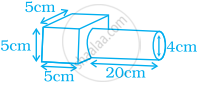
Work out the surface area of following shape (use π = 3.14).
Advertisements
उत्तर
In the given figure, there is a cube of side 5 cm and a cylinder of height 20 cm and radius is 2 cm.
So, total surface area = surface area of the cube + curved surface area of cylinder
= 6(5)2 + 2π(2) × 20 ...`[(∵ "Surface area of cube" = 6a^2),(∴ "Surface area of cylinder" = 2 pirh)]`
= 150 + 80π
Total surface area = 150 + 251.2 = 401.2 cm2
Notes
In this question assume that cylinder is at end open.
APPEARS IN
संबंधित प्रश्न
A suitcase with measures 80 cm × 48 cm × 24 cm is to be covered with a tarpaulin cloth. How many metres of tarpaulin of width 96 cm is required to cover 100 such suitcases?
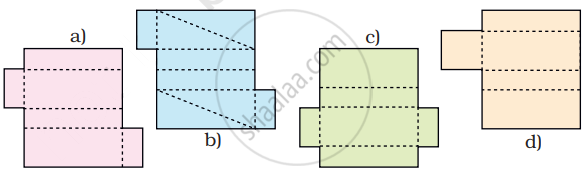
Ramya made four more shapes. Each is to be folded along the dotted lines. You have to find out which of these can be made into a box.
A pentagonal prism has ______ faces.
Every solid shape has a unique net.
Find the perimeter of the given figure.
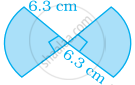
Find the area of the shaded portion in the following figure.
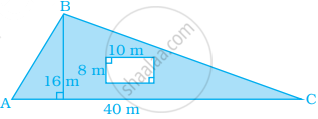
Find the area of the shaded portion in the following figure.

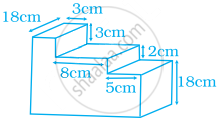
Work out the surface area of following shape (use π = 3.14).
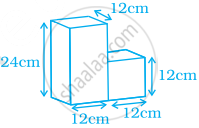
Work out the surface area of following shape (use π = 3.14).
Out of the following which is a 3-D figure?
A solid with no vertex is ______.
A sphere has ______ vertex, ______ edge and ______ curved surface.
While sphere is a 2-D figure, circle is a 3-D figure.
The circle, the square, the rectangle and the triangle are examples of plane figures.
The circle, the square, the rectangle and the triangle are examples of plane figures.
The circle, the square, the rectangle, and the triangle are examples of plane figures.
The circle, the square, the rectangle and the triangle are examples of plane figures.
