Advertisements
Advertisements
प्रश्न
Work in groups of four. Discuss how the story would have been different if.
Pongo had arrived on the scene before the last orange was eaten.
Advertisements
उत्तर
The narrator was got red-handed when he came out from the docks. As his apron string was broken, the policeman, Pongo could find out his bulging pockets. The seventeen oranges in his pockets. Pongo caught him for his theft and locked him in a cabin. He kept the narrator in the cabin, he went out to bring another policeman to be a witness to the case.
The narrator was fear–stricken. A voice from the narrator’s head told him to eat away all the oranges. It forced him to eat the seeds and the peels. The narrator had to eat them to destroy the evidence. He ate the oranges quickly. But only one orange was left. At that time, the policemen had come near the cabin.
The narrator heard the sound of their arrival. They opened the cabin and found only one orange left on the table. They understood the narrator’s attempt to destroy the evidence. They seized the last orange and warned him of his criminal act of destroying the evidence. Both of them decided to produce the narrator before the court to get him punished, thereby teaching a lesson to others.
APPEARS IN
संबंधित प्रश्न
“Why do volcanoes erupt?”
She wondered why ______.
Discuss in groups of five. Make a story about the comic strip. Then share it in the class.

Change the following into Direct Speech.
Nevin asked his father when the next letter would come.
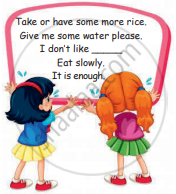
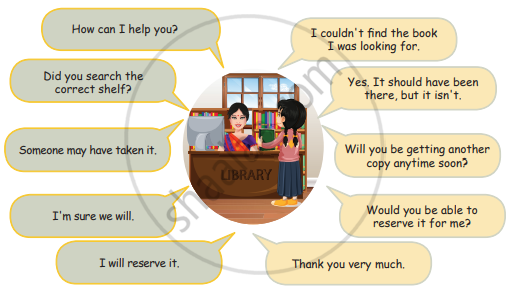
Structures that are useful for this situation.

Borrowing a book from public Library.
Interview your teacher and get her responses for the following questions.
- Why did you become a teacher?
- How do you come to school every day?
- Do you have any pets?
- What kinds of books do you like to read?
- What are your hobbies?
What are the different kinds of books in this bookshop or in any other bookshop you have seen? Tell the class.
There are many reasons why something happens.
For example
| Event | Reasons |
|
|
Prepare a speech on “The importance of a reading habit” in about 100–150 words using the hints given below together with your own ideas.
- Introduction
- Suggested value points Knowledge enrichment – Skill development – Meaningful usage of time – Overall development
- Conclusion
Build a conversation for the following situation with a minimum of five exchange.
A father and his daughter about the advantages of the habit of newspaper reading.
