Advertisements
Advertisements
प्रश्न
With the help of the Motilal Nehru Report 1928, briefly describe the events that led to the launching of the Civil Disobedience Movement.
Advertisements
उत्तर
The Secretary of State for India, Lord Birkenhead, asked the Indian leaders to prepare and produce a Constitution for India which should be acceptable to all the political parties of India. He threw this challenge twice. First in 1925 and again in 1927. This time the National Congress accepted this challenge. An All Party Conference was held at Bombay under the Presidentship of Mrs. Annie Besant in May 1928. There, a small sub committee was constituted under Motilal Nehru, to draft a Constitution for British India. The committee submitted the report, which is called the Nehru Report. It recommended the following main features of the proposed Constitution:
- Attainment of Dominion Status by India at an early date.
- The religious minorities be given full protection and their interests be safeguarded.
- The Executive had to be responsible to the Legislature, and
- India to have a Federal form of Government, with provisions of provincial autonomy.
- Linguistic organisation of the British provinces.
- The Governors to work on the advice of the Provincial Executive Councils.
The committee rejected the idea of separate electorates, but favoured the protection of minorities. Shortly thereafter, the All-Party Conference was held again in December 1928 at Calcutta to consider and give final shape to Nehru’s Report which was also called ‘Nehru’s Constitution.’ Jinnah who represented the Muslim League, opposed some of its provisions. Jinnah demanded that certain safeguards for the minorities be incorporated in the Constitution. On the basis of this amendment, the Muslim League provisionally approved the Nehru Report. But the League totally rejected the report when Jinnah announced his famous Fourteen Points Plan, as the minimum condition, acceptable to the League for any political settlement.
संबंधित प्रश्न
Why was the Congress session held at Lahore significant to the National Movement?
Explain the following statement with a reason.
The deliberations in the First Round Table Conference proved to be meaningless.
Answer the following question in 25 to 30 words.
Why did the Indian National Congress withdraw the Civil Disobedience Movement?
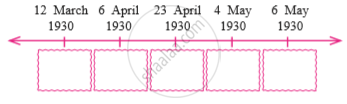
Complete the following timeline of Civil Disobedience Movement.
Gather additional information along with photographs about the work of the following personality in the Civil Disobedience Movement and exhibit it in the class.
Sarojini Naidu:
When and by whom w as the Civil Disobedience Movement launched?
Who is popularly known as the Frontier Gandhi?
Mention any two events which led to the Civil Disobedience Movement of 1930.
Why was the Simon Commission appointed by the British Government? Why did the Congress boycott the Commission.
People protested against the ______ because it had seven British members and no Indian representation.
