Advertisements
Advertisements
प्रश्न
Why was the Simon Commission appointed by the British Government? Why did the Congress boycott the Commission.
The Simon Commission was appointed in November 1927 by the British Government. Subsequently, the Civil Disobedience Movement began. In this context answer the following questions:
- Why was the Simon Commission appointed by the British Government? Why did the Congress boycott the Commission?
- The Civil Disobedience Movement was launched by Gandhiji with his famous Dandi March. Mention the significance of this historic event.
- Why did Gandhiji suspend Civil Disobedience Movement in 1931 and later in 1934 call it off?
Advertisements
उत्तर १
The Simon Commission was appointed by the Government to look into the working of the Government of India Act 1919 and suggest further reforms.
The Congress decided to Boycott it because:
- It was an ‘all white’ commission. No Indian was included in it.
- It refused to accept the demand for Swaraj.
उत्तर २
- The Simon Commission was formed in 1927 to review the reforms made under the Government of India Act of 1919. However, it faced widespread opposition since all its members were British, and the government was unwilling to consider the demand for Swaraj.
- The Civil Disobedience Movement began with the Dandi March on March 12, 1930. Gandhiji and 79 Satyagrahis marched from Sabarmati Ashram to Dandi, a village 390 km away on Gujarat’s west coast.
- The goal was to transform the national movement into a mass movement.
- Breaking the salt laws led to the spread of the Civil Disobedience Movement, which included boycotting foreign goods and refusing to pay taxes.
- A large number of people, including women, took part in the movement.
- The movement pressured the government to sign the Gandhi-Irwin Pact.
- Since the government could not suppress the Satyagraha, negotiations with Gandhiji began through Tej Bahadur Sapru and Jayakar.
- This resulted in the signing of the Gandhi-Irwin Pact in March 1931.
- According to the terms of the pact, Congress agreed to suspend the Civil Disobedience Movement.
- The government agreed to release political prisoners who had not committed violent crimes.
- However, the global Great Depression of the 1930s severely impacted Indian farmers.
- Gandhiji requested an interview with Viceroy Willingdon but it was denied.
- Congress then passed a resolution to restart the Civil Disobedience Movement.
- The government responded by issuing ordinances, granting itself special powers, and repressing the movement.
- Congress was declared illegal, and many leaders were arrested with their properties seized.
- Communal tensions were stirred up during this period.
- Over time, the Civil Disobedience Movement lost its momentum, and Congress officially ended it in 1934.
Notes
Students should refer to the answer according to their question.
APPEARS IN
संबंधित प्रश्न
Answer the following question in 25 to 30 words.
Why did Gandhiji decide to break the Salt Act to begin the satyagraha all over the country?
Plot on an outline map of India ,the places mentioned in the chapter where the Civil Disobedience Movement took place.
Why was the Dandi March important in the history of the National Movement?
What was the reaction of the Indians to the Simon Commission?
Why was the ‘Civil Disobedience Movement’ of March 1930, withdrawn?
Or
What assurance did Gandhiji withdraw the Civil Disobedience Movement.
How did the people of India react of the appointment of Simon Commission.
The British Government announced the formation of the Simon Commission in 1927. In this context briefly explain the purpose of its formation and its main recommendations.
The Civil Disobedience Movement was significant in the history of the National Movement. With-reference to this movement, write short notes on the circumstances leading to Civil Disobedience Movement.
Identify the picture as shown and answer the following: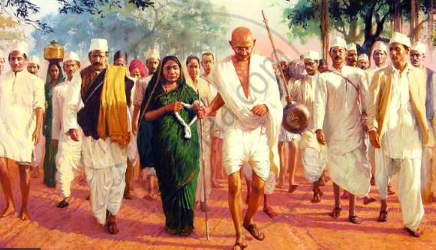
(i) With which movement it is associated?
(ii) When and where the movement took place?
Gather additional information along with photographs about the work of the following personality in the Civil Disobedience Movement and exhibit it in the class.
Khan Abdul Gafar Khan:
