Advertisements
Advertisements
प्रश्न
Why do the worker ants carry the grubs about?
Advertisements
उत्तर
The worker ants carry the grubs about daily for airing, exercise and sunshine.
संबंधित प्रश्न
Thinking about the Poem
What does the poet wish for the snake?
Look at the following sentences. They each have two clauses, or two parts each with their own subject and verb or verb phrase. Often, one part (italicised) tells us when or why something happened.
• I reached the market when most of the shops had closed. (Tells us when I reached.)
• When Rahul Dravid walked back towards the pavilion, everyone stood up. (Tells us when everyone stood up.)
• The telephone rang and Ganga picked it up. (Tells us what happened next.)
• Gunjan has been with us ever since the school began. (Tells us for how long he has been with us.)
I. Identify the two parts in the sentences below by underlining the part that gives us the information in brackets.
1. Where other girls wore traditional Indian dresses, Santosh preferred shorts.
(Contrasts her dress with that of others)
2. She left home and got herself enrolled in a school in Delhi. (Tells us what happened after the first action.)
3. She decided to fight the system when the right moment arrived. (Tells us when she was going to fight the system.)
4. Little Maria had not yet celebrated her tenth birthday when she was packed off to train in the United States. (Tells us when Maria was sent to the U.S.)
Read the following conversation between two friends.
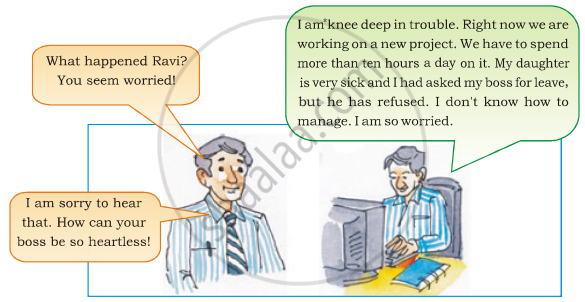
Read the song once again.
I am dotted silver threads dropped from heaven
By the gods. Nature then takes me, to adorn
Her fields and valleys.
I am beautiful pearls, plucked from the
Crown of Ishtar by the daughter of Dawn
To embellish the gardens.
When I cry the hills laugh;
When I humble myself the flowers rejoice;
When I bow, all things are elated.
The field and the cloud are lovers
And between them I am a messenger of mercy.
I quench the thirst of the one;
I cure the ailment of the other.
The voice of thunder declares my arrival;
The rainbow announces my departure.
I am like earthly life which begins at
The feet of the mad elements and ends
Under the upraised wings of death.
I emerge from the heart of the sea and
Soar with the breeze. When I see a field in
Need, I descend and embrace the flowers and
The trees in a million little ways.
I touch gently at the windows with my
Soft fingers, and my announcement is a
Welcome song. All can hear, but only
The sensitive can understand.
I am the sigh of the sea;
The laughter of the field;
The tears of heaven.
So with love -
Sighs from the deep sea of affection; Laughter from the colourful
field of the spirit; Tears from the endless heaven of memories.
About the Poet
Kahlil Gibran (1883-1931) was a Lebanese-American artist, poet and writer. His
poetry is notable for its use of formal language as well as insights on topics of life using
spiritual terms. One of his most notable lines of poetry in the English-speaking world is
from Sand and Foam (1926) which reads 'Half of what I say is meaningless, but I say
it so that the other half may reach you.'
Know all about Chess . Read and enjoy :
You now know a little about Koneru Humpychess player but do you know how to play chess? Let's know more about it:
Have you ever played chess? Did you know that chess is the oldest skill game in the world? But chess is more than just a. game of skill. It can tell you much about the way people lived in medieval times. If you look at the way a chess board is set up, then study the pieces and how they are used, you will realise that chess is a history of medieval times in miniature. The six different chess pieces on the board represent a cross section of medieval life with its many ceremonies grandeur ,and wars .
Chess was played many centuries ago in China, India, and Persia. No one really knows for sure in which country it originated. Then, in the eighth century, armies of Arabs known as Moors invaded Persia. The Moors learned chess from the Persians. When the Moors later invaded Spain, the soldiers brought the game of chess with them. Soon the Spanish were playing chess, too. From Spain, the popularity of chess quickly spread throughout all of Europe
Europeans gave chess pieces the names we know today; they probably had trouble pronouncing and spelling the Persian names, so they modernized them to reflect the way they lived. Today, the names certainly aren't modem but a thousand years ago they represented the very way in which both ordinary people and persons of rank lived their lives.
The pawns on the chess board represent serfs, or labourers. There are more of them than any other piece on the board, and often they are sacrificed to save the more valuable pieces. In medieval times, serfs were considered no more than the property of landowners, or chattels. Life was brutally hard for serfs during this era of history. They worked hard and died young. They were often left unprotected while wars raged around them. They could be traded, used as a diversion, or even sacrificed to allow the landowners to escape harm.
The castle piece on a chess board is the home, or the refuge, just as it was a home in medieval times. In Chess, each side has two castles, or rooks, as they are sometimes called.
The knight on a chess board represents the professional soldier of medieval times whose job it was to protect persons of rank, and there are two of them per side in a game of chess. Knights in a game of chess are more important than pawns, but less important than bishops, kings, or queens. Their purpose in the game of chess is to protect the more important pieces, and they can be sacrificed to save those pieces just as pawns can.
There is a bishop in the game of chess, who represents the church. The Church was a rich and mighty force in medieval times, and religion played a large part in every person's life. It is no wonder that a figure that represented the concept of religion found its way into the game. A bishop was the name for a priest in the Catholic church who had risen through the ranks to a more powerful position. In the game of chess, there are two bishops for each side.
The queen is the only piece on the board during a chess game that represents a woman, and she is the most powerful piece of the game.
The king is the tallest piece on the board, and is as well defended on the chessboard as in medieval life. In medieval times, the surrender of the king would mean the loss of the kingdom to invading armies and that could mean change for the worse. It was to everyone's advantage, from the lowest serf to the highest-ranking official, to keep the king safe from harm.. The king is the most important, but not the most powerful piece in chess. If you do not protect your king, you lose the game.
The next time you set up your chessboard and get ready 7 to play a friendly game or two, think of chess as a 6 history lesson. The pieces on the board represent a way 5 of life that is no more, and the real life dramas that occurred in medieval times are now only a game.
What does he plant who plants a tree? a
He plants a friend of sun and sky;b
He plants the flag of breezes free;
The shaft of beauty, towering high;
He plants a home to heaven anigh;
For song and mother-croon of bird
In hushed and happy twilight heard____
The treble of heaven's harmony_____
These things he plants who plants a tree.
Read the lines given above and answer the question that follow:
"My father lived at Blenheim then,
Yon little stream hard by;
They burnt his dwelling to the ground,
And he was forced to fly;
So with his wife and child he fled,
Nor had he where to rest his head.
"With fire and sword the country round
Was wasted far and wide,
And many a childing mother then,
And new-born baby died;
But things like that, you know, must be
At every famous victory;
Read the lines given above and answer the question that follow.
Explain with reference to context.
"They say it was a shocking sight
After the field was won;
For many thousand bodies here
Lay rotting in the sun;
But things like that, you know, must be
After a famous victory.
"Great praise the Duke of Marlbro'won,
And our good Prince Eugene."
"Why,'twas a very wicked thing!"
Said little Wilhelmine.
"Nay...nay...my little girl,"quoth he,
"It was a famous victory.
"And everybody praised the Duke
Who this great fight did win."
"But what good came of it at last?"
Quoth little Peterkin.
"Why that I cannot tell,"said he,
"But 'twas a famous victory."
Read the lines given above and answer the question that follow.
In “The Battle of Blenheim,” why are Wilhelmine’s words “twas a very wicked thing” ironic?
Oh yes, we know it keeps them still,
They don't climb out the window sill,
They never fight or kick or punch,
They leave you free to cook the lunch
And wash the dishes in the sink....
But did you ever stop to think,
To wonder just exactly what
This does to your beloved tot?
IT ROTS THE SENSE IN THE HEAD!
IT KILLS IMAGINATION DEAD!
IT CLOGS AND CLUTTERS UP THE MIND!
IT MAKES A CHILD SO DULL AND BLIND
HE CAN NO LONGER UNDERSTAND
A FANTASY, A FAIRYLAND!
HIS BRAIN BECOMES AS SOFT AS CHEESE!
HIS POWERS OF THINKING RUST AND FREEZE!
HE CANNOT THINK - HE ONLY SEES!
Read the lines given above and answer the question given below.
How are televisions helpful to parents?
Read the extract given below and answer the questions that follow :
An angry athlete is an athlete who will make mistakes, as any coach will tell you I was no exception. On the first of my three qualifying jumps, I leaped from several inches beyond the · take-off board for a foul.
(i) When and where is this story set? What reason does the narrator Jesse Owens give for the heightened nationalistic feelings at this time?
(ii) In which event had Owens been confident of winning a gold medal? Why?
(iii) What had, made Owens angry enough to make mistakes?
(iv) Name Owens' rival who approached him at this point. What advice did this athlete give Owens?
(v) How did the two athletes perform in the finals? What does Jesse Owens consider his 'Greatest Olympic Prize'? Why?
Read the extract given below and answer the questions that follow :
One Sunday morning Squealer announced that the hens, who just come in to lay again, must surrender their eggs.
(i) Why were the hens required to surrender their eggs?
(ii) How did the hens react to receiving this information?
(iii) The three young black Minorca pullets led the other hens in 'something resembling a rebellion'. How exactly did they do this?
(iv) What steps did Napoleon take to put down this 'rebellion'?
(v) How long did the rebellion last? Describe the consequences of the rebellion. What do you learn of Napoleon's character from the way in which he dealt with the rebellion?
The tiger was still licking his arm, with increasing relish. The phrase in underlined suggests that Timothy
Mr Gessler in his last wasn’t in good health. Give three examples to prove this.
Where did the old flea collected by Mr Wonka live?
How did Vijay Singh feel when he was told to go to the Haunted Deserts?
Word in the box given below indicates a large number of… For example, ‘a herd of cows’ refers to many cows. Complete the following phrase with a suitable word from the box.
a _____________of chicks
Where did the author usually spend his afternoons?
Multiple Choice Question:
What does the expression Whatif mean?
Find out the meaning of the following words by looking them up in the dictionary. Then use them in sentences of your own.
smearing
Add im- or in- to each of the following words and use them in place of the italicised words in the sentences given below.
| patient, proper, possible, sensitive, competent |
"Don’t lose patience. Your letter will come one day," the postman told me.
