Advertisements
Advertisements
प्रश्न
Why do moss plants produce very large number of male gametes? Provide one reason. What are these gametes called?
Advertisements
उत्तर १
Moss plants produce a large number of male gametes to increase the chances of fertilisation, as the eggs are located in the archegonium and the male gametes have to swim in water to reach the eggs for fertilisation to occur. The male gametes are called antherozoids.
उत्तर २
Moss plants produce a very large number of male gametes because the male gametes need to move through a moist environment to reach the egg for fertilization. Many male gametes fail to reach the egg, so producing them in large numbers compensates for this loss. These male gametes are called antherozoids.
APPEARS IN
संबंधित प्रश्न
As a senior biology student you have been asked to demonstrate to the students of secondary level in your school, the procedure(s) that shall ensure cross-pollination in a hermaphrodite flower. List the different steps that you would suggest and provide reasons for each one of them.
Make a list of any three outbreeding devices that flowering plants have developed and explain how they help to encourage cross-pollination.
Give the floral adaptations for anemophily.
Draw a diagram of a section of a megasporangium of an angiosperm and label funiculus, Micropyle, embryosac and nuclleus.
Differentiate between the following:
Self pollination and cross pollination.
When maturation time of reproductive parts in a flower is different.
Answer the following question.
Write the difference in the characteristics of the progeny produced as a result of the two processes.
What is a flower? Draw a typical flower and label its different parts.
Differentiate Between Cross Pollination and Self Pollination:
Give an account of any two biotic agents for pollination along with their adaptations.
Cleistogamous flowers are ______.
Anemophily type of pollination is found in ______.
Heterostyly as a contrivance for cross-pollination is found in ______.
Which type of pollination does the figure indicate?
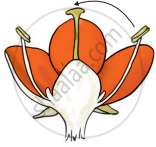
Consider the following statements depicting adaptation of flowers to carryout successful pollination.
- Stigma is long, sticky and unwettable.
- Sepals, petals or perianth (if present) have waxy coating.
- Stamens with long filament and versatile anthers.
- Tubular corolla is seen.
- Flowers are noctumal.
Which of the above statements clearly depict hydrophily?
Briefly discuss any two methods by which plants avoid self-pollination.
Identify the set of correct statements:
- The flowers of Vallisneria are colourful and produce nectar.
- The flowers of waterlily are not pollinated by water.
- In most of water-pollinated species, the pollen grains are protected from wetting.
- Pollen grains of some hydrophytes are long and ribbon like.
- In some hydrophytes, the pollen grains are carried passively inside water.
Choose the correct answer from the options given below:
Which one of the following flower is hypohydrophilous?
Anemophily is the process of pollination by which agent?
