Advertisements
Advertisements
प्रश्न
Whose advice did the king finally think of seeking?
Advertisements
उत्तर
The king finally thought of seeking the hermit’s advice who lived in a distant jungle.
संबंधित प्रश्न
Answer these question in a few word or a couple of sentences .
How old are Margie and Tommy?
Answer of these question in two or three paragraphs (100–150 words).
What are the main features of the mechanical teachers and the schoolrooms that
Margie and Tommy have in the story?
For whom does the prince send the sapphires and why?
During their conversation Lushkoff reveals that Sergei’s cook, Olga, is responsible for the positive change in him. How has Olga saved Lushkoff?
Read the following conversation between two friends.
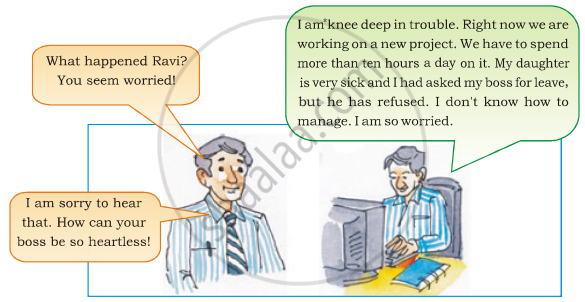
After having read the story, you realise the anguish of the illiterate adults. You want to make your friends aware of it and contribute something in bringing about a change in the lives of the illiterate adults. Deliver a speech in the morning assembly at your school about the Importance of Adult Education and ways to implement it.
Read the following to make your speech effective:
The introduction of a speech is like the nose of an airplane. The nose sets the course and leads the plane off in a specific direction. A good introduction sets the direction of your speech by
- getting the attention of your audience
- introducing your topic
- stating your central idea or purpose
- briefly identifying the main points
- making your audience eager to hear what you have to say
On the basis of your understanding of the poem, answer the following question
by ticking the correct choice.
In the poem 'The Solitary Reaper' to whom does the poet say, ' Stop here or gently
pass'?
Easton, with a little laugh, as if amused, was about to speak again when the other forestalled him. The glum-faced man had been watching the girl’s countenance with veiled glances from his keen, shrewd eyes.
“You’ll excuse me for speaking, miss, but, I see you’re acquainted with the marshall here. If you’ll ask him to speak a word for me when we get to the pen he’ll do it, and it’ll make things easier for me there. He’s taking me to Leavenworth prison. It’s seven years for counterfeiting.”
“Oh!” said the girl, with a deep breath and returning color. “So that is what you are doing out here? A marshal!”
“My dear Miss Fairchild,” said Easton, calmly, “I had to do something. Money has a way of taking wings unto itself, and you know it takes money to keep step with our crowd in Washington. I saw this opening in the West, and—well, a marshalship isn’t quite as high a position as that of ambassador, but—”
Read the extract given below and answer the question that follow.
What did the glum faced man tell the young woman ? What effect did it have on her?
As it turned out, Luz broke his own past record. In doing so, he pushed me on to a peak performance. I remember that at the instant I landed from my final jump—the one which set the Olympic record of 26 feet 5-5/16 inches—he was at my side, congratulating me. Despite the fact that Hitler glared at us from the stands not a hundred yards away, Luz shook my hand hard—and it wasn’t a fake “smile with a broken heart” sort of grip, either.
You can melt down all the gold medals and cups I have, and they couldn’t be a plating on the 24-carat friendship I felt for Luz Long at that moment. I realized then, too, that Luz was the epitome of what Pierre de Coubertin, founder of the modern Olympic Games, must have had in mind when he said, “The important thing in the Olympic Games is not winning but taking part. The essential thing in life is not conquering but fighting well.”
Read the extract given below and answer the question that follow.
You can melt down all the gold medals and cups I have, and they wouldn’t be a plating on the 24-carat friendship I felt for Luz Long at that moment.
So after that, dimly, dimly, she sensed it, she was different and they knew her difference and kept away. There was talk that her father and mother were taking her back to Earth next year; it seemed vital to her that they do so, though it would mean the loss of thousands of dollars to her family. And so, the children hated her for all these reasons of big and little consequence. They hated her pale snow face, her waiting silence, her thinness, and her possible future. “Get away 1” The boy gave her another push. “What’re you waiting for?”Then, for the first time, she turned and looked at him. And what she was waiting for was in her eyes. “Well, don’t wait around here !” cried the boy savagely. “You won’t see nothing!” Her lips moved. “Nothing 1” he cried. “It was all a joke, wasn’t it?” He turned to the other children. “Nothing’s happening today. Is it ?”
Read the extract given below and answer the question that follow.
What was Margot waiting for? Why did William say it was a joke?
Name some other creatures that live in anthills.
Answer the following question
Whom does Golu ask, “Why don’t you ever fly like other birds?”
Was the customer interested in the care and feeding of the doves he had bought? If not, why not?
Discuss the following topic in groups.
If you had to live in a home like Tilloo’s, what parts of life would you find most difficult? What compensations might there be?
Where did the old flea collected by Mr Wonka live?
What led the king of Iran to the cave of the shepherd?
What happens when the adults give too many instructions to their children?
How does a tree prove to be beneficial during Summers?
Multiple Choice Question:
Which one of the following is not associated with the real beauty?
Replace the italicised portion of the sentence below with a suitable phrase from the box. Make necessary changes, wherever required.
I was in a difficult situation till my friends came to my rescue.
