Advertisements
Advertisements
प्रश्न
Who said to whom and when / why?
| Who said | To whom? | When / why? | |
| ......the world is full of inequalities. | |||
| I want to do something interesting. | |||
| It is against the will of God. | |||
| Our home is full of love....... | |||
| ...... we can affirm along with United Nations that men and women are equal. |
Advertisements
उत्तर
| Who said | To whom? | When / why? | |
| ......the world is full of inequalities. | Tomba | Lanthoi | When he is discussing gender equality with his daughter. |
| I want to do something interesting. | Lanthoi | Ashangbi | When she wants to discuss something with her mother. |
| It is against the will of God. | Ashangbi | Lanthoi | When she is talking about the subjugation of women. |
| Our home is full of love....... | Lanthoi | Ashangbi | When she is discussing gender equality with her mother. |
| ...... we can affirm along with United Nations that men and women are equal. | Ashangbi | Lanthoi |
When Lanthoi asked her about the provisions available to enable women to express their potential and set themselves free from suppression. |
संबंधित प्रश्न
A1. True or False
State whether the following statements are true or false:
(i) A new research suggests that eating healthy food and getting proper sleep helps children to succeed in school.
(ii) Kids in the age group of 6-12 years should get an average sleep of little less than 7 hours.
(iii) Kids should start their day with yogurt, fruits and veggies.
(iv) Children should have consistent sleeping habit.
A new research suggests that eating healthy food and getting proper sleep can help children succeed in school. According to research, when kids go to school without eating breakfast, their cognitive function can be affected.
According to study, kids should start the day with fruits, proteins and whole grains and they should avoid sugary cereals because they cause a sugar high. If the kids do need to eat something prior to dinner, parents should offer healthy choices like yogurt, fruits and veggies or baked chips. Children have also been advised to drink water instead of soda as-it lacks nutritional value. Moreover, research suggests that children need a good night's sleep for theiroverall school performance. It is said that. lack of sleep can lead to problems with attention and memory in the classroom, affect impulse control and mood regulation lead to.
anxiety and even depression.
While kids aged 6-12 years should get nine hours sleep nightly, adolescents from the age of 13 to 18 years should get an average sleep of little more than seven hours per night. However, the research suggests that catching up on lost sleep on the weekend can make matters worse and recommended a consistent bedtime seven days a week.
A2. Find
Fill in the blocks with the following given in the passage:
(i) Two things to be avoided by children:
(ii) Lack of sleep due to mood regulation leads to:
A3. Select
Select the correct word from the brackets and complete the statements given below:
(anxiety, consistent, impulse, attention)
(i) Last minutes study causes......... to the students.
(ii) Stress affects the.............. for a quick action.
(iii) Saina has shown ........... improvement in her performance.
(iv) Students should pay ..............in class.
A4. Language study
(i) Pick out anyone sentence from the passage where a modal auxiliary indicating advice is used.
(ii) Pick out the correct conjunctions from the given sentences:
(a) Kids should avoid sugary cereals because they cause a sugar high.
(b) It is said that lack of sleep can lead to problems.
A5. Personal response
We should eat healthy food. Explain..
Answer any three of the following questions in 30-40 words each:
(a) What did M. Hamel tell them about the French language? What did he ask them to do and why?
(b) Why does Asokamitran call Subbu, ‘a charitable and improvident man’?
(c) How did the instructor turn Douglas into a swimmer?
(d) Why did Sophie like her brother, Geoff more than any other person?
“I have done something; oh, God! I've done something real at last.” Why does Andrew say this? What does it mean?
Discuss the importance of time in the narration of a story.
Read the story aloud (or present it) in groups of three - the narrator, the peacock, and the crane.
Who was the first person to withdraw cash from the ATM?
Tackling the Issues
Ask the class to discuss solutions to an issue that plagues contemporary society at large or just your community—for example, homelessness, violence, environmental degradation, hunger.
Half the class should mention idealistic solutions to the chosen issue; the other half should mention only realistic approaches to solving the problem.
See if, in listening to both sides, someone can come up with a proposal that is both realistic and unconventional—an idea that hasn't been tried yet.
Recall Merlin’s memories and complete the story map.
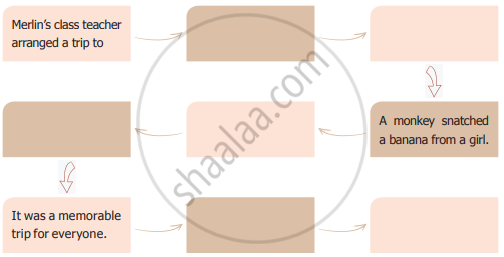
Read scene I of the play carefully and answer the question below.
List the characters that appear in the scene. What human characteristics do they exhibit?
The passage given below is on Kabbadi. Read the passage and complete the activities that follow.
Kabbadi (கபடி - in Tamil) is a contact team sport that originated in Tamil Nadu, India. It is the national sport of Bangladesh. It is also popular in South Asia and is the state game of the Indian states of Tamil Nadu, Kerala, Andhra Pradesh, Bihar, Haryana, Karnataka, Maharashtra, Punjab, and Telangana.
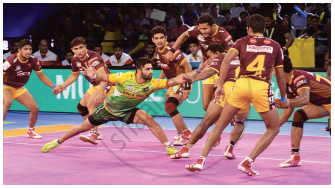
Kabbadi is played between two teams of seven players: the objective of the game is for a single player on offence referred to as a 'raider', to run in to the opposing teams half of a court, tag out as many of their defenders as possible, and return to their own half of the court–all without being tackled by the defenders. Points are scored for each player tagged by the raider, while the opposing team earns a point for stopping the raider. Players are taken out of the game if they are tagged or tackled, but can be 'revived' for each point scored by their team from a tag or tackle. The raider should hold his breath and utter the words like 'kabbadi kabbadi, hututu hututu, chadu kudu' etc. while the opponents try to catch him. If he stops uttering these words, he is considered out.
The game is known by its regional names in different parts of the subcontinent, such as Kabbadi or Chedugudu in Andhra Pradesh, Kabbadi in Kerala and Telangana, Hadudu in Bangladesh, Bhavatik in Maldives, Kauddi or Kabbadi in the Punjab Region, Hu-Tu-Tu in Western India and Hu-Do-Do in Eastern India and Chadakudu in South India. The highest governing body of Kabbadi is the International Kabbadi Federation.
Given below is the visual presentation of the first paragraph.
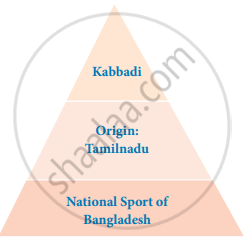
i) Represent the other paragraphs in a visual form of your choice(flow chart, mind-map, pie-chart, etc.).
ii) Choose the correct option.
1. A contact sport usually involves a ______contact between players.
- violent
- gentle
- physical
2. Kabbadi is a game played between ______.
- seven teams of two players
- two teams of seven players
- four teams of seven players
3. A single ______.
- player on offence is referred to as a raider
- offence is referred to as a raider
- raider is an offence by the player
iii) Answer the following.
- How does a raider score points for his team?
- When does a raider concede a point to the opponent team?
- Can a player be revived when he/she is out of the game? Explain your answer.
- Kabbadi is called by different names in different parts of India. Do you know how Pallankuzhi is called in Karnataka, Andhra Pradesh and Kerala?
