Advertisements
Advertisements
प्रश्न
| Our national emblem is taken from Ashoka’s pillar at Sarnath. It is found on all government documents, coins, currency notes, postcards, and envelopes. It consists of four lions standing back to back but, we can see only three lions at a time. There is a Dharma chakra in the centre of the base plate, with the figure of a bull in the right and that of a horse in the left. The entire structure is sitting on a lotus. The words ‘Sathyameva Jayate’ is written under it in Devanagari script. These words mean, ‘Truth alone Triumphs’. |
- Where is our national emblem taken from?
- Where is our national emblem found?
- What does ‘Sathyameva Jayate’ mean?
- What are the animals found in the emblem?
Advertisements
उत्तर
- Our national Emblem is taken from Ashoka’s pillar at Sarnath.
- It is found on all government documents, coins, currency notes, postcards, and envelopes.
- Sathyameva Jayate means, “Truth alone Triumphs”.
- Lions, bulls, and horses are the animals found in the emblem.
APPEARS IN
संबंधित प्रश्न
What distinguishes the tribal imagination from the secular imagination?
Discuss in groups, reasons/ consequences/ effects:
The life of the cherry tree was threatened.
Form groups of 6-8. One person (leader) chooses one item - a picture, a paragraph, or a lesson from any one of the 9th standard textbooks and writes the reference on a slip of paper, and folds it. Others ask him/her questions and try to guess what it is, from his/her answers. Follow the rules given below.
- The maximum number of questions the rest of the group can ask is 20.
- You cannot ask a direct question like ‘What do you have in mind?’
- You can ask ‘Wh-’ questions or ‘Yes/no’ questions.
- The leader has to give truthful answers.
What is ‘e-mail’ or electronic mail?
How can we make our nation proud?
Jaswantgarh is named after the Indian soldier ______.
Many may lie and______.
Let us learn a few more word by joining the dots. Join the dots and fill the table below.
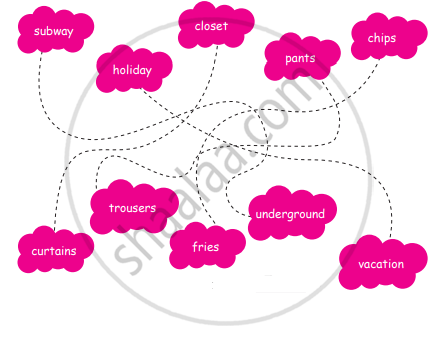
| subway | |
| holiday | |
| closet | |
| pants | |
| chips |
Who was Hiawatha?
Being a bachelor, the stranger had no patience with children.
