Advertisements
Advertisements
प्रश्न
When a substrate is being metabolized, why does not all the energy that released in one step. It is released in multiple steps.What is the advantage of step-wise release?
Advertisements
उत्तर
The complete combustion of glucose, which produces CO2 and H2O as end products, yields energy most of which is given out as heat.
C6H12O6 + 6O2 → 6CO2 + 6H2O + Energy
If this energy is to be useful to the cell, it should be able to utilise it to synthesise other molecules that the cell requires. The strategy that the plant cell uses is to catabolise the glucose molecule in such a way that not all the liberated energy goes out as heat. The key is to oxidise glucose not in one step but. in several small steps enabling some steps to be just large enough such that the energy released can be coupled to ATP synthesis.
APPEARS IN
संबंधित प्रश्न
What are respiratory substrates?
Name the most common respiratory substrate.
Differentiate between Respiration and Combustion.
What happens to the energy liberated during respiration?
One same common function is performed by?
Do the plants respire all day and all night or only at night?
Name the following:
Energy currency of cell.
Name the following:
Oxidative breakdown of carbohydrates to release energy.
Name the following:
An organism which respires throughout life anaerobically.
Why is it usually difficult to demonstrate respiration in green plants?
How is tilling of the soil useful for the crops growing in it?
Fill in the blank :
_________ are the openings found on older stems.
Fill in the blank :
Glycolysis occurs in the _______of the cells.
Fill in the blank:
_____________ is a chemical which absorbs oxygen of the air.
How do the following structures help in respiration in plants?
Lenticels _____________
The following two chemical reactions are supposed to indicate a certain process occurring in the green plants under two different conditions:
(a) C6H12O6 + 6O2 → 6CO2 + _______ + 38 ATP
(b) C6H12O6 → ________ + 2 CO2 + 2 ATP
(i) Fill in the blank in each reaction.
(ii) Name the process represented by the two reactions.
(iii) What are the conditions under which the two reactions (a) and (b) are occurring respectively?
The following diagram refers to an apparatus which is used to demonstrate a physiological process:
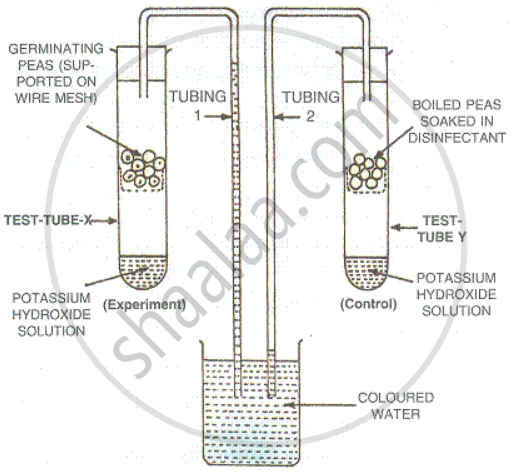
What is the purpose of keeping boiled peas soaked in a disinfectant in test tube Y?
The following diagram refers to an apparatus which is used to demonstrate a physiological process:
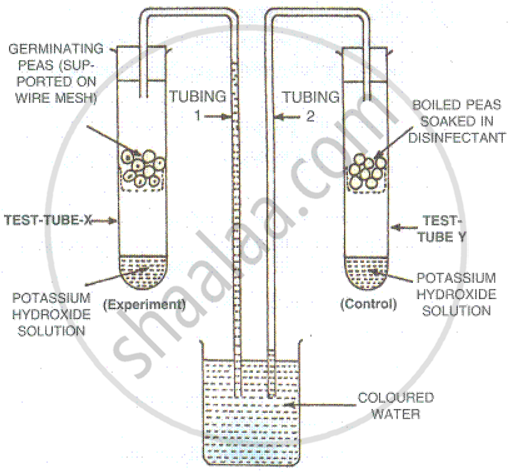
Define the biological process shown in the experiment.
Complete the following statement by choosing the correct alternative out of those given below.
Every living cell of the plant
Name the following:
The process of living beings which is concerned with the release of energy for use in the body.
Which gas present in the air is essential for aerobic respiration?
A food stall owner was preparing dough for making bhaturas. He added a pinch of yeast and sugar to the dough and left it in a warm place. After few hours, the dough had risen. There was a sour smell too.
Why did the dough rise?
A food stall owner was preparing dough for making bhaturas. He added a pinch of yeast and sugar to the dough and left it in a warm place. After few hours, the dough had risen. There was a sour smell too.
Why did the dough smell sour?
Mitochondria are called powerhouses of the cell. Which of the following observations support this statement?
Explain the term “Energy Currency”. Which substance acts as energy currency in plants and animals?
Respiration requires O2. How did the first cells on the earth manage to survive in an atmosphere that lacked O2?
How does a tree trunk exchange gases with the environment although it lacks stomata?
