Advertisements
Advertisements
प्रश्न
A food stall owner was preparing dough for making bhaturas. He added a pinch of yeast and sugar to the dough and left it in a warm place. After few hours, the dough had risen. There was a sour smell too.
Why did the dough rise?
Advertisements
उत्तर
Yeast undergoes anaerobic respiration (in the absence of oxygen) and produces ethyl alcohol and carbon dioxide. The CO2 released during respiration by the yeast results in the rise of the dough.
APPEARS IN
संबंधित प्रश्न
Name the following:
Oxidative breakdown of carbohydrates to release energy.
Name the following:
An organism which respires throughout life anaerobically.
Fill in the blank :
_________ are the openings found on older stems.
Fill in the blank:
_____________ is a chemical which absorbs oxygen of the air.
The following two chemical reactions are supposed to indicate a certain process occurring in the green plants under two different conditions:
(a) C6H12O6 + 6O2 → 6CO2 + _______ + 38 ATP
(b) C6H12O6 → ________ + 2 CO2 + 2 ATP
(i) Fill in the blank in each reaction.
(ii) Name the process represented by the two reactions.
(iii) What are the conditions under which the two reactions (a) and (b) are occurring respectively?
The following diagram refers to an apparatus which is used to demonstrate a physiological process:
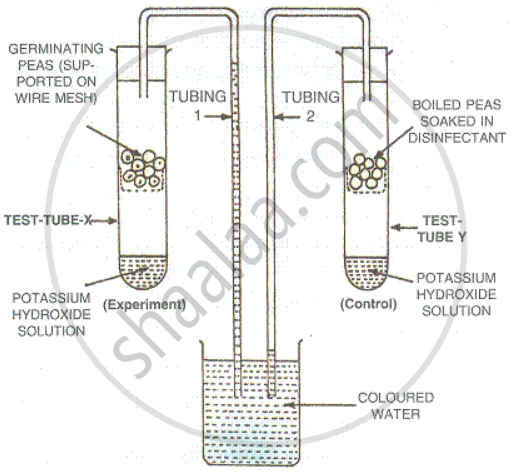
What is the purpose of keeping boiled peas soaked in a disinfectant in test tube Y?
The following diagram refers to an apparatus which is used to demonstrate a physiological process:
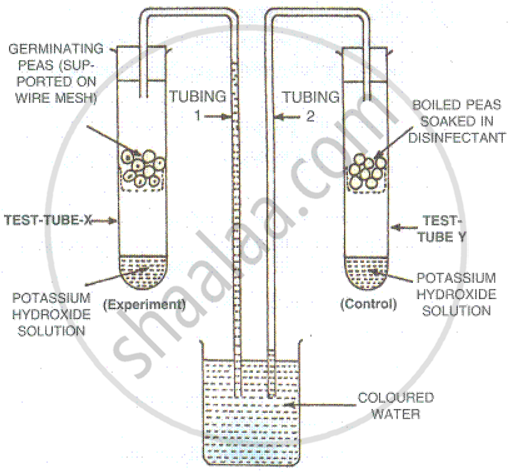
Define the biological process shown in the experiment.
Complete the following statement by choosing the correct alternative out of those given below.
Every living cell of the plant
Respiration requires O2. How did the first cells on the earth manage to survive in an atmosphere that lacked O2?
How does a tree trunk exchange gases with the environment although it lacks stomata?
