Advertisements
Advertisements
प्रश्न
What is power? How do you differentiate kilowatt from kilowatt-hour? The Jog Falls in Karnataka state are nearly 20 m high. 2000 tonnes of waterfalls from it in a minute. Calculate the equivalent power if all this energy can be utilized? (g = 10 m s–2)
Advertisements
उत्तर
Power is defined as the rate of doing work or the rate of transfer of energy, Kilowatt is the unit of power and kilowatt-hour is the unit of energy or work as a kilowatt-hour
= unit of power × unit of time.
Energy possessed by 2000 tonnes
(= 2000 x 103 kg) water at a height of 20 m, Ef, = mgh
= 2000 x 103 x 10 x 20
= 4 x 10⁸ J
Power generated if all this energy can be
utilized,
P = `"E"_"p"/"t"`
= `(4 xx 10^8 "J")/(60"s")` (∵ t = 1 min = 60 s)
= `2/3 xx 10^7 "W"`
APPEARS IN
संबंधित प्रश्न
No work is done by a force if the body
How much work is done when a force of 1 N moves a body through a distance of 1 m in its own direction?
A boy of mass m climbs up a staircase of vertical height h.
- What is the work done by the boy against the force of gravity?
- What would have been the work done if he uses a lift in climbing the same vertical height?
Explain, why submarines are able to dive underwater as well as a sail on the surface of the water?
A truck driver can load oil drums into the back of the truck by pushing them up a sloping plank, or by lifting them directly. Each drum has a mass of 80 kg, the plank is 3 m long, and the back of the truck is 0.8 m above the ground.
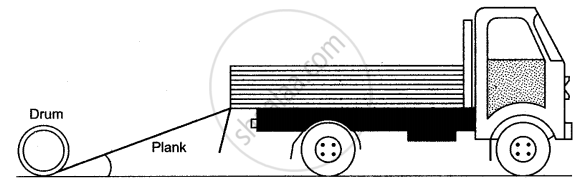
(i) How much force would be needed to lift a drum into the truck directly/without using the plank? (Take g = 10 m/s2)
(ii) How much energy would be required in lifting the drum into the truck without the plank?
(iii) If the force needed to push the drum up the plank is 300 N, why is this less than the answer to part (i)?
(iv) When the truck is loaded, the driver drives off. List the major energy changes that take place in moving the truck.
(v) The driver has to stop at the factory gates. What happens to the kinetic energy of the truck?
A force is applied on a body of mass 20 kg moving with a velocity of 40 ms−1. The body attains a velocity of 50 ms−1 in 2 seconds. Calculate the work done by the body.
A bucketful of water is to be drawn from a well ______ will be done when a ______ is applied to do this because there will be a ______ of water.
(displacement, work, force)
________ is said to be done when a force is acting on it.
A car is accelerated on a levelled road and attains a velocity 4 times of its initial velocity. In this process the potential energy of the car
