Advertisements
Advertisements
प्रश्न
A pair of bullocks exerts a force of 140 N on a plough. The field being ploughed is 15 m long. How much work is done in ploughing the length of the field?
Advertisements
उत्तर
Given: Force F = 140N
Displacement s = 15m
Work done = Force × Displacement
W = F × s
W = 140N × 15m
= 2100 Nm
= 2100 J
Work done in the end = 2100 J
Hence, 2100 J of work is done in ploughing the length of the field.
संबंधित प्रश्न
Is it possible that a force is acting on a body but still the work done is zero? Explain giving one example.
A force of 50 N acts on a body and moves it a distance of 4 m on horizontal surface. Calculate the work done if the direction of force is at an angle of 60° to the horizontal surface.
The work done on an object does not depend on ______.
P, Q and R are three forces which act as shown in fig.
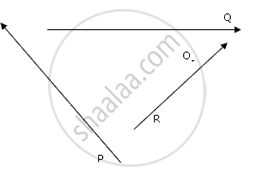
The point O lies in the same plane. Given, P = Q = R = 10N
(i) Which force has the least moment about O? Give a reason.
(ii)Which force has the greatest moment about O? Give a reason.
Can work done be zero even if force acts on the body?
In the following case write yes, if the work is being done and no if no work is being done.
A coolie standing with a heavy load on his head
In the following case write yes, if the work is being done and no if no work is being done.
A boy climbing up a staircase.
What should be the characteristic of a source of energy?
A force can cause an object to change its ______.
A uniform chain of length 2 m is kept on a table such that a length of 60 cm hangs freely from the edge of the table. The total mass of the chain is 4 kg. What is the work done in pulling the entire chain on the table?
