Advertisements
Advertisements
प्रश्न
What else do you think Nishad and Maya will find out about him? How? Will they ever be friends? Think about these questions and write a paragraph or two to continue the story.
Advertisements
उत्तर
Nishad and Maya would have found out that the Sunday visitor is Mr Nath’s brother.
Mr Nath used to work for a big private company and has left the job for while because he was not keeping well.
He is suffering from some liver ailment and will be undergoing a surgery soon.
Nishad succeeds in befriending him and goes to his house every evening to play with him. He finds Mr Nath a caring and loving person.
He becomes a frequent visitor to his place. Maya regrets about her earlier thoughts about Mr Nath.
She feels sorry about it. Nishad takes her along one day and the they all become friends.
संबंधित प्रश्न
Here are some words with silent letters. Learn their spelling. Your teacher will dictate these words to you. Write them down and underline the silent letters.
| knock | wrestle | walk | wrong |
| knee | half | honest | daughter |
| hours | return | hornet | calm |
| could | sign | island | button |
Thinking about the Poem
What should we do to make friends with the wind?
Does everybody have a cosy bed to lie in when it rains? Look around you and describe how different kinds of people or animals spend time, seek shelter etc. during rain.
How does the poet imagine her to be, after death? Does he think of her as a person living in a very happy state (a ‘heaven’)? Or does he see her now as a part of nature? In which lines of the poem do you find your answer?
Read the following conversation between two friends.
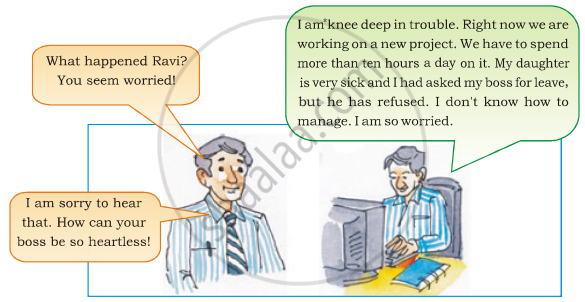
Notices
Read the following captions
. Change them into active (voice) and explain their meaning.
e.g. All credit cards accepted.
We accept credit cards.
Meaning: The organization accepts credit cards from customers for all their transactions.
1. Domestic help required
_______________________________________
2. All types of computer servicing undertaken.
_______________________________________
3. Using cell phones is not allowed (University Campus)
_______________________________________
4. Spoken English classes conducted.
_______________________________________
5. All Recharge Coupons sold here.
_______________________________________
The black man's face bespoke revenge
As the fire passed from his sight.
For all he saw in his stick of wood
Was a chance to spite the white.
The last man of this forlorn group
Did nought except for gain.
Giving only to those who gave
Was how he played the game.
Their logs held tight in death's still hands
Was proof of human sin.
They didn't die from the cold without
They died from the cold within.
Read the lines given above and answer the question that follow.
Who are ‘they’ referred to here ? Where were they ?
Such wondrous, fine, fantastic tales
Of dragons, gypsies, queens, and whales
And treasure isles, and distant shores
Where smugglers rowed with muffled oars,
And pirates wearing purple pants,
And sailing ships and elephants,
And cannibals crouching 'round the pot,
Stirring away at something hot.
(It smells so good , what can it be?
Good gracious, it's Penelope.)
The younger ones had Beatrix Potter
With Mr.Tod,the dirty rotter,
And Squirrel Nutkin,Pigling Bland,
And Mrs.Tiggy-Winkle and-
Just How The Camel Got His Hump,
And How the Monkey Lost His Rump,
And Mr. Toad, and bless my soul,
There's Mr.Rat and Mr. Mole-
Oh, books, what books they used to know,
Those children living long ago!
Read the lines given above and answer the question given below.
Explain with reference to context.
The boy looked up. He took his hands from his face and looked up at his teacher. The light from Mr. Oliver’s torch fell on the boy’s face, if you could call it a face. He had no eyes, ears, nose or mouth. It was just a round smooth head with a school cap on top of it.
And that’s where the story should end, as indeed it has for several people who have had similar experiences and dropped dead of inexplicable heart attacks. But for Mr. Oliver, it did not end there. The torch fell from his trembling hand. He turned and scrambled down the path, running blindly through the trees and calling for help. He was still running towards the school buildings when he saw a lantern swinging in the middle of the path. Mr. Oliver had never before been so pleased to see the night watchman. He stumbled up to the watchman, gasping for breath and speaking incoherently.
What is it, Sahib? Asked the watchman, has there been an accident? Why are you running?
I saw something, something horrible, a boy weeping in the forest and he had no face.
No face, Sahib?
No eyes, no nose, mouth, nothing.
Do you mean it was like this, Sahib? asked the watchman, and raised the lamp to his own face. The watchman had no eyes, no ears, no features at all, not even an eyebrow. The wind blew the lamp out and Mr. Oliver had his heart attack.
Read the extract given below and answer the question that follow.
Why did the torch fall from Mr Oliver’s hand? Why was his hand trembling?
Suddenly all the tension seemed to ebb out of my body as the truth of what he said hit me. Confidently, I drew a line a full foot in back of the board and proceeded to jump from there. I qualified with almost a foot to spare.
That night I walked over to Luz Long’s room in the Olympic village to thank him. I knew that if it hadn’t been for him I probably wouldn’t be jumping in the finals the following day. We sat in his quarters and talked for two hours—about track and field, ourselves, the world situation, a dozen other things.
When I finally got up to leave, we both knew that a real friendship had been formed. Luz would go out to the field the next day trying to beat me if he could. But I knew that he wanted me to do my best—even if that meant my winning.
Read the extract given below and answer the question that follow.
How did the rivalry of Owens and Long end?
Read the extract given below and answer the questions that follow:
Mabel: Oh! Why didn’t I face it? But I couldn’t—I had to believe.
Dancy: And now you can’t. It’s the end, Mabel.
Mabel: [Looking up at him] No.
[Dancy goes suddenly on his knees and seizes her hand.]
Dancy: Forgive me!
Mabel: [Putting her hand on his head] Yes; oh, yes! I think I’ve known for a long time, really. Only — why? What made you?
(i) How does Dancy respond to Mabel’s question?
(ii) What makes Dancy say ‘that’s not in human nature’ a little later?
(iii) Why does Inspector Dede arrive at Dancy’s house? How does Mabel try to stall him?
(iv) To whom was Dancy’s suicide note addressed? What had he written in it?
(v) What does Margaret mean when she says that keeping faith is ‘not enough’ and ‘we’ve all done that’?
What, in your opinion, should his friends have done?
Who enters soon after? What does he say about the young Venetian who has just arrived? What gifts has the Venetian brought with him?
Read the extract given below and answer the questions that follow :
An angry athlete is an athlete who will make mistakes, as any coach will tell you I was no exception. On the first of my three qualifying jumps, I leaped from several inches beyond the · take-off board for a foul.
(i) When and where is this story set? What reason does the narrator Jesse Owens give for the heightened nationalistic feelings at this time?
(ii) In which event had Owens been confident of winning a gold medal? Why?
(iii) What had, made Owens angry enough to make mistakes?
(iv) Name Owens' rival who approached him at this point. What advice did this athlete give Owens?
(v) How did the two athletes perform in the finals? What does Jesse Owens consider his 'Greatest Olympic Prize'? Why?
Describe the change the cherry tree underwent after the kind old poured a pinch of ash over it.
Who made the pact with the sun? What was it about?
What is the story’s underlying message or advice to the readers? Do you also support the author’s view?
Who have tea parties under the trees?
How did father make an attempt to save the Cat for the Second time?
The words given against the sentences below can be used both as nouns and verbs. Use them appropriately to fill in the blanks.
(i) The police are _______________________ the area to catch the burglars. (comb)
(ii) An ordinary plastic ______________________________ costs five rupees.
Complete the following sentence by providing a reason:
In the poem, Dover Beach, the poet wants his beloved to be "true" to him because ______.
