Advertisements
Advertisements
प्रश्न
What are the different ways of knowing the time during the day?
Advertisements
उत्तर
There are many ways to know “the time”. For example:
- Listening to the radio/television
- asking someone who knows
- by judging the intensity of sunlight.
APPEARS IN
संबंधित प्रश्न
Read the poem aloud using proper intonation.
The toy train covers 14 km in three hours
Preethi’s own trauma inspired her to create SoulFree, a foundation for those suffering from mental illness.
They watched the ______ tumbling towards the shore.
When the sea was ______ they would skim stones.
What did the people say?
What is Numismatics?
Painting can help unleash your creative side. How?
Listen to the passage carefully and write the answer.
Fleming’s thought at breakfast
Sir Alexander Fleming, who discovered penicillin, was once forced into an interview in New York by two journalists just as he was about to have breakfast. One of them asked him, ‘Sir, what are you thinking about right now? We wish to know what a great scientist think while getting ready for breakfast’. Fleming mused a while on the question and he replied, ‘I am thinking of something very special. The journalist, who were all ears, drew themselves forward. ‘I am thinking, whether to have one egg or two.
- Name the scientist.
- What did he discover?
- Who approached the scientist?
- What was the question asked by the journalist?
- When did they meet the scientist?
Listen to the flash news. Read the question given below, then listen to the flash news again and complete the response.
What escaped from the zoo?
What did Rahul engrave?
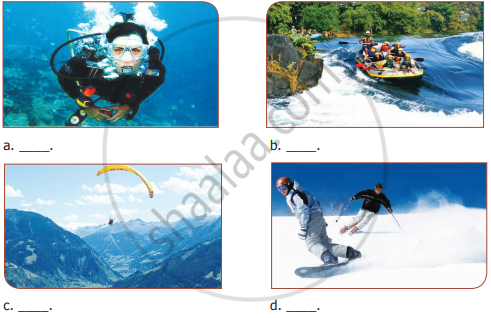
Listen to your teacher and number the pictures accordingly.
What does the red signal mean?
Let’s practice with P and F.
| pleased | pricked | pinched | punished |
| fat | fruit | fell | forgotten |
| palm | pair | proud | parade |
| farm | fare | frown | fish |
Where is Manipur on the map of India?
What are some of the different sounds you hear when the Ice-cream Man comes?
Read the questions based on the running commentary of a cricket match. Then, listen to the running commentary of the match read out by your teacher or played on the recorder and tick the right answers.
49th over, first ball, Kulasekara to Yuvraj, 1 run, yorker outside off, dug out to point, Yuvraj and Dhoni scamper through for a single. Perfect time for Dhoni to hit the winning runs. He deserves to hit the runs. Second ball, Kulasekara to Dhoni, SIX!! India are World Champions! A nation of a billion will sleep well tonight. What a shot to end the game! Yuvraj can’t control his emotions. He is in tears. Sachin runs in from the dressing room and is mobbed. What marvellous scenes in Mumbai! Dhoni got under the length ball and absolutely hammered that out of sight and out of the park. The White Kookaburra soared over the fence. Bhajji too is in tears. 28 years in waiting and the helicopter shot has brought an end to the game.
The finishers of old times Dhoni and Yuvraj, who were popularly called ‘ The Finishers ’ against Pakistan and Sri Lanka a few years ago, took the game closer and a thrilling finish was on the cards. They needed 30 off 30 deliveries when the batting power play became mandatory. Could they do it? They were up against a lethal bowler in Malinga. Just three runs of the Malinga over meant the Indians needed 27 off the next four overs. There were nerves all around, but the two batsmen in the middle looked to be in a different world altogether. Pressure was just a distant relative and they kept their cool to help India romp home with 10 deliveries to spare.
i) Who faced the first ball in the 49th over?
- Kulasekara
- Yuvraj
- Dhoni
- Sachin
ii) Which batsman hit a sixer?
- Kulasekara
- Bajji
- Dhoni
- Yuvraj
iii) Where was the match held?
- Chennai
- Delhi
- Calcutta
- Mumbai
iv) Who were popularly called ‘The Finishers’?
- Dhoni and Yuvaraj
- Bajji and Malinga
- Gambhir and Yuvaraj
- Perara and Malinga
v) How many runs did India need to win the match in the last four overs?
- 21
- 27
- 30
- 37
Listen to the passage read out aloud by the teacher or played on a recorder and answer the questions that follow.
Listen to the views of a leading economist R. Azhagarasan about EMI in an interview.
We live in a world where everyone likes to lead a comfortable and luxurious life, though our salaries are not enough to meet our needs. In such a situation, the EMI seems to be the only option. It helps people pay for the expensive things, they have purchased, in parts as installments. It gives monetary power to buy expensive things beyond the capacity of a common man. Otherwise, many people will never be able to buy such things. This proves beneficial for people in purchasing a house and other essential appliances and accessories.
It also has some negative unavoidable results. If people are not able to pay EMI on time, they have to keep on paying the loan amount for years together with interest. If people are not able to pay EMI on time, they may face serious problems such as the penalty for default, repossession of the purchased items, and might even be subjected to legal actions. Moreover, people may have the tendency to buy things that are not at all necessary, paying EMIs over a longer period of time. This may lead them into never ending debts. Hence, people should learn to spend within their means.
i. The speaker says that our income is sufficient to meet our needs. Is it true or false?
ii. EMI is the only ______for people who buy very expensive things.
- consolation
- setback
- option
- debt
iii. One is able to buy costly things with ______power offered by EMI.
- physical
- withstanding
- honorary
- monetary
iv. If people fail to pay EMIs, they may be subjected to ______.
- expulsion
- high pressure
- legal action
- dejection
v. People should learn to spend ______their means.
- within
- beyond
- above
- beneath
Some phrases have been left out in the poem below. Fill in the missing phrases on listening to the reading or the audio played by the teacher. You may listen again, if required
The Soldier
If I should die, ______
That there’s some corner______
That is ______ There shall be
In that rich earth a richer ______
A dust whom England bore, shaped, made aware,
Gave, _____ roam;
A body ______ air,
Washed ______ suns of home.
And think, ______ away,
A pulse in the ______, no less
Gives somewhere back ______ given;
Her______; dreams happy as her day;
And laughter,______ and gentleness,
In hearts .______ English heaven.
Rupert Brooke
